

You are standing at the bathroom mirror at 7.40am, toothbrush in one hand, phone propped against the tap. The video says to look yourself in the eye and say it out loud: I am confident. I am lovable. I am enough.
So you say it. Your reflection says it back. And somewhere under the words, a second voice pipes up, unasked: are you, though? What about Tuesday? What about the email you still haven’t answered?
By the time you spit and rinse, you feel slightly worse than when you started. You assume you did it wrong. Maybe you need more conviction, or a better morning routine, or a sticky note on the fridge.
Here is the slightly uncomfortable news, and the more useful news after it. That second voice is not a personal failing. Psychologists have measured it, and for a lot of people it is the predictable result of the exercise itself. There is also a different kind of affirmation, much less Instagrammable, that has been tested in more than a hundred studies. It does not ask you to believe anything about yourself at all.
Do positive affirmations work? The 2009 study that tested “I am a lovable person”
The study most people cite on this question came out of Canada. Joanne Wood and John Lee of the University of Waterloo, working with Elaine Perunovic of the University of New Brunswick, published it in Psychological Science in 2009 under a title that gives the game away: “Positive self-statements: power for some, peril for others”.
They started with a simple question: does anyone actually do this? In a first survey, 249 students filled in the Rosenberg self-esteem scale and rated how often they used positive self-statements, on a scale from 1 (never) to 8 (almost daily). About half picked 6 or higher. Affirmations were not a fringe habit even then, and students on the whole believed they worked.
The doorbell experiment
The second study was the clever one. Sixty-eight students, split evenly between people with high and low self-esteem, spent four minutes writing down whatever was on their mind. Half of each group had an extra instruction. Every time they heard a doorbell sound, which rang every 15 seconds, they were to say to themselves: “I am a lovable person.”
Then everyone filled in mood questionnaires and a measure of how they felt about themselves in that moment.
For the people who already had high self-esteem, the mantra gave a small lift. For the people with low self-esteem, it did the opposite. They ended up in a worse mood, and feeling worse about themselves, than low self-esteem students who had simply written their thoughts down without the affirmation. Repeating the statement widened the gap between the two groups rather than closing it.
A third study, with 116 students, came at it from another angle. Participants thought about “I am a lovable person” either by focusing only on the ways it was true, or by considering ways it was and was not true. People with high self-esteem did better with the purely positive version. People with low self-esteem did better when they were allowed to admit the less flattering evidence too.
The researchers’ own summary was blunt. Positive self-statements, they warned when the paper came out, may “backfire for the very people who need them the most”.
Why a kind sentence can sting
The Waterloo team’s explanation is the part worth remembering. When a statement sits far outside what you believe about yourself, your mind does not simply absorb it. It argues. “I am lovable” invites a quick internal audit, and if your self-image is shaky, the audit turns up counter-evidence. The negative thoughts then crowd out the positive one you were trying to install.
If you have high self-esteem, the same sentence lands inside your comfort zone. It confirms what you already think, so it feels pleasant. If you don’t, it lands outside, and each repetition becomes another prompt to disagree with yourself.
That is not a reason to think you are broken. It is a reason to think the tool was designed for someone else.
A fair caveat: these were small laboratory studies with university students, a few minutes long, measuring mood right afterwards. They tell us nothing about what happens after six months of daily mantras. What they do show, clearly, is that “just say nice things to yourself” is not a neutral instruction. For some people it can tip the wrong way.
An affirmation that asks you to believe something you don’t will mostly teach you how to argue with yourself.
What self-affirmation theory actually says (and why it’s different)
Here is where the story turns, because psychologists have been studying something called self-affirmation since the 1980s, and it is not the mirror mantra.
The idea comes from the social psychologist Claude Steele, who set it out in a 1988 chapter in Advances in Experimental Social Psychology. As David Sherman of the University of California, Santa Barbara, explains in a 2013 review, Steele’s argument was that people are driven to protect their overall sense of being a decent, capable person, not just their standing in one particular area. When something threatens that sense, we get defensive: we rationalise, dismiss the bad news, or avoid it.
The flexible part is what makes it useful. Because the self is a whole system, you can shore it up in one area to cope with a threat in another. Remind yourself of what you care about, in your relationships, your work, your faith or your sense of humour, and a criticism in a different area feels less like a verdict on your whole life.
What a values affirmation looks like in practice
In the lab, the standard version is almost boringly modest. People pick a value that matters to them, such as friends and family, and write for a short while about why it matters and when it has shaped what they do. Sherman notes that this writing is self-generated: participants are not handed a slogan, they describe their own priorities in their own words.
Notice what is missing. Nobody is asked to declare that they are wonderful. Nobody is asked to believe a claim about their own lovability. You are asked to describe something you already know to be true: that you care about your sister, or about doing careful work, or about being the person who turns up.
That is the crucial difference from the Wood study. There is nothing for the sceptical second voice to argue with.
What happens in the brain
In 2016 a team led by Christopher Cascio and Emily Falk, with colleagues including Matthew Lieberman and Shelley Taylor, put the exercise into an fMRI scanner. They recruited sedentary adults aged 18 to 64 who were taking part in a study on physical activity messages, and published the results in Social Cognitive and Affective Neuroscience.
People in the affirmation group reflected on their most important values, imagining how they might act on them in future. Compared with people in the control group, they showed more activity in regions linked to thinking about the self (the medial prefrontal cortex and posterior cingulate) and regions linked to valuing rewards (the ventral striatum and ventromedial prefrontal cortex). That brain activity also predicted who went on to cut down on sedentary time later in a separate physical activity programme.
Brain imaging is easy to overread, so treat this as supporting colour rather than proof. The sample was modest, a few dozen people per group, and the researchers themselves noted they could not know exactly what each person imagined while lying in the scanner. Still, it fits the theory: thinking about your values seems to register as personally meaningful and rewarding, not just as words.
How strong is the evidence for values-based self-affirmation?
This is where honesty matters most, because self-affirmation has had some spectacular headlines and some sobering replications.
Health advice: small but consistent
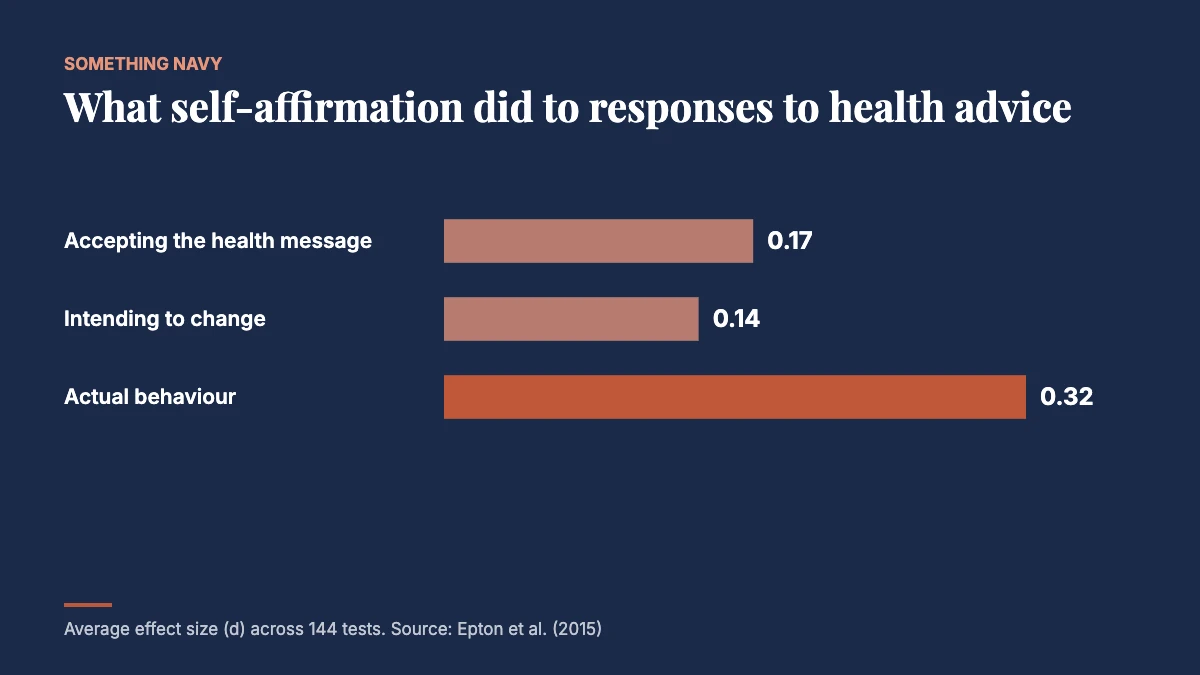
One of the clearer bodies of evidence concerns health messages. In 2015 Tracy Epton, Peter Harris, Rachel Kane, Guido van Koningsbruggen and Paschal Sheeran pooled 144 experimental tests in a meta-analysis in Health Psychology. The idea being tested was that people often get defensive when told that one of their habits puts their health at risk, and that affirming their values first might lower the drawbridge.
It did, a bit. Affirmed people were slightly more accepting of the health message (an average effect of 0.17 across 3,433 participants) and slightly more likely to intend to change (0.14 across 5,564). The effect on actual behaviour was larger, at 0.32 across 2,715 people. In plain English, those are small effects. They will not turn a smoker into a marathon runner. But small effects from a few minutes of writing are not nothing.
Classrooms: a famous result, then a reality check
The study that made self-affirmation famous was published in Science in 2006 by Geoffrey Cohen, Julio Garcia, Nancy Apfel and Allison Master. In two randomised field experiments, a brief values-writing exercise improved African American students’ grades and narrowed the racial achievement gap by about 40%. The theory was that it eased the stress of “stereotype threat”, the worry of confirming a negative stereotype about your group.
It was an extraordinary claim for a few short writing exercises, and later work has been more mixed. In 2017 a team led by Hanselman, with Rozek, Grigg and Borman, ran large, well-powered replications in a setting where an earlier big trial had found lasting benefits. They found no effect, with estimates tight enough to rule out benefits larger than an effect size of 0.10. None of the moderators researchers had proposed could explain why. The authors concluded that self-affirmation may be fragile when rolled out widely in schools.
A year later, Borman’s team published a district-wide study of 920 students in Psychological Science, and this time they did find a benefit: the exercise roughly halved the growth of the racial achievement gap as students moved from middle to high school. The effects were largest in schools where minority students faced stronger signals of identity threat, and among students who engaged properly with the writing.
The best summary so far is a 2021 meta-analysis of 58 studies by Wu, Spreckelsen and Geoffrey Cohen in the Journal of Social Issues. For students facing a social identity threat, the average effect was small, a Hedges’ g of 0.15. For students not facing that threat, it was essentially zero, at 0.01. Results varied a lot between studies, and the exercise seemed to work better when it felt like ordinary classwork rather than a research project.
So, fairly stated: values affirmation is not a magic fix for inequality, and the school results are small and contested. It appears to help some people, under pressure, in some settings, and not others.
Well-being: the newest and largest review
The most recent evidence goes beyond classrooms and doctors’ leaflets. In October 2025, Yunian Zhang, Boyin Chen and Minhong Wang of the University of Hong Kong and Xinyang Hu of the University of Oxford published a meta-analysis in American Psychologist covering 129 studies and 17,748 participants. The exercises asked people to reflect on their core values, identity or positive traits.
According to the American Psychological Association’s summary, affirmations had positive effects on general well-being, social well-being and self-perception, and reduced things like anxiety and negative mood. The effects lasted across an average follow-up of nearly two weeks. The authors called the benefits “small but significant”, with effect sizes ranging from 0.26 to 0.32 for the positive outcomes. Most of the underlying studies used American college students, which the authors themselves flag as a gap.
Put the pieces together and a sensible picture emerges. Telling yourself you are great is a gamble, and it is most likely to go badly for exactly the people who most want it to work. Writing about what you value is a modest, cheap, well-tested nudge. It is closer in spirit to self-compassion than to cheerleading, and like journaling, its power comes from putting real thoughts into your own words.



How to write an affirmation that has evidence behind it
The research does not hand us a perfect script, and anyone who tells you it does is overselling. But the studies point to a handful of features that separate the version that tends to help from the version that can backfire. Here is how to use them.
1. Start with a value, not a verdict
The mirror affirmation is a verdict on you: I am lovable, I am confident. The tested version starts with a value: something you care about. Pick from a short list, such as family, friendship, honesty, creativity, faith, humour, learning or doing good work. Choose the one that genuinely matters most to you right now, not the one that sounds most impressive.
Example: “Of everything on this list, the one I keep coming back to is my friendships.”
2. Make it something you can’t argue with
The lesson of the Wood study is that a statement you don’t believe invites a rebuttal. So write sentences that are simply true. You cannot easily dispute that you care about your friends, or that you have tried to be honest with someone. Aim for statements your inner sceptic would sign off on.
Example: “I care about the people I’m close to, even in weeks when I’m bad at texting back.”
3. Add a specific memory
Values affirmations in research involve writing about why a value matters and when it has shown up in your life. A concrete example does more work than an abstract claim, because it is evidence rather than assertion. One small, real moment is enough.
Example: “Last winter I drove forty minutes to sit with Maya when her dad was in hospital, and I’d do it again.”
4. Point it towards the future
The Cascio brain-imaging study found stronger activity in reward and self-related regions when affirmed people imagined acting on their values in the future. You don’t need a scanner to borrow the idea. Finish with one sentence about how this value might show up in the coming day or week.
Example: “This week, that looks like ringing my brother instead of sending a meme.”
5. Use it before the hard thing, not as wallpaper
The evidence is strongest when people are facing a threat: a tough health message, a test, a situation where they feel judged. Sherman’s review notes that affirmation works best for those under the greatest pressure, and the classroom studies suggest timing and context matter. So save this for the morning of the difficult meeting or the evening before an exam, rather than chanting it every day until it means nothing. Treat it as something you reach for, a little like an if-then plan for moments you know will be hard.
Example: “Before tomorrow’s review, I’m going to spend five minutes writing about why doing careful work matters to me.”
Try this
- Write down six values: family, friendship, honesty, creativity, learning, kindness. Add any that are missing for you.
- Circle the one that matters most to you right now.
- Spend five minutes writing about why it matters and one time it guided something you did.
- Finish with one sentence about how it could show up this week.
- Don’t reread it for style. Nobody is marking it.
So, should you stop saying affirmations?
Not necessarily. If you already feel reasonably good about yourself and a morning mantra gives you a lift, the Wood study suggests that is probably real, if modest. Nobody needs to rip the sticky note off the fridge.
But if you have tried “I am enough” and felt that quiet voice push back, take it as information rather than failure. You are not doing it wrong. You may be one of the people the mantra was never built for. The values version asks less of you and, as far as the research can tell, gives back a little more: no slogans, no pretending, just five minutes spent writing down what you already know matters. The effects are small. They are also among the better-supported small things you can do for yourself on a hard morning.
Official links and research
- Borman, G. D., Grigg, J., Rozek, C. S., Hanselman, P., & Dewey, N. A. (2018). Self-affirmation effects are produced by school context, student engagement with the intervention, and time: Lessons from a district-wide implementation. Psychological Science, 29(11). DOI
- Cascio, C. N., O’Donnell, M. B., Tinney, F. J., Lieberman, M. D., Taylor, S. E., Strecher, V. J., & Falk, E. B. (2016). Self-affirmation activates brain systems associated with self-related processing and reward and is reinforced by future orientation. Social Cognitive and Affective Neuroscience, 11(4), 621–629. DOI
- Cohen, G. L., Garcia, J., Apfel, N., & Master, A. (2006). Reducing the racial achievement gap: A social-psychological intervention. Science, 313(5791), 1307–1310. DOI
- Epton, T., Harris, P. R., Kane, R., van Koningsbruggen, G. M., & Sheeran, P. (2015). The impact of self-affirmation on health-behavior change: A meta-analysis. Health Psychology, 34(3), 187–196. DOI
- Hanselman, P., Rozek, C. S., Grigg, J., & Borman, G. D. (2017). New evidence on self-affirmation effects and theorized sources of heterogeneity from large-scale replications. Journal of Educational Psychology, 109(3), 405–424. DOI
- Sherman, D. K. (2013). Self-affirmation: Understanding the effects. Social and Personality Psychology Compass, 7(11), 834–845. DOI
- Steele, C. M. (1988). The psychology of self-affirmation: Sustaining the integrity of the self. Advances in Experimental Social Psychology, 21, 261–302. DOI
- Wood, J. V., Perunovic, W. Q. E., & Lee, J. W. (2009). Positive self-statements: Power for some, peril for others. Psychological Science, 20(7), 860–866. DOI
- Wu, Z., Spreckelsen, T. F., & Cohen, G. L. (2021). A meta-analysis of the effect of values affirmation on academic achievement. Journal of Social Issues, 77(3), 702–750. DOI
- Zhang, Y., Chen, B., Hu, X., & Wang, M. (2025). The impact of self-affirmation interventions on well-being: A meta-analysis. American Psychologist. DOI
Cover photo: Ashley Piszek on Unsplash. Charts and graphics: Something Navy, with photography by M. İkbal K on Unsplash.
How we reported this. Every figure was checked against the 10 sources above. Reviewed by Valentino Adkins, Senior Content Manager. Report an error · How we work