
The message arrived at 9.14pm. You saw it at 9.15. You have now spent twenty minutes doing nothing at all, because a friend once told you that replying straight away looks keen, and keen is fatal.
So you wait. You put the phone face down. You pick it up again to check you really did put it face down.
Almost everyone has been given some version of this advice. Don’t text first. Leave it a day. Be a little mysterious. Let them wonder. It has filled dating columns and self-help books for decades, and it rests on one simple idea: people want what they cannot quite have.
The odd thing is that science has both backed this idea and badly undermined it. One well-known experiment found that uncertainty really did make people more attractive. Several others found that coldness, aloofness and fake indifference tend to backfire, sometimes within minutes.
So let us put the folk wisdom in the ring and see how it does, round by round.
Round 1: “Keep them guessing and they’ll keep thinking about you”
This is the strongest version of the claim, and it has the strongest evidence behind it.
In 2011, Erin Whitchurch and Timothy Wilson of the University of Virginia and Daniel Gilbert of Harvard University published a short paper in Psychological Science with a title borrowed from the daisy-petal game: “He loves me, he loves me not…”. Its subtitle made a bold promise. Uncertainty, it said, can increase romantic attraction.
Inside the Facebook experiment
The researchers recruited 47 female undergraduates at the University of Virginia. Each woman was told that male students at two other universities, Michigan and UCLA, had looked at her Facebook profile and rated how well they thought they would get along with her.
She was then shown the profiles of four of those men. The men did not exist. What changed was what each woman was told about them.
- One group heard that these four men had rated her the highest of all the women they had seen.
- A second group heard that the men had rated her as about average.
- A third group was told the four men might be from either set. She had no idea whether they liked her a lot or only a little.
The first two groups behaved exactly as decades of research on reciprocity would predict. Women who believed the men liked them most were more attracted to those men than women who believed they had been rated as average. We tend to like people who like us.
The surprise was the third group. Women who did not know where they stood were the most attracted of all, more than the women who had been told they were the top pick.
They also said the men had come to mind more often. Asked how frequently thoughts of the men had “popped into their head” over the previous 15 minutes, on a scale from 1 to 9, the uncertain women averaged 5.07. Women who knew they were liked best averaged 3.56, and the women rated as average landed at 4.63.
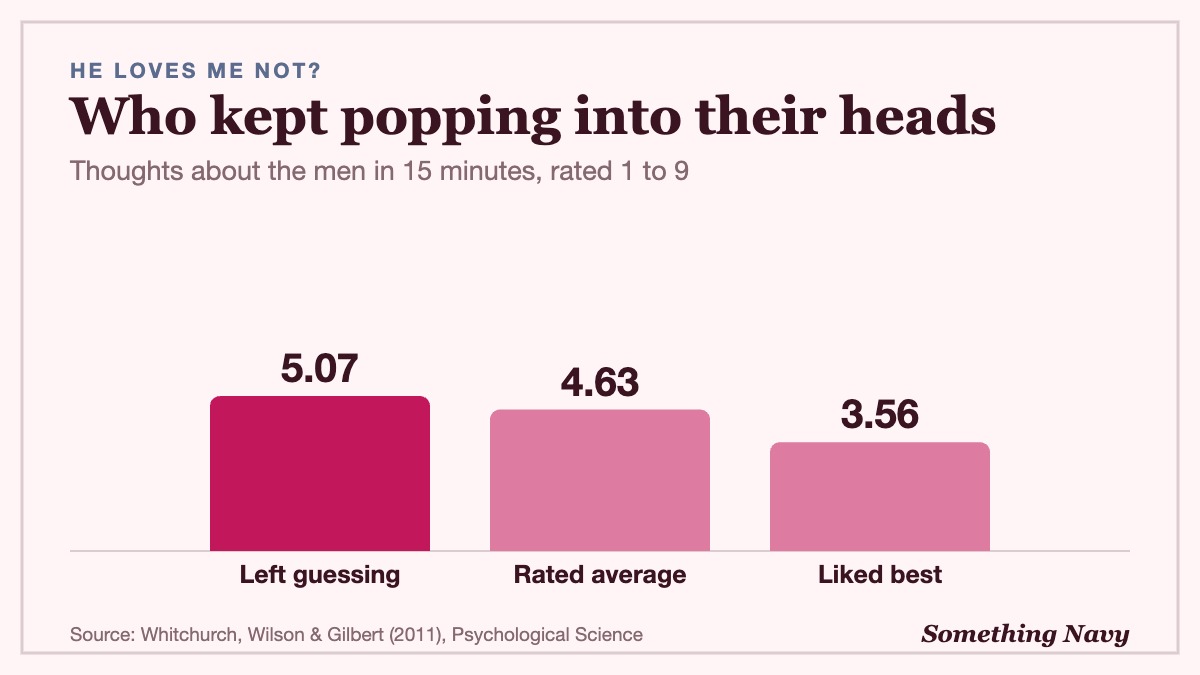
The authors’ explanation is intuitive. Once you know someone likes you, the question is closed, and the mind moves on. While you are unsure, you keep turning it over. That repeated attention, they suggested, may itself feed attraction. It is a cousin of the Zeigarnik effect, the tendency for unfinished business to nag at us more than finished business does.
What the study did
- Who: 47 female students at the University of Virginia.
- What: Rated four (fictional) men after being told the men liked them a lot, about average, or leaving it unclear.
- Found: The “unclear” group felt the most attraction and reported thinking about the men most often.
- Missing: Men as participants, real meetings, and any follow-up beyond one lab session.


The fine print on 47 students
Before anyone rewrites their texting strategy, it is worth reading the paper closely.
The idea that thinking about the men explained the attraction was suggestive rather than settled. The researchers ran a statistical test of that pathway, and it was inconclusive: its range of plausible values included zero. The overall difference in thoughts across all three groups was not statistically significant either. Only the comparison between the uncertain group and the liked-best group was.
Then there is scope. All 47 participants were young women at one American university, looking at photographs of men they would never meet. Nobody went on a date. Nobody found out, a week later, that the man had been lukewarm all along.
It also does not seem to have been widely repeated. One small student study at Western Carolina University, with 63 men and women, found no effect of uncertainty on attraction or on pupil dilation, a rough marker of arousal. That is one unpublished study, so it settles nothing, but it is a reason for caution.
And crucially, the women in the uncertain group were not being ignored. They had every reason to think the men might adore them. That is uncertainty with a hopeful edge, which is very different from being left on read.
Verdict on Round 1
Partly true. Not knowing can hold someone’s attention, at least in the opening moments and at least in a lab. It is a spark, not a strategy.
Round 2: “Act unavailable and you’ll look like a prize”
Here the folk wisdom stretches further. The claim is not just that mystery is intriguing, but that seeming hard to get makes you look more valuable, the way a sold-out restaurant seems better than an empty one.
Psychologists have been testing this for over fifty years, and the early results were embarrassing for the theory.
What a 1973 lab got right
In 1973, Elaine Walster and her colleagues published a paper in the Journal of Personality and Social Psychology with a wonderfully candid subtitle: “Understanding an elusive phenomenon”. They had set out to prove that a hard-to-get woman is more desirable. Five experiments in a row failed to show it.
Their sixth experiment, with 71 male students, finally found something. The men were most drawn to a woman who was selectively hard to get: easy for him, but hard for everyone else. She beat the woman who was cool to all comers, the woman who was keen on everyone, and the woman they knew nothing about.
That distinction turns out to be the hinge of the whole debate.
Being choosy is attractive. Being cold is not.
The speed-daters who liked everyone
More than three decades later, a team from Northwestern University and the Massachusetts Institute of Technology tested the same idea with real people meeting face to face. Paul Eastwick, Eli Finkel, Daniel Mochon and Dan Ariely ran seven speed-dating sessions with 156 undergraduates. Each person had four-minute dates with nine to 13 people of the opposite sex and rated each one afterwards.
Within each pairing, liking was mutual in the usual way: if you particularly fancied someone, they tended to fancy you back a little more. But across the whole evening, something reversed. People who reported desire for nearly everyone they met were less desired in return. Their dates seemed to read them as unselective, someone who would say yes to anybody.
If your goal is to get someone to notice you, the unselective flavor is going to fail, and fast.
Paul Eastwick, Northwestern University (2007)
Notice what the speed-daters rewarded. It was not indifference. It was being wanted specifically, by someone who was clearly not wanting everyone. The same principle explains why the women in the Virginia study were drawn to men who might have picked them out from the crowd.
Verdict on Round 2
Mostly false as stated. Seeming generally unavailable did not help in the 1973 experiments. Seeming discerning, while plainly interested in this one person, does.


Round 3: “Make them chase and they’ll fall harder”
This is the version people actually practise: the delayed reply, the cancelled plan, the warm-then-cool message. The idea is that effort builds investment.
Xianchi Dai of the Chinese University of Hong Kong, with Ping Dong and Jayson Jia, tested it in a paper published in the Journal of Experimental Psychology: General in 2014. Their key move was to separate two feelings we usually lump together: wanting someone and liking them.
In the first experiment, 101 single men imagined a lunch date with a woman who was either responsive or hard to get. Some pictured a woman they already had a crush on; others pictured a randomly assigned stranger.
The second experiment was more realistic. Sixty-one male students had a five-minute conversation with a female student who was secretly working with the researchers and had been trained to act either warm and engaged or distant. Some men had chosen her from four profiles and emailed her an introduction beforehand. Others were simply assigned to her.
Wanting is not the same as liking
In both experiments, the warm, easy-to-get woman was liked more. Every time, regardless of anything else.
Wanting was a different story. Among men who had already invested, who had picked her out or already had a crush, the hard-to-get version made them more motivated to pursue her. Among men who had not yet invested, playing hard to get lowered both their liking and their motivation. They simply lost interest.
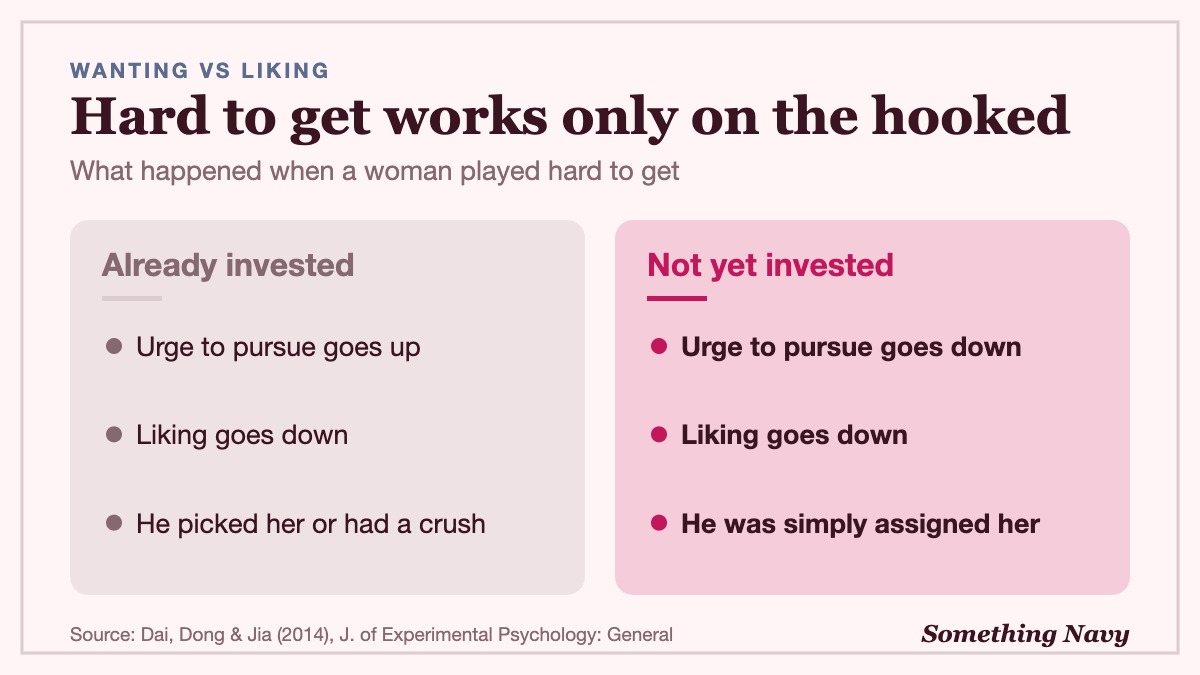
That finding deserves a moment. Playing hard to get can make someone chase you harder while liking you less. It works, in other words, by producing a feeling that looks a lot like anxiety and not much like affection.
And it only works on people who are already hooked. On a new match who is still deciding, it is mostly a way to be forgotten.
Verdict on Round 3
True in a narrow and not very flattering sense. You can raise someone’s desire to pursue you, but only once they are invested, and at the cost of how much they actually like you.
Where the chase stops working
Lay the evidence side by side and a pattern appears. Uncertainty and scarcity act on attention. Warmth acts on attachment.
| Study | Who took part | What helped | The catch |
|---|---|---|---|
| Walster et al. (1973) | 71 male students (sixth experiment) | A woman choosy with others but keen on him | Five earlier experiments found no hard-to-get effect |
| Eastwick et al. (2007) | 156 speed-daters | Liking one person more than the rest | Liking everyone made you less liked |
| Whitchurch et al. (2011) | 47 female students | Not knowing if the men liked them | No real meetings; one lab session |
| Dai et al. (2014) | 101 and 61 male students | Being hard to get, if he was already invested | Liking fell in every condition |
| Birnbaum et al. (2016) | Couples, including a daily diary study | A partner who responds with understanding | Effect was stronger for women than men |
The last row is where most relationships are actually lived. Gurit Birnbaum of the Interdisciplinary Center Herzliya in Israel and Harry Reis of the University of Rochester have spent years on a quality psychologists call responsiveness: feeling that your partner understands you, values you and cares about what you need.
In three studies published in the Journal of Personality and Social Psychology in 2016, they looked at whether responsiveness kills desire, as the “keep them guessing” school would predict. It did the opposite. According to the University of Rochester’s summary, one study had 100 couples keep daily diaries for six weeks. On days when people felt their partner was responsive, they reported more sexual desire. Responsiveness made people feel special and made their partner seem a more valuable mate, and the link was stronger for women.
Earlier work by the same pair with strangers was messier: responsiveness from an unknown man did not reliably make him more attractive to women. Warmth from a stranger can feel premature. Warmth from someone you are getting to know is a different thing.
So the mystery that might win a first glance is not what keeps people close. If anything, insecurity about where you stand is a classic driver of distress in relationships, which anyone familiar with anxious attachment will recognise.
Uncertainty is a spotlight. It is not a foundation.
What to do with a crush this week
None of this means declaring undying love after one coffee. The research points to something more relaxed, and less exhausting, than strategy.
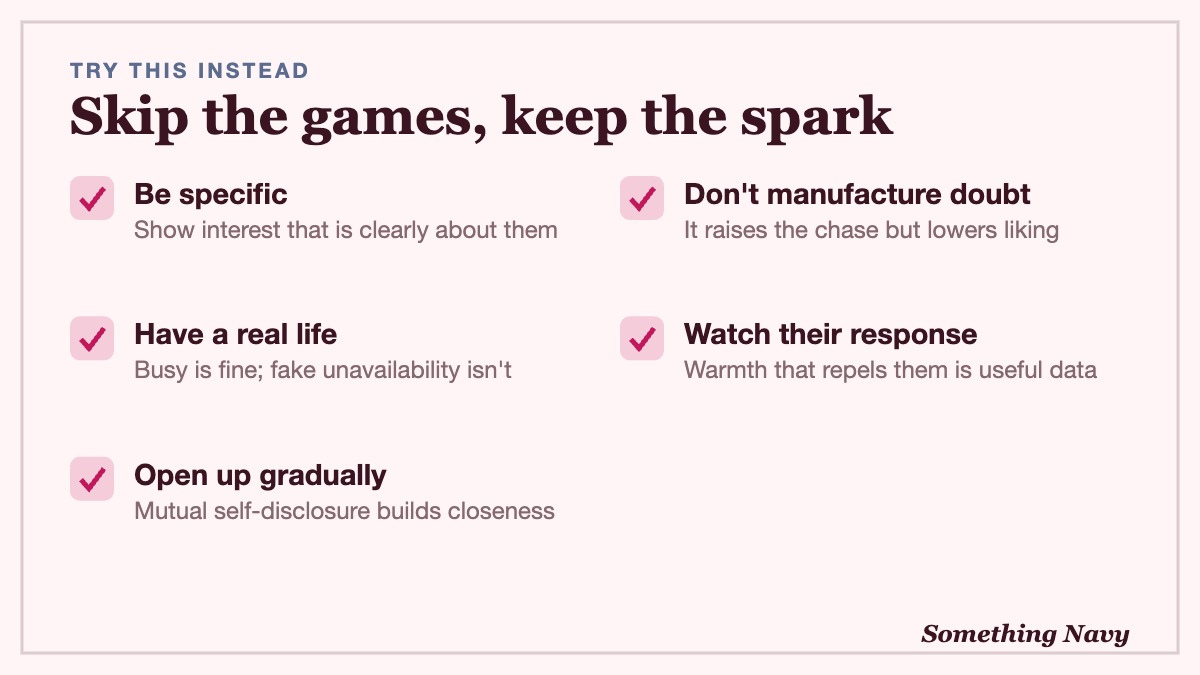
- Be specific, not universal. The speed-dating data rewards interest that is clearly about this person. Mention the thing they said that stuck with you. Generic enthusiasm reads as unselective.
- Have a life, honestly. Walster’s “selectively hard to get” woman was busy with her own world but warm to the person in front of her. Being genuinely occupied is fine. Inventing unavailability is a different thing.
- Let a little mystery happen naturally. Early on, you do not need to share everything at once. Gradual, mutual self-disclosure is how closeness builds anyway, which is the idea behind the 36 questions.
- Do not manufacture doubt. Dai’s work suggests games can raise the urge to chase while lowering affection. That is a poor trade if you want to be liked.
- Watch how they respond to warmth. If your openness makes someone lose interest, that tells you something useful about the relationship you would be building.
One more thing. If you are on the receiving end of hot-and-cold behaviour and cannot stop thinking about it, that is not proof of chemistry. The Virginia study suggests rumination itself can masquerade as attraction. Sometimes what feels like a pull is just an open loop.
It is also worth remembering how much it can hurt when the uncertainty never resolves. Being ghosted is, in a sense, playing hard to get taken to its logical end.
The text you were going to delay
Back to the phone, face down on the table.
The honest reading of fifty years of research is that the wait might buy you a sliver of extra attention from someone already interested. It will not make them like you more, and with someone still deciding, it may just let the moment pass.
Uncertainty grabs attention. Warmth builds relationships. Most of us, if we are honest, want the second one.
So reply when you want to. Say something that could only have been written to them.
Sources
- Birnbaum, G. E., Reis, H. T., Mizrahi, M., Kanat-Maymon, Y., Sass, O., & Granovski-Milner, C. (2016). Intimately connected: The importance of partner responsiveness for experiencing sexual desire. Journal of Personality and Social Psychology, 111(4), 530–546. DOI
- Dai, X., Dong, P., & Jia, J. S. (2014). When does playing hard to get increase romantic attraction? Journal of Experimental Psychology: General, 143(2), 521–526. DOI
- Eastwick, P. W., Finkel, E. J., Mochon, D., & Ariely, D. (2007). Selective versus unselective romantic desire: Not all reciprocity is created equal. Psychological Science, 18(4), 317–319. DOI
- Walster, E., Walster, G. W., Piliavin, J., & Schmidt, L. (1973). “Playing hard to get”: Understanding an elusive phenomenon. Journal of Personality and Social Psychology, 26(1), 113–121. DOI
- Whitchurch, E. R., Wilson, T. D., & Gilbert, D. T. (2011). “He loves me, he loves me not . . . ”: Uncertainty can increase romantic attraction. Psychological Science, 22(2), 172–175. DOI
Cover photo: Brooke Cagle on Unsplash. Charts and graphics: Something Navy.
How we reported this. We went back to the original research for this story, 5 sources in all, listed above, and checked every figure against them. If you think we have got something wrong, tell us and we will look at it. Read more about how we work.