
You are at a wedding, somewhere between the speeches and the cake, wedged at a round table with people you have known for eleven minutes. The bride’s cousin leans across the centrepieces and asks the newlyweds the question every wedding guest eventually asks: “So how did you two meet?”
There is a small pause. The couple exchange a look. One of them laughs and says, “Honestly? An app.”
Nobody at the table blinks. A generation ago, that answer would have earned an awkward silence. Now it barely registers. The more surprising answer, these days, might be “through a friend”.
How couples meet now: what the Stanford survey found
The clearest picture of this shift comes from a nationally representative American study called How Couples Meet and Stay Together, run by the sociologist Michael Rosenfeld at Stanford University. In 2019, Rosenfeld, Reuben Thomas of the University of New Mexico and Sonia Hausen, then a Stanford graduate student, published the results of its 2017 wave in the Proceedings of the National Academy of Sciences. The paper had a pointed title: “Disintermediating your friends”.
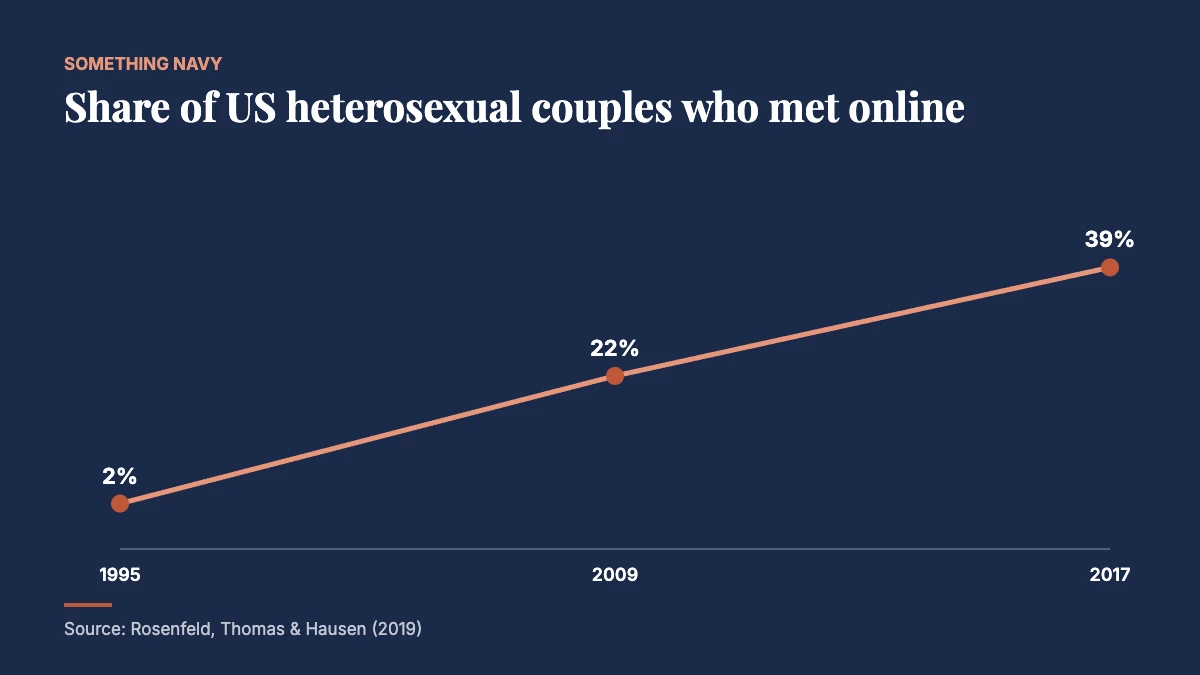
The headline number is hard to argue with. Among heterosexual couples who got together in 2017, about 39% had met online. In 1995, the year the graphical web was arriving in ordinary homes, that figure was 2%. The team’s earlier survey wave had put it at roughly 22% for couples who met in 2009, so the climb sped up in the smartphone years.
What lost out? Almost everything else. Meeting through friends fell from 33% of couples in 1995 to 20% in 2017. Being introduced by family slid from 15% to 7%. Meeting at work dropped from 19% to 11%, through neighbours from 8% to 3%, and at church from 7% to 4%. The authors pinpoint 2013 as roughly the year that online meeting overtook friends as the most common way for heterosexual couples in the US to find each other.
One category bucked the trend: bars and restaurants rose from 19% to 27%. So the romantic night out has not vanished. It is the introductions that moved.
A note on the numbers
The 2017 figures rest on 2,997 “how did you meet” answers from that year’s survey, combined with 2,495 from the 2009 wave. The surveys were run online through a large research panel, and like most modern polls they had low cumulative response rates (around 11% for 2017). The samples were designed to be nationally representative, but this is still a survey of people describing their own lives, not a census.
Why friends lost their matchmaking job
The word “disintermediating” is borrowed from economics. It describes what happens when a middleman gets cut out, the way online booking sites thinned out high-street travel agents. In this case, the middlemen were your mates.
For most of the twentieth century, meeting a partner usually ran through someone you already knew. A friend invited you to a party; a colleague mentioned their single cousin. Those introductions came with a built-in filter, because whoever made them had already vouched for both of you.
Rosenfeld’s data suggest the internet did not simply add another route on top of these. It replaced the go-between. Among couples who met online, the share who were brought together by a friend or other third person shrank from 11.2% in 2009 to 3.7% in 2017. Nearly nine in ten online couples in 2017 had been complete strangers before they connected.
“Meeting a significant other online has replaced meeting through friends,” Rosenfeld said in an interview published by Phys.org when the study came out. The impulse to pair up has not changed. Only the plumbing has.
There is something quietly freeing in this. Apps let people look beyond the small pool of others their friends happen to know, which matters most for anyone whose social circle offers thin pickings. Rosenfeld has pointed out that gay couples meet online at a much higher rate than straight couples, which fits the same logic. If your friends and family cannot easily introduce you to a likely match, a search tool can.
Whether a wider pool changes who we end up with is a separate question. If you have ever wondered whether the old idea that opposites attract survives in a world of filters and profiles, the research on similarity is worth a look.

Do couples who meet online last longer?
Here the evidence gets more interesting, and a little more tangled.
In 2013, a team led by the psychologist John Cacioppo of the University of Chicago published a large study, also in PNAS, of 19,131 Americans who had married between 2005 and 2012. More than a third of them had met their spouse online. When the researchers compared outcomes, couples who met online were slightly less likely to have separated or divorced: 5.96%, against 7.67% for those who met offline. On a seven-point scale of marital satisfaction, they also scored a touch higher, 5.64 compared with 5.48.
Those differences held after adjusting for factors such as education and employment, which matters, because online daters in the sample were more educated and more likely to be in work. Cacioppo and his colleagues floated several possible explanations without testing them directly: people on dating sites may be more set on finding a long-term partner, a bigger pool may allow pickier choices, and chatting by message first may encourage people to open up.
The eHarmony question
Before you text this to your app-sceptic uncle, there is a catch. The study was funded by the dating site eHarmony, and Cacioppo sat on the company’s scientific advisory board, as Scientific American reported at the time. To guard against bias, two independent statisticians oversaw the analysis, and eHarmony agreed in advance that the results would be published whatever they showed.
That does not make the findings wrong. It does mean they deserve a second look. And it is also worth noticing how small the gap is. A difference of under two percentage points in separation, and around a sixth of a point on a seven-point scale, is real in a sample this size but modest in anyone’s actual marriage.
Rosenfeld’s own data point in a gentler direction. In his surveys, once you account for when a couple got together, how they met made no significant difference to their chances of breaking up. The one clear difference was speed: heterosexual couples who met online moved to marriage faster. “Ultimately, it doesn’t matter how you met your significant other,” he said.
That chimes with what researchers find again and again about lasting relationships. The habits a couple builds matter far more than the first hello, from how you handle conflict to whether you choose to live together before marriage, another question Rosenfeld has studied.


What Pew and newer surveys say about online dating
The most recent large Pew Research Center survey on the subject was carried out in July 2022 and published in February 2023. It polled 6,034 American adults, and found that 53% of under-30s had used a dating site or app at some point, compared with 37% of people aged 30 to 49, 20% of those aged 50 to 64 and 13% of over-65s.
Pew’s headline on meeting partners looks smaller than Rosenfeld’s: one in ten partnered adults met their current partner online, rising to one in five among partnered adults under 30. The difference is largely about who is being counted. Pew asked everyone who is currently partnered, including couples who met in the 1970s and 1980s, while Rosenfeld’s 39% describes couples who got together in one recent year.
Experiences were split almost down the middle. Some 53% of online daters described their time on apps as positive and 46% as negative, with men more upbeat (57%) than women (48%).
Newer data suggest the apps are no longer growing in the US. A January 2026 survey of 2,012 adults by the research firm SSRS found that 37% had ever used a dating site or app, against 39% in 2025, and only 6% were current users. Yet among people who had used them, half said they had been in a committed relationship with someone they met that way, up from 42% in 2024. Asked whether relationships that start on apps are more or less successful than ones that start in person, 58% of all adults said just as successful, while 37% said less.
Swipe fatigue and the return of the singles night
If online dating is so effective, why does everyone seem so tired of it?
A 2024 Forbes Health survey, carried out by OnePoll among 1,000 Americans who had used a dating app in the previous year, found that 78% felt emotionally, mentally or physically worn out by the apps at least sometimes. Women reported it more than men (80% against 74%), and millennials and Gen Z more than baby boomers. It was a commercial poll, not an academic study.
The same mood is showing up in usage figures. Ofcom, the UK communications regulator, reported in its 2024 Online Nation research that Tinder lost around 600,000 UK users, a fall of 5%, over the previous year.
Meanwhile, the old-fashioned singles night is having a moment. Eventbrite reported that attendance at singles and dating events on its US platform rose 42% between 2022 and 2023, with game-based dating events up 163%. By May 2026, Axios was reporting Eventbrite data showing that the number of singles events on the platform had doubled between 2022 and 2025.
None of this means the apps are finished. But it hints that people want back some of what was lost when the friend-as-matchmaker disappeared: a bit of context, a shared activity, a room full of real faces. There is good evidence that we underestimate how much we enjoy talking to strangers, which may be part of the appeal of a speed-dating evening over a fortieth swipe.
So, how did you two meet?
Back at the wedding table, the answer “an app” now places the couple squarely in the mainstream. If the bride’s cousin is under 30, she probably has a profile somewhere too, and may well be quietly sick of it.
The research is reassuring for anyone still sheepish about their own origin story. Meeting online is now the single most common way American couples begin. On the best evidence available, it does no harm to your chances, and it may offer a slightly wider view of who is out there.
The story people tell at weddings has changed. What happens after the first message, the patience, the kindness, the willingness to keep turning up, has not.
Official links and research
- Cacioppo, J. T., Cacioppo, S., Gonzaga, G. C., Ogburn, E. L., & VanderWeele, T. J. (2013). Marital satisfaction and break-ups differ across on-line and off-line meeting venues. Proceedings of the National Academy of Sciences, 110(25), 10135–10140. DOI
- Rosenfeld, M. J., Thomas, R. J., & Hausen, S. (2019). Disintermediating your friends: How online dating in the United States displaces other ways of meeting. Proceedings of the National Academy of Sciences, 116(36), 17753–17758. DOI
- Phys.org. (2019). Online dating is the most popular way couples meet. Link
- Vogels, E. A., & McClain, C. (2023, February 2). Key findings about online dating in the U.S. Pew Research Center. Link
- SSRS. (2026). The public and online dating 2026: Topline. Link
- Prendergast, C., & DiGiacinto, J. (2025). Dating app fatigue survey. Forbes Health. Link
- Ofcom. (2025, February 14). Appy Valentine’s Day: Top online dating trends revealed. Link
- Eventbrite. (2024, April 10). Eventbrite sees ongoing surge in speed dating events, with new concepts emerging to cater to diverse preferences. Link
- Axios. (2026, May 13). Why singles are choosing bars over bios. Link
Cover photo: Alvin Mahmudov on Unsplash. Charts and graphics: Something Navy, with photography by Gabriel Martin on Unsplash.
How we reported this. Every figure was checked against the 9 sources above. Reviewed by Brooke Hilland, Senior Content Editor. Report an error · How we work