

The door to the meeting room opens and a man you have never seen walks in, coffee in one hand, laptop under his arm. He has not said a word. He has not even sat down. And yet some quiet part of you has already filed a report: friendly, a bit smug, probably reliable.
You did not decide this. It simply arrived, fully formed.
Over the next hour he will talk, disagree with someone and make a joke that falls flat. But that first report will sit in the background the whole time, colouring what you hear.
Psychologists have spent decades timing that report and trying to catch it out. It arrives astonishingly fast, we trust it more than we should, and it is more open to revision than it feels. Here is how it unfolds, from a tenth of a second to several months.
The first 100 milliseconds: how fast we judge faces
In 2006, Janine Willis and Alexander Todorov of Princeton University published a paper in Psychological Science whose title did most of the explaining: “First impressions: making up your mind after a 100-ms exposure to a face”. A hundred milliseconds is a tenth of a second.
The design was neat. First, 128 people looked at photographs of 66 unfamiliar faces with no time pressure at all and rated each one on a single trait: attractiveness, likeability, trustworthiness, competence or aggressiveness. Those unhurried ratings became the benchmark. Then a separate group of 117 people saw the same faces flashed for 100 milliseconds, half a second or a full second, and made the same judgements.
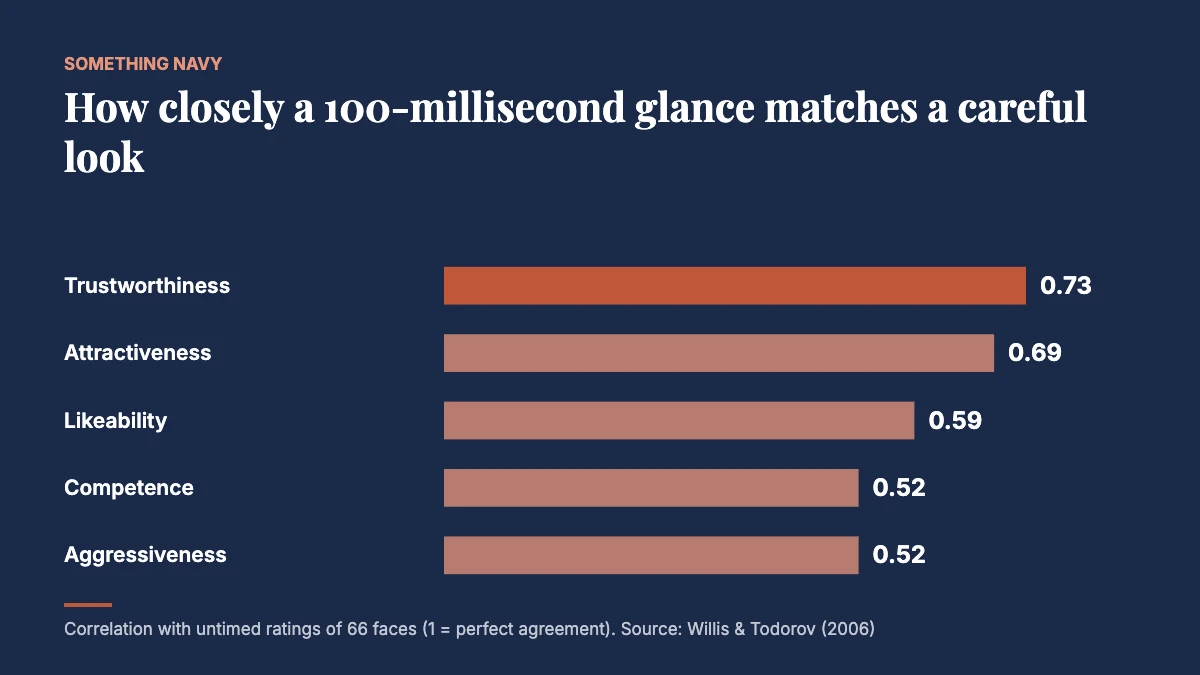
The rushed ratings closely resembled the careful ones. For trustworthiness, the correlation between the 100-millisecond judgements and the untimed benchmark was .73, on a scale where 1 would mean perfect agreement. Attractiveness came in at .69. Even the weakest traits, competence and aggressiveness, managed .52.
More time changed surprisingly little. Stretching the exposure to a full second, ten times longer, did not produce significantly stronger agreement for any trait. Trustworthiness at one second was .74, barely different from .73 at a tenth of that.
What extra time did change was confidence. Between 100 and 500 milliseconds, people became significantly more sure of themselves on four of the five traits. In the university’s announcement, Todorov summed it up: “Observers simply became more confident in their judgments as the duration lengthened.”
Be precise about what this shows. A brief glimpse produces roughly the same verdict as a long stare. It says nothing about whether that verdict is correct, and that distinction turns out to be the whole story.
A tenth of a second is enough to make up your mind. It is nowhere near enough to know if you should have.
The first second: when snap judgements start to matter
These verdicts do not stay inside our heads. They leak into decisions.
A year earlier, Todorov and colleagues Anesu Mandisodza, Amir Goren and Crystal Hall had published a much-discussed report in Science. They showed people black-and-white headshots of pairs of candidates from real US congressional elections and asked a single question: which one looks more competent? In some versions people saw the faces for just one second, and judgements were discarded if a participant recognised either candidate.
The candidate judged more competent won 71.6% of the Senate races from 2000, 2002 and 2004, according to Princeton’s summary of the work. In 600 House races from 2002 and 2004, the figure was 66.8%. Across the project 843 Princeton students took part, and the ratings also tracked the margin of victory.
This is a correlational finding. It does not show that voters chose purely on looks, and many other things differ between winners and losers. What it suggests is that a one-second impression of a stranger’s face is widely shared, and that it lines up with real decisions made by real voters.

The first 30 seconds: thin slices of behaviour
Add movement to a face and you get what researchers call a “thin slice”: a short excerpt of behaviour from which people draw conclusions.
The best-known thin-slice study comes from Nalini Ambady and Robert Rosenthal of Harvard University, published in 1993 in the Journal of Personality and Social Psychology. They took video of 13 college teachers and cut three 10-second clips of each one, 30 seconds in total. The sound was turned off completely. Nine untrained female undergraduates then rated what they saw on 15 dimensions such as confident, optimistic and anxious.
At the end of the semester, the teachers’ real students filled in their usual course evaluations. The strangers’ composite rating from 30 seconds of silent video correlated with those end-of-term evaluations at .76. A second study with 13 high school teachers, this time compared with ratings from their principal, came in at .68.
Cutting the clips to five seconds, then two, made no significant difference. Across all six versions of the task the average correlation was .59.
This is often told as a triumph for snap judgement. Two caveats spoil it slightly. The samples were tiny, 13 teachers per study. And the thing being predicted was itself an impression: course evaluations measure how students felt about a teacher, not how much they learned. Strangers agreed with students. Nobody showed that either group was right about who taught best. That pattern, impressive agreement with uncertain accuracy, keeps coming back.
The first conversation: how accurate are snap judgements?
When researchers check whether first impressions are actually correct, the answer is often: not very.
Trustworthy faces, untrustworthy people
In 2013, Nicholas Rule, Anne Krendl, Zorana Ivcevic and Nalini Ambady reported five studies in the Journal of Personality and Social Psychology that went looking for accuracy in trustworthiness judgements.
In one, 50 undergraduates rated the faces of 15 executives who had been convicted of fraud alongside 15 non-criminal executives of similar rank. The fraudsters scored 3.85 for trustworthiness on average. The honest executives scored 3.97. Statistically, there was no difference. In another, 50 raters judged 25 servicemen convicted of war crimes and 25 recipients of the Purple Heart, matched for rank, race and sex. Again, nothing: 4.01 for the criminals against 4.12 for the decorated.
The most direct test happened in the lab. The researchers photographed 46 students and then gave them a timed test with a cash prize and a tempting chance to cheat. Twenty-six of them took it. When a separate group of 50 students at a different university rated the photos for trustworthiness, those ratings had no meaningful relationship with who had cheated. The correlation was .06, effectively zero.
What did work is telling. Ratings of intelligence from the same photos were related to test scores, and ratings of extraversion matched people’s own reports. Faces are not empty of information. They just seem poor at the one thing we most want to know: whether someone will treat us fairly. The authors concluded that trustworthiness judgements may reflect impressions people share rather than anything true about the person being judged.
Relying on looks can make you worse than guessing
Christopher Olivola and Alexander Todorov pushed the point further in a 2010 paper in the Journal of Experimental Social Psychology, cheerfully titled “Fooled by first impressions?”.
Their first data set came from a website where users posted photos and strangers guessed facts about them. The researchers analysed 1,005,406 guesses about 901 people, covering eleven characteristics such as whether someone had ever been arrested, used drugs, owned a gun or had a degree.
For each trait there was a simple alternative to looking at the photo: guess whatever answer is most common. On every characteristic except having a college degree, the judges did significantly worse than that boring strategy. The face did not merely fail to help. It pulled people away from better information.
A second study had more than a thousand people guess the party of US House candidates from headshots. With an even split, they were right about 55% of the time. When 80% of candidates were Democrats, and participants were told so, accuracy reached only 60%. Answering “Democrat” every time would have scored 80%.
A face can feel like evidence. Very often it is a distraction dressed up as evidence.
The same face, different impressions
In 2011, Rob Jenkins, David White, Xandra Van Montfort and Mike Burton published an unsettling study in Cognition. They gave 20 British undergraduates 40 ordinary photographs taken from the internet and asked them to sort the pictures into piles, one pile per person. The participants did not know that the photos showed only two people, both Dutch celebrities unknown in the UK.
The median number of piles was 7.5. Some participants made as many as 16. Not one of them got the right answer of two. When Dutch participants who knew the celebrities did the same task, the median was exactly two.
In a later experiment from the same paper, 40 students judged the attractiveness of 400 photos showing 20 different people. The variation between pictures of the same person was so large that, for any pair of faces, choosing different photos could flip which one was rated more attractive.
Increasingly, we first meet people through a single image: a dating profile, a work headshot, a square on a video call. If one person can look like several people depending on the photo, a confident verdict from one picture rests on a far narrower base than it feels.
Try this at home
- Scroll back through your camera roll and pick out ten photos of one friend taken in different places, years and lighting.
- Show them, shuffled, to someone who has never met that friend and ask how many different people they think they’re looking at.
- Then ask them to rate each photo for how friendly and how trustworthy the person looks, on a scale of 1 to 7.
- Compare the highest and lowest scores. That spread is roughly how much of a “first impression” belongs to the photo rather than the person.
- Finally, ask your friend which photo they would put on a dating app, and see whether it matches the one strangers rated highest.
Backgrounds count too
The setting shapes the verdict too. In 2023, Abi Cook, Meg Thompson and Paddy Ross of Durham University published a study in PLOS ONE on video-call backgrounds. They showed 167 adults still images of faces against six different backdrops and asked for ratings of trustworthiness and competence on 7-point scales.
People in front of a bookcase scored highest for competence, at 4.96, with houseplants close behind at 4.90. The same faces in front of a living room scored 4.41, and in front of a novelty image (a walrus on an iceberg) just 4.34. Trustworthiness followed a similar pattern, and smiling faces did better throughout.
The differences are a fraction of a point, and the image set mostly featured white faces, a limit the authors flagged. Still, the shelf behind your head is quietly doing some of the talking.


The first months: how first impressions change
The more hopeful news is in what happens next.
Accurate early reads pay off later
In a study published in Social Psychological and Personality Science in 2013, Lauren Human, Gillian Sandstrom, Jeremy Biesanz and Elizabeth Dunn followed 113 undergraduates through a semester. Early in term, in the second or third week, students in small course groups met each member of their group one-on-one for just two to three minutes, then rated that person’s personality and how much they liked them. That produced 530 first impressions. At the end of the semester, 109 of the students reported back on how those relationships had turned out.
The researchers were interested in a specific kind of accuracy: whether you picked up what was distinctive about a person, matching how that person described themselves, rather than just assuming they were typical. Students whose brief first impressions were accurate in this sense went on to report more liking, more interest and more interaction with that person by the end of term. The link with interaction held even after accounting for how much they had liked the person at the start.
The study is correlational, so it cannot prove that accuracy caused the friendships to grow, and self-descriptions are an imperfect yardstick. But it fits a sensible idea: seeing someone clearly, early on, gives a relationship better footing than a flattering guess. How long acquaintances take to deepen is the subject of our piece on the 200 hours it takes to make a friend.
Not all new information is equal
Impressions do update, but some kinds of evidence move them much further than others. In 2019, Marco Brambilla, Luciana Carraro, Luigi Castelli and Simona Sacchi published three experiments in the Journal of Experimental Social Psychology, with 347 participants in total. People formed an impression of someone from one piece of behaviour, then learned a second piece that contradicted it.
When that new information was about morality, honesty or fairness, impressions shifted much more than when it was about how sociable or how competent the person was. In the first experiment, for example, positive moral information shifted impressions by an average of 1.46 on the rating scale, against 0.88 for positive information about sociability. Negative moral information pulled impressions down harder too. The researchers found that moral behaviour was seen as more revealing of a person’s intentions, and that this explained the bigger shift.
Put plainly, watching a colleague you had written off as cold own up to a mistake is likely to shift your view more than watching them tell a good joke. The same works in reverse.

We underestimate how well our own first impressions land
There is one more twist on the timeline, and it concerns the impression we think we made. Erica Boothby, Gus Cooney, Gillian Sandstrom and Margaret Clark reported in Psychological Science in 2018 that after a first conversation, people consistently believe their partner liked them less than they actually did. In one of their studies, among first-year students getting to know their dorm mates, this gap lasted for several months. Clark described the pattern as being “self-protectively pessimistic”.
We have covered this liking gap in more detail, but it adds a neat symmetry. We are too confident in our snap judgements of other people, and too gloomy about their snap judgements of us. If you have ever replayed a first meeting at 2am, wincing at something you said, the spotlight effect is probably working alongside it.
What to do with a 100-millisecond verdict
You cannot switch off the instant read. It arrives before you can object, and most people around you would land on roughly the same verdict. That consensus is exactly what makes it feel trustworthy.
What the evidence supports is humility about the step from “looks” to “is”. Convicted fraudsters looked as trustworthy as honest executives. Leaning on appearance made people worse than playing the odds. One person can read as several. And more looking mostly bought more confidence.
The practical move is to treat the first impression as a hypothesis rather than a conclusion. Notice it, then go looking for the kind of information that actually predicts behaviour: how someone treats people who can do nothing for them, whether they keep small promises, what they do when they get something wrong. Those are the moral cues the Brambilla experiments found people update on most strongly, and they take conversations, not milliseconds, to collect.
And when you are the stranger walking into the meeting room, take some comfort. The verdict the room reaches in a tenth of a second is fast, shared and frequently wrong. The one it reaches after a few months of watching how you behave is slower, and much more likely to be about you.
Frequently asked questions
In Willis and Todorov’s 2006 experiments, judgements of traits such as trustworthiness after a 100-millisecond glimpse of a face closely matched judgements made with unlimited time. Longer viewing mainly made people more confident.
Partly, depending on the trait. Studies have found some accuracy for traits like extraversion and intelligence, but trustworthiness judgements from faces failed to tell fraudsters from honest executives or cheaters from non-cheaters.
Yes. Experiments by Brambilla and colleagues found that impressions shift most when people learn something about a person’s morality, such as honesty or fairness, rather than how sociable or competent they are.
A great deal. Jenkins and colleagues showed that different photos of the same person vary so much that strangers think they show several people, and a 2023 Durham study found that video-call backgrounds shifted ratings of competence and trust.
Official links and research
- Ambady, N., & Rosenthal, R. (1993). Half a minute: Predicting teacher evaluations from thin slices of nonverbal behavior and physical attractiveness. Journal of Personality and Social Psychology, 64(3), 431–441. DOI
- Boothby, E. J., Cooney, G., Sandstrom, G. M., & Clark, M. S. (2018). The liking gap in conversations: Do people like us more than we think? Psychological Science, 29(11), 1742–1756. DOI
- Brambilla, M., Carraro, L., Castelli, L., & Sacchi, S. (2019). Changing impressions: Moral character dominates impression updating. Journal of Experimental Social Psychology, 82, 64–73. DOI
- Cook, A., Thompson, M., & Ross, P. (2023). Virtual first impressions: Zoom backgrounds affect judgements of trust and competence. PLOS ONE, 18(9), e0291444. DOI
- Human, L. J., Sandstrom, G. M., Biesanz, J. C., & Dunn, E. W. (2013). Accurate first impressions leave a lasting impression: The long-term effects of distinctive self-other agreement on relationship development. Social Psychological and Personality Science, 4(4), 395–402. DOI
- Jenkins, R., White, D., Van Montfort, X., & Burton, A. M. (2011). Variability in photos of the same face. Cognition, 121, 313–323. DOI
- Olivola, C. Y., & Todorov, A. (2010). Fooled by first impressions? Reexamining the diagnostic value of appearance-based inferences. Journal of Experimental Social Psychology, 46, 315–324. DOI
- Rule, N. O., Krendl, A. C., Ivcevic, Z., & Ambady, N. (2013). Accuracy and consensus in judgments of trustworthiness from faces: Behavioral and neural correlates. Journal of Personality and Social Psychology, 104(3), 409–426. DOI
- Todorov, A., Mandisodza, A. N., Goren, A., & Hall, C. C. (2005). Inferences of competence from faces predict election outcomes. Science, 308(5728), 1623–1626. DOI
- Willis, J., & Todorov, A. (2006). First impressions: Making up your mind after a 100-ms exposure to a face. Psychological Science, 17(7), 592–598. DOI
Cover photo: Resume Genius on Unsplash. Charts and graphics: Something Navy, with photography by Elliot Blyth and Brooke Winters on Unsplash.
How we reported this. Every figure was checked against the 10 sources above. Reviewed by Brooke Hilland, Senior Content Editor. Report an error · How we work