
The alarm goes at 6.45. Your eyes open, but your brain stays somewhere else, slow and padded, as if it missed the memo.
Downstairs, someone you live with is already humming, showered, halfway through a to-do list. By 11pm they are yawning on the sofa. You, meanwhile, have just woken up properly, and your best ideas are queuing for attention.
For most of history, the owl in that picture has been told a story about character. Lazy. Undisciplined. Should just go to bed earlier.
The science tells a different story. Whether you are an early bird or a night owl is shaped in part by hundreds of genetic variants, by your age and by light, and the gap between your body clock and your office clock has a name, a measurable cost and, encouragingly, some workable fixes.
Here are the myths owls hear most, what the research shows, and a plan you can start tomorrow (at a civilised hour).
Myth one: owls simply lack willpower
Scientists call your natural timing preference your chronotype. It is the reason two people with identical jobs and identical alarm clocks can feel completely different at 7am.
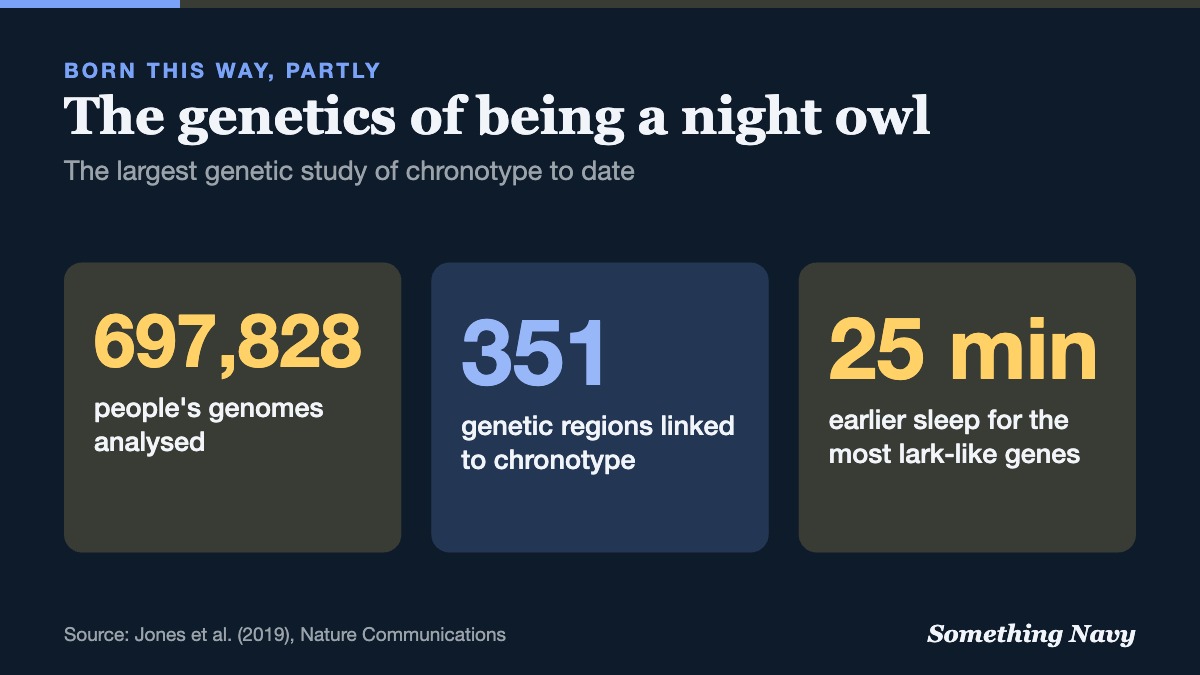
The strongest evidence that it is not a matter of grit came in 2019. A team led by Samuel Jones and Michael Weedon at the University of Exeter pooled genetic data from 697,828 people in the UK Biobank and the consumer genetics company 23andMe, and searched the genome for variants linked to being a “morning person”. Their results, published in Nature Communications, raised the number of known regions associated with chronotype from 24 to 351.
Many of those regions sit near genes involved in the circadian clock itself. Others are active in the retina, the tissue that detects the light your clock uses to set itself, and in parts of the brain such as the hypothalamus and pituitary.
Crucially, the team did not rely only on what people said about themselves. In about 86,000 participants who wore activity monitors, those carrying the most morning-linked variants went to sleep and woke roughly 25 minutes earlier than those carrying the fewest.
Twenty-five minutes does not sound like much. But it is the average effect of genes alone, and it nudges every single night of your life.
Genes are not the whole picture: light and habits push chronotype around too. And the variants shifted when people slept, not how long or how well. An owl’s problem is rarely that their sleep is broken. It is that it is scheduled for the wrong hours.
Being an owl is a setting, not a character flaw.
Myth two: you are born a lark or an owl and stay that way
If you were a teenager who could sleep until lunch and are now a 45-year-old who wakes at 6am without an alarm, you have lived through one of the most reliable patterns in sleep science.
Till Roenneberg, a chronobiologist at Ludwig Maximilian University of Munich, spent decades collecting sleep timing data through a simple survey, the Munich ChronoType Questionnaire. Rather than asking people to label themselves, it asks when they sleep on days when no alarm or obligation is involved, and uses the midpoint of that sleep as a measure of chronotype.
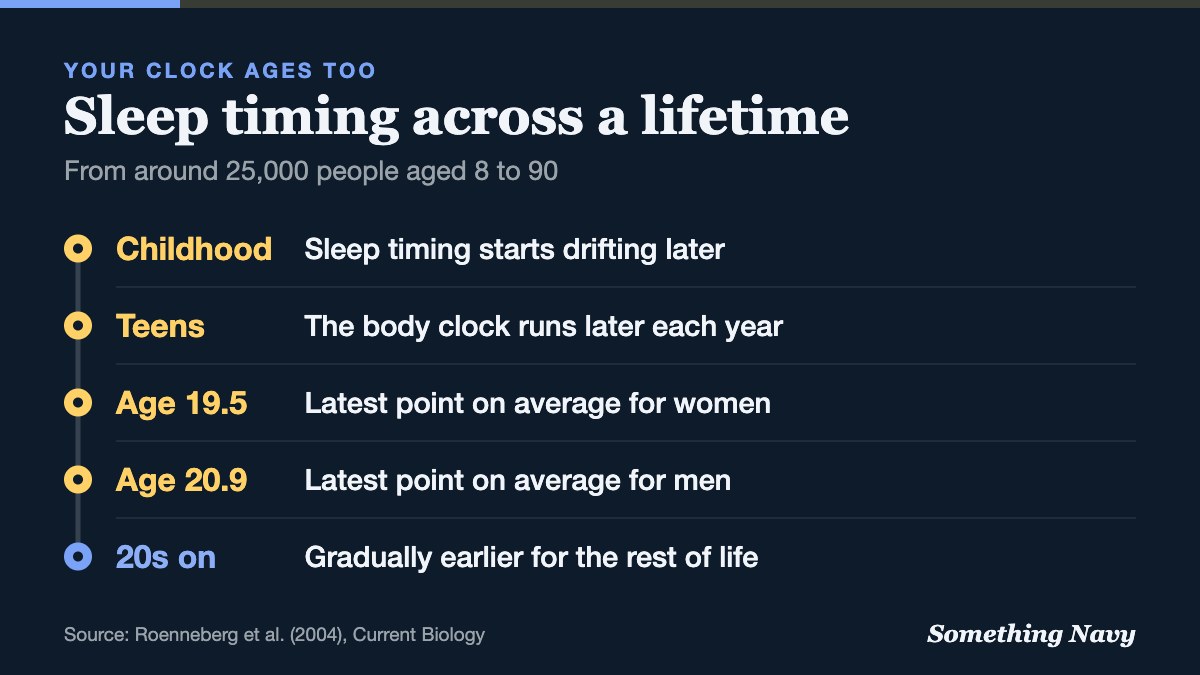
In a 2004 paper in Current Biology, Roenneberg and colleagues reported data from around 25,000 people aged 8 to 90. Sleep timing drifted steadily later through childhood and adolescence, then reversed with surprising abruptness at around age 20.
For women in the sample, the latest timing came at about 19.5 years; for men, at about 20.9. After that, people become gradually earlier for the rest of their lives. The change was so sharp that the authors proposed it as the first biological marker of the end of adolescence.
Roenneberg himself was careful about cause and effect. He put it neatly to Nature: “Do teenagers sleep late because they go to the disco, or do they go to the disco because they sleep late?” The timing of the reversal, he argued, hints at biology rather than nightlife.
So the sleepy 16-year-old who cannot face an 8.30 registration is not simply being difficult. Their clock is, on average, running later than it will at almost any other point in their life.


Myth three: a weekend lie-in is just lazy
Up early all week, asleep until 10am on Saturday, and faintly guilty about it? Roenneberg’s group gave that pattern a name. In a 2006 study in Chronobiology International, Marc Wittmann, Jenny Dinich, Martha Merrow and Roenneberg described social jetlag: the gap between when your body would naturally sleep and when work or school makes you sleep.
It is measured as the difference between the midpoint of your sleep on free days and on workdays. A late chronotype on a 9-to-5 timetable can effectively fly a couple of time zones east every Monday and back again every Friday night, without ever leaving home.
In that study of 501 volunteers, late chronotypes showed the biggest gap, building up a sleep debt during the week and paying it back at weekends. Lateness was linked with more smoking, and the authors argued the trouble lay mainly in the misalignment, not in being an owl as such.
A 2012 follow-up in Current Biology, by Roenneberg, Karla Allebrandt, Merrow and Céline Vetter, linked social jetlag with higher body mass index. Roenneberg estimated that in Western societies “two thirds of the population are burdened” with a significant mismatch between internal time and social schedules.
That makes the Saturday lie-in look less like indulgence and more like repayment. Your body is settling a debt the working week ran up.
Myth four: night owls are doomed to die young
This 2018 headline alarmed owls everywhere. It deserves a careful read, not a panic.
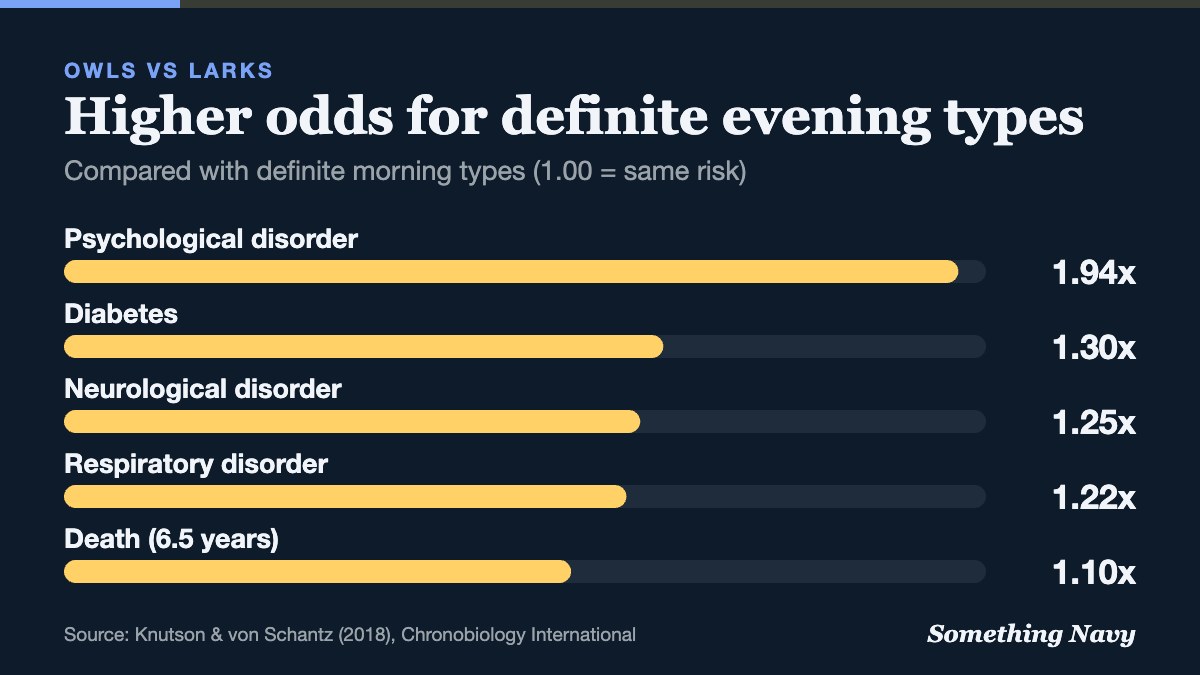
Kristen Knutson of Northwestern University and Malcolm von Schantz of the University of Surrey analysed 433,268 UK Biobank participants aged 38 to 73, who had described themselves as definite morning types, moderate morning, moderate evening or definite evening types. Deaths were tracked over an average of 6.5 years.
In their paper in Chronobiology International, definite evening types had a 10% higher risk of death over that period than definite morning types (a hazard ratio of 1.10). They were also more likely to report a range of health conditions: the odds of a psychological disorder were 1.94 times higher, diabetes 1.30, neurological disorders 1.25 and respiratory disorders 1.22.
Now the caveats, because they matter. This was an observational study. It shows that owls, on average, had worse health outcomes, not that being an owl caused them. Chronotype was a single self-reported answer, and owls in the sample may differ in many other ways, from shift work to smoking.
The authors themselves pointed towards mismatch rather than destiny. Knutson told reporters: “Night owls trying to live in a morning lark world may have health consequences for their bodies.” Her suggestions were about schedules, not about blaming people.
It is also worth noting what the 2019 genetic study found when it tried to test causation more directly. Using a method called Mendelian randomisation, Jones and colleagues found evidence that being a morning person was linked to better mental health, but no evidence that it affected BMI or the risk of type 2 diabetes. Other researchers said the mental health finding still needed confirming.
A 10% relative risk in a large population is real and worth taking seriously. It is not a sentence passed on you personally.
Myth five: early birds have sharper minds
The image of the productive lark, inbox cleared before breakfast, is powerful. The evidence on thinking skills is far less tidy.
In 2024, Raha West and Daqing Ma of Imperial College London looked at 26,820 UK Biobank participants who had completed tests of reasoning, memory and reaction time. Their study in BMJ Public Health found that evening types and people in between both scored higher than morning types.
Before owls start gloating, the limits are significant. The study was cross-sectional, so it cannot show cause. Sleep and chronotype were self-reported, the tests were not controlled for time of day, and education could not be fully adjusted for. Alzheimer’s Research UK’s Jacqui Hanley cautioned that “we don’t know if being a ‘morning’ or ‘evening’ person affects memory and thinking.”
The fair reading: there is no good evidence owls are duller. The same study found sleep length mattered: seven to nine hours was associated with better scores, and very long sleep with worse ones.
Myth six: your body clock cannot be moved
The most reassuring finding comes from a small but carefully designed trial.
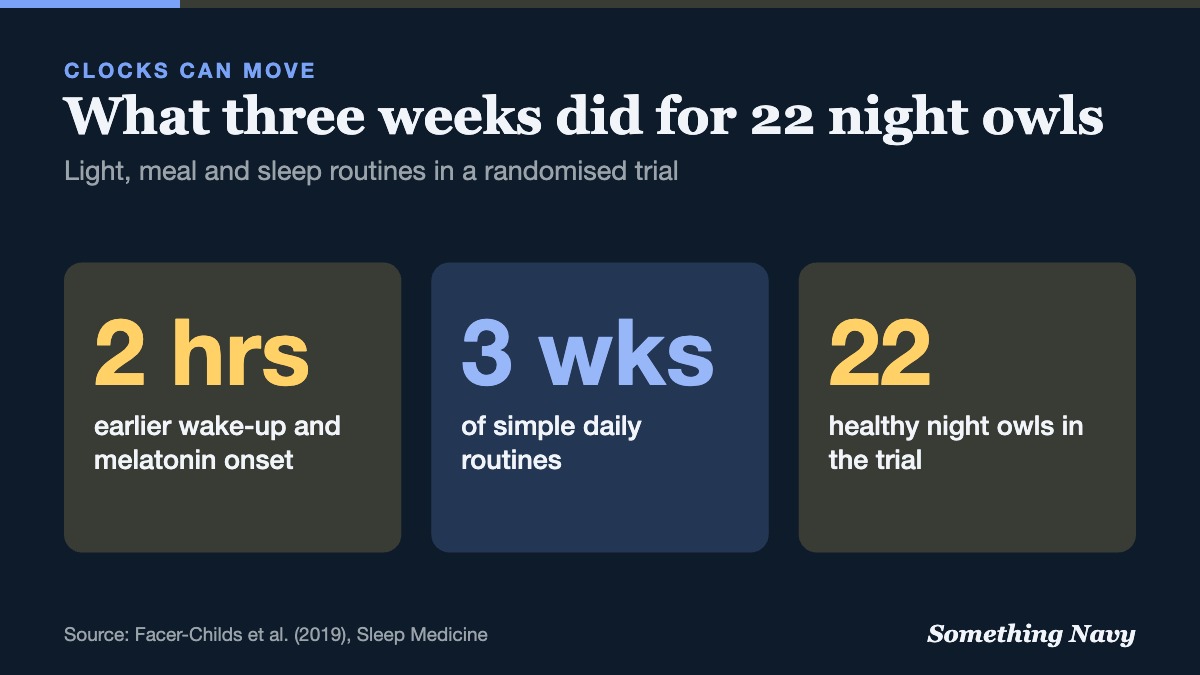
In 2019, a team led by Elise Facer-Childs, with Benita Middleton and Debra Skene of the University of Surrey and Andrew Bagshaw of the University of Birmingham, put that to the test. They recruited healthy night owls whose typical bedtime was around 2.30am and whose wake time was around 10.15am, and randomly assigned them to two groups. Twelve people followed a set of simple routines for three weeks; ten controls carried on as normal.
According to the University of Birmingham’s summary, the experimental group was asked to wake two to three hours earlier than usual and get as much outdoor light as possible in the morning, go to bed earlier while limiting evening light, keep the same sleep and wake times on workdays and free days, eat breakfast soon after waking, eat lunch at the same time each day and avoid dinner after 7pm. Caffeine and exercise timing were also part of the plan.
The results, published in Sleep Medicine, were striking. Measured with wrist-worn monitors, the group’s average wake time moved from 10.31 to 8.36, nearly two hours earlier. Their melatonin onset, a hormonal marker of the body clock, also shifted about two hours earlier, from around midnight to just after 10pm.
And they did not simply lose sleep to get there. Total sleep time did not suffer. Participants reported lower depression and stress scores, less daytime sleepiness, and their reaction time and grip strength improved in the morning.
Twenty-two people is a small study, and the authors said so plainly. Adherence was mostly self-reported, and real life could not be controlled. But it is a proof of principle, and it matches what we know about how light sets the clock.
The clock is stubborn. It is not fixed.


Myths and what the research shows
| Myth | What the research shows |
|---|---|
| Owls lack discipline | Chronotype is linked to 351 genetic regions; morning-linked variants shift sleep about 25 minutes earlier |
| You are a lark or owl for life | Timing gets later through the teens, peaks around 20 and then drifts earlier with age |
| Weekend lie-ins are lazy | They often repay “social jetlag”, the sleep debt built by early weekday schedules |
| Owls are doomed to poor health | Owls show higher risks on average, but the data are observational and mismatch may be the key factor |
| Larks are smarter | One large study found evening types scored slightly higher, with major caveats |
| Your clock cannot move | A three-week routine shifted owls’ sleep and melatonin about two hours earlier |
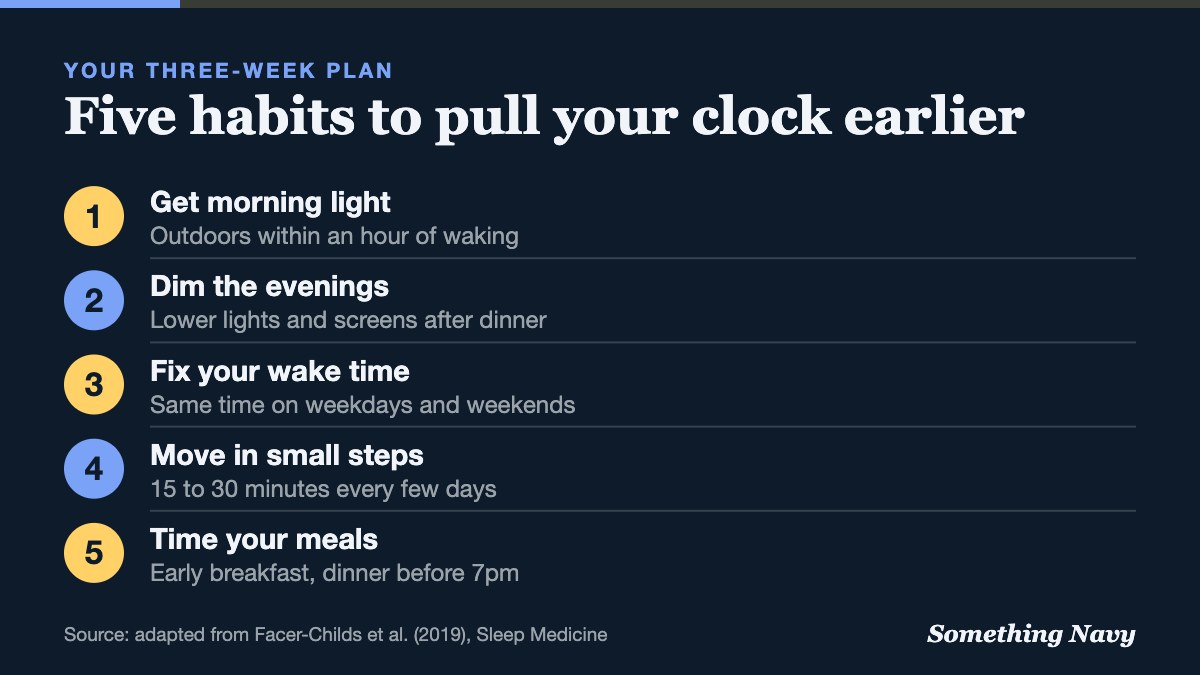
A three-week plan for owls in an early-bird world
You do not need to become a 5am person. The goal is narrower and kinder: shrink the gap between your body’s time and the clock on the wall, so that weekdays feel less like jetlag.
1. Treat morning light as medicine
Light in the hours after waking is the strongest signal for pulling your clock earlier. Get outside within an hour of getting up, even on grey days: walk part of the commute, drink your coffee by an open door, take a phone call outdoors.
2. Dim the evenings
Light late at night pushes the clock the other way. Lower the main lights after dinner and keep screens dimmer and further away. Our look at whether blue light really ruins sleep explains why overall brightness matters more than the colour filter.
3. Anchor your wake time, including weekends
This is the hardest step and the most important. The trial kept sleep and wake times fixed on free days too. Big Saturday lie-ins quietly undo the week’s progress. If you need extra sleep, try adding it at the start of the night rather than the end.
4. Move earlier in small steps
Shifting by 15 to 30 minutes every few days is easier to stick with than one heroic leap. An if-then plan helps here: “If my alarm goes, then I open the curtains before I look at my phone.”
5. Put meals on a timetable
Breakfast soon after waking, lunch at a regular time and dinner before 7pm were all part of the trial.
Try this for three weeks
- Pick one fixed wake time for all seven days and write it down.
- Spend at least 15 minutes outdoors before 10am.
- Dim the lights at home an hour before you want to sleep.
- Notice how you feel at the end of each week, not each morning.
- Be patient: building a routine often takes longer than the famous 21 days.
When the world will not move, work with your peak
Even with a shifted clock, most owls will stay later than most larks. That is fine. The point is to stop fighting your biology on every front at once.
Where you have any control over your day, protect your sharpest hours for the work that needs them. For many owls, that means meetings and admin in the morning, focused thinking in the afternoon or early evening. In the Birmingham trial, participants’ peak performance moved from evening to afternoon, which is a realistic target for most office lives.
And if you live with a teenager, remember the curve. Their clock is at its latest point in life. A calm conversation about morning light and weekend wake times will probably go further than a lecture about laziness.
The lark is not more virtuous for waking at six. They just happen to own a clock that matches the timetable.
Your clock is a fact, not a flaw
For generations, owls have been told their lateness is a moral failing. The science of the last two decades says something gentler and more useful: your timing is partly written in your genes, shaped by your age, and nudged daily by light.
That means two things are true at once. You are not lazy. And you are not stuck.
Tomorrow, open the curtains a little earlier than usual and step into the daylight. Your clock is listening.
Frequently asked questions
Partly. A 2019 study of nearly 700,000 people linked 351 regions of the genome to chronotype, but light, age and habits also play a large role.
Sleep timing is latest around the end of the teens. In Roenneberg’s data it peaked at about 19.5 for women and 20.9 for men, then became earlier with age.
One large UK study found definite evening types had a 10% higher risk of death over about six and a half years, but it was observational and cannot show that chronotype itself is the cause.
In a small 2019 trial, owls who used morning light, regular meals and fixed sleep times moved their sleep about two hours earlier within three weeks.
Sources
- Facer-Childs, E. R., Middleton, B., Skene, D. J., & Bagshaw, A. P. (2019). Resetting the late timing of ‘night owls’ has a positive impact on mental health and performance. Sleep Medicine, 60, 236–247. DOI
- Jones, S. E., et al. (2019). Genome-wide association analyses of chronotype in 697,828 individuals provides insights into circadian rhythms. Nature Communications, 10, 343. DOI
- Knutson, K. L., & von Schantz, M. (2018). Associations between chronotype, morbidity and mortality in the UK Biobank cohort. Chronobiology International, 35(8), 1045–1053. DOI
- Roenneberg, T., Kuehnle, T., Pramstaller, P. P., Ricken, J., Havel, M., Guth, A., & Merrow, M. (2004). A marker for the end of adolescence. Current Biology, 14(24), R1038–R1039. DOI
- Roenneberg, T., Allebrandt, K. V., Merrow, M., & Vetter, C. (2012). Social jetlag and obesity. Current Biology, 22(10), 939–943. DOI
- West, R., & Ma, D. (2024). Sleep duration, chronotype, health and lifestyle factors affect cognition: a UK Biobank cross-sectional study. BMJ Public Health. DOI
- Wittmann, M., Dinich, J., Merrow, M., & Roenneberg, T. (2006). Social jetlag: Misalignment of biological and social time. Chronobiology International, 23(1–2), 497–509. DOI
Cover photo: blue sky on Unsplash. Charts and graphics: Something Navy.
How we reported this. We went back to the original research for this story, 7 sources in all, listed above, and checked every figure against them. If you think we have got something wrong, tell us and we will look at it. Read more about how we work.