
Most of us are not short on intentions. You mean to start running again, finish the report before Friday, book that check-up, call your mother on Sundays. The intention is real. What goes missing is the moment of actually starting, and psychologists have a name for the space between meaning to and doing: the intention–behavior gap.
One of the best-studied ways to close it is almost embarrassingly simple. It is a plan phrased as “if this happens, then I will do that.” Decades of experiments suggest that this small change in how you phrase a goal can make a large difference to whether it happens.
What an if–then plan looks like
The psychologist Peter Gollwitzer, who has spent much of his career at New York University and the University of Konstanz, called these plans implementation intentions. A goal says what you want: “I want to exercise more.” An implementation intention ties a specific moment to a specific action:
- If it is 7 a.m. on a weekday, then I put on my running shoes and go out the door.
- If I sit down at my desk after lunch, then I open the report before I look at email.
- If I want a snack after dinner, then I make a cup of tea instead.
The point is that the decision has already been made. When the moment arrives, you are not weighing up whether you feel like it. You are carrying out a plan you made when you were calm and clear-headed.


Two experiments that made the idea famous
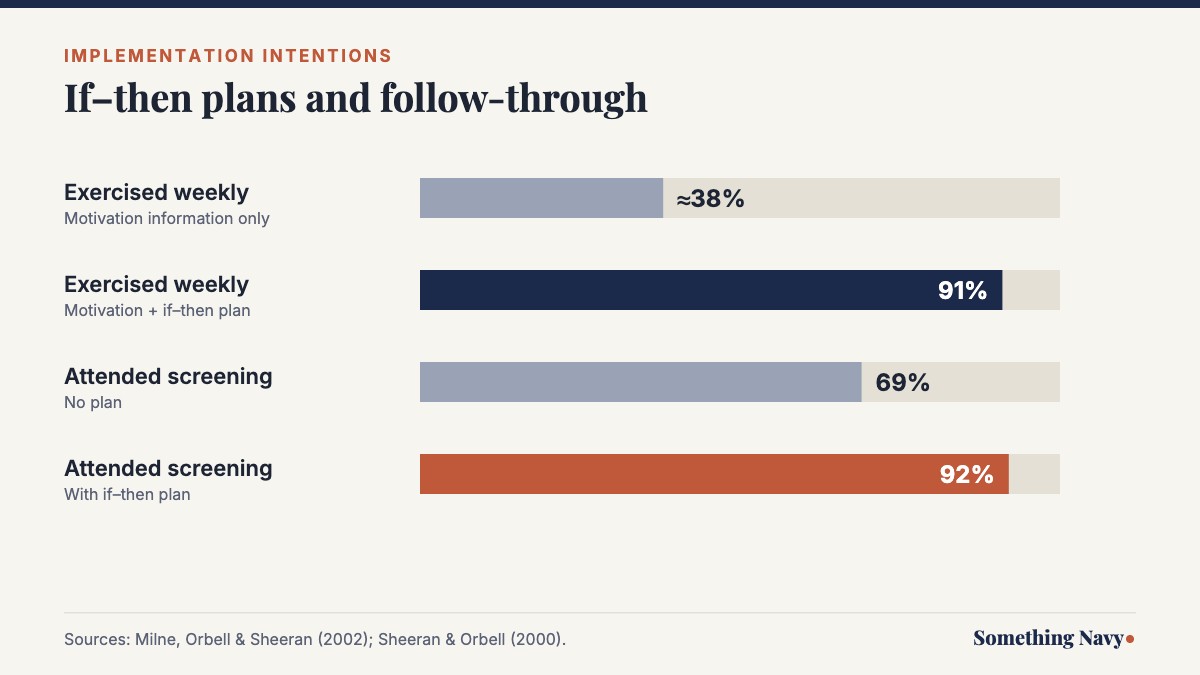
Some of the most striking evidence comes from health research. In one study published in 2002, Sarah Milne, Sheina Orbell and Paschal Sheeran divided 248 university students into three groups. One simply tracked their exercise. A second also read material about the health benefits of exercise and the risks of heart disease. A third read the same material and then wrote down exactly when, where and for how long they would exercise in the coming week.
The motivational reading on its own made little difference: in both of the first two groups, only around 35 to 38 percent exercised at least once a week. In the group that also made a specific plan, 91 percent did.
A similar pattern appeared in a 2000 study of 114 women in England who were due for cervical cancer screening. Those who were asked to write down when, where and how they would book their appointment attended at a rate of 92 percent, compared with 69 percent in the comparison group, even though both groups were similarly motivated.
How well do if–then plans work overall?
Single studies can be flukes, so the more important evidence comes from looking across many. In 2006, Gollwitzer and Sheeran published a meta-analysis that combined 94 independent studies involving more than 8,000 people. Participants who formed if–then plans were considerably more likely to follow through on their goals than those who had only set the goal. The average effect was medium to large by the standards of psychology, which is unusual for something that takes a minute to write down.
The studies covered a wide spread of behavior: exercise and diet, studying, keeping medical appointments, recycling, and sticking to personal commitments.
The honest caveats
It is worth being clear about the limits. Later work suggests the original meta-analysis estimate was probably inflated by publication bias, the tendency for studies with positive results to be more likely to get published. Effects also tend to be smaller for complicated, long-term goals than for one-off actions like booking an appointment. Many of the studies used students and short follow-up periods.
If–then plans also cannot create motivation that is not there. They help people act on goals they already hold. If you do not really want to go running, a perfectly phrased plan will not change that.
Even so, the central finding, that a concrete plan beats a vague intention, has held up well across many labs and countries.
Why such a small trick makes a difference
Two things tend to go wrong between intending and doing. The first is that we miss the moment: lunch ends, the email tab is already open, and the window has passed. Naming the cue in advance makes you far more likely to notice it when it comes.
The second is hesitation. If the response is already chosen, there is no pause in which to talk yourself out of it, and that pause is where procrastination usually wins. Gollwitzer describes this as handing control of the behavior over to the situation, so that the cue itself prompts the action.
It is also why if–then plans pair so well with habit-building. A habit is essentially a cue and a response that have been repeated until they fire on their own. An if–then plan gives you the cue and the response on day one. We look at how long that repetition takes in our piece on how long it really takes to form a habit.
Writing a plan you will actually use
Make the “if” something you will genuinely run into, such as “after I drop the kids at school,” rather than “sometime in the morning.” A specific time, a place, or something you already do every day all work well.
Keep the “then” small and concrete. “Write 200 words” works; “work on the book” does not. If the action is big, plan only the first step: “open the document and write the first sentence.”
Plans for obstacles are especially useful. “If it is raining, then I do 20 minutes of the workout video in the living room” saves the day that the weather would otherwise have cancelled. “If a colleague asks me to take on extra work this week, then I will say I need to check my schedule first” protects a commitment before it is under pressure.
Keep the list short. One or two plans that you use are worth more than ten that you forget. And write them down, or say them out loud. It sounds trivial, but spelling out the exact moment is where most of the benefit comes from.
Pairing plans with a reality check
Some researchers combine if–then planning with a technique called mental contrasting, developed by Gabriele Oettingen, who is married to Gollwitzer and works with him. You first picture the outcome you want, then picture the main obstacle that stands in your way, and only then write an if–then plan for that obstacle. Oettingen popularized the sequence under the name WOOP: wish, outcome, obstacle, plan.
The logic is simple. Positive daydreaming on its own can feel good without producing action, while thinking about obstacles on its own can feel discouraging. Together, they point your plan at the moment most likely to derail you.
Frequently asked questions
It is a plan that links a specific situation to a specific action, usually phrased as “if X happens, then I will do Y.” The term was coined by psychologist Peter Gollwitzer.
A 2006 meta-analysis of 94 studies found that people who made if–then plans were considerably more likely to reach their goals. Later analyses suggest the effect is somewhat smaller than first estimated, but still meaningful.
Start with one or two for your most important goal, especially for the moments where you usually get stuck. Too many plans are hard to remember.
They can help you respond differently to a trigger, for example “if I feel the urge to check my phone during work, then I will put it in a drawer.” They work best alongside changes to your surroundings.
More ideas for following through in our Self-Growth section.
Sources
- Gollwitzer, P. M., & Sheeran, P. (2006). Implementation intentions and goal achievement: A meta-analysis of effects and processes. Advances in Experimental Social Psychology, 38, 69–119. University of Konstanz repository
- Milne, S., Orbell, S., & Sheeran, P. (2002). Combining motivational and volitional interventions to promote exercise participation: Protection motivation theory and implementation intentions. British Journal of Health Psychology. Wiley Online Library
- Sheeran, P., & Orbell, S. (2000). Using implementation intentions to increase attendance for cervical cancer screening. Health Psychology, 19(3), 283–289. PubMed
- Gollwitzer, P. M. (1999). Implementation intentions: Strong effects of simple plans. American Psychologist, 54(7), 493–503.
How we reported this. We went back to the original research for this story, four sources in all, listed above, and checked every figure against them. If you think we have got something wrong, tell us and we will look at it. Read more about how we work.
Cover photo: Alexa Williams on Unsplash. Charts and graphics: Something Navy.