
It is 7am. The bathroom is still grey, the extractor fan is humming, and you are standing under a perfectly pleasant stream of warm water with your hand on the dial.
You have read the posts. You have heard the podcast host who swears by it. All you have to do is turn your wrist to the right and stay there.
Your hand does not move. A small, reasonable voice asks what, exactly, you are about to suffer for.
That is a fair question, and it has a better answer than most of the people shouting about cold water would like.
Why cold showers became a wellness habit
Cold water has been sold as a cure for everything from tiredness to low mood. The modern version arrived through ice baths in elite sport, then spread to morning routines, social feeds and tubs in suburban gardens.
Most of what gets shared online, though, rests on a surprisingly small pile of evidence. Two studies, both in the journal PLOS ONE, do most of the heavy lifting.
The Dutch trial: 3,018 people and one month of cold water
In January 2015, a team led by Geert Buijze at the Academic Medical Center in Amsterdam ran a large randomised trial of cold showering. They screened 4,229 adults and enrolled 3,018 aged 18 to 65 who were in good health and did not already take cold showers.
Volunteers were split into four groups. Three took their usual hot shower and then switched to the coldest water available for 30, 60 or 90 seconds at the end. The fourth group carried on showering as normal. The cold routine ran for 30 straight days, after which people could keep going or stop as they liked, and everyone was followed for 90 days in total. The results appeared in September 2016.
What changed and what did not
The headline finding was a 29% drop in sickness absence from work compared with the control group. It was statistically significant, and it is the number quoted everywhere.
What gets quoted far less often is the other half. The cold-shower groups did not report fewer days of actually being ill. They got sick about as often as everyone else; they simply took fewer days off when they did.
The length of the cold burst made no difference either. Thirty seconds did as well as 90, which is either good news for the reluctant or a clue that something other than the water itself was at work.
How seriously to take the 29%
The authors were careful here. Volunteers knew which group they were in, because it is hard to hide a cold shower from the person standing in it. Absence was self-reported. The sample was healthier than the general population. And the paper says plainly that cause and effect cannot be established.
There are several ways to read the gap between “sick as often” and “off work less”. Perhaps cold water helps people feel slightly more able to push through a mild cold. Perhaps people who had signed up to a daily challenge felt more motivated to show up. Many participants did say they felt more energetic, though the paper gives no figures for that.
Quality of life nudged up a little at 30 days, measured on a standard mental health scale, but the difference had vanished by 90 days. Work engagement and anxiety showed no meaningful change.
The cold-shower groups were ill just as often. They simply went to work anyway.
The most striking number in the whole study may be about habit rather than health. After the 30 days were up, 64% of participants kept taking cold showers regularly, even though nobody was asking them to. Anyone who has read about how long it really takes to form a habit will know that a two-thirds stick rate is unusually high for any new behaviour, let alone an unpleasant one.


What the 2025 meta-analysis found about stress, sleep and quality of life
Nearly a decade later, Tara Cain and colleagues at the University of South Australia gathered every randomised trial they could find on cold-water immersion in healthy adults. Their systematic review and meta-analysis was published in PLOS ONE in January 2025.
The bar for inclusion was water at 15°C or colder, for at least 30 seconds, at or above chest level. Only 11 trials qualified, with 3,177 participants between them. That total sounds healthy until you notice that 3,018 of those people came from the Dutch shower study. The other ten were small trials of baths and plunges, often after exercise, and the review notes that every one of those ten recruited only men.
Stress: a dip at 12 hours, then nothing
Across the trials, cold water did not change stress immediately afterwards, at one hour, at 24 hours or at 48 hours. At 12 hours, though, there was a clear and statistically significant reduction.
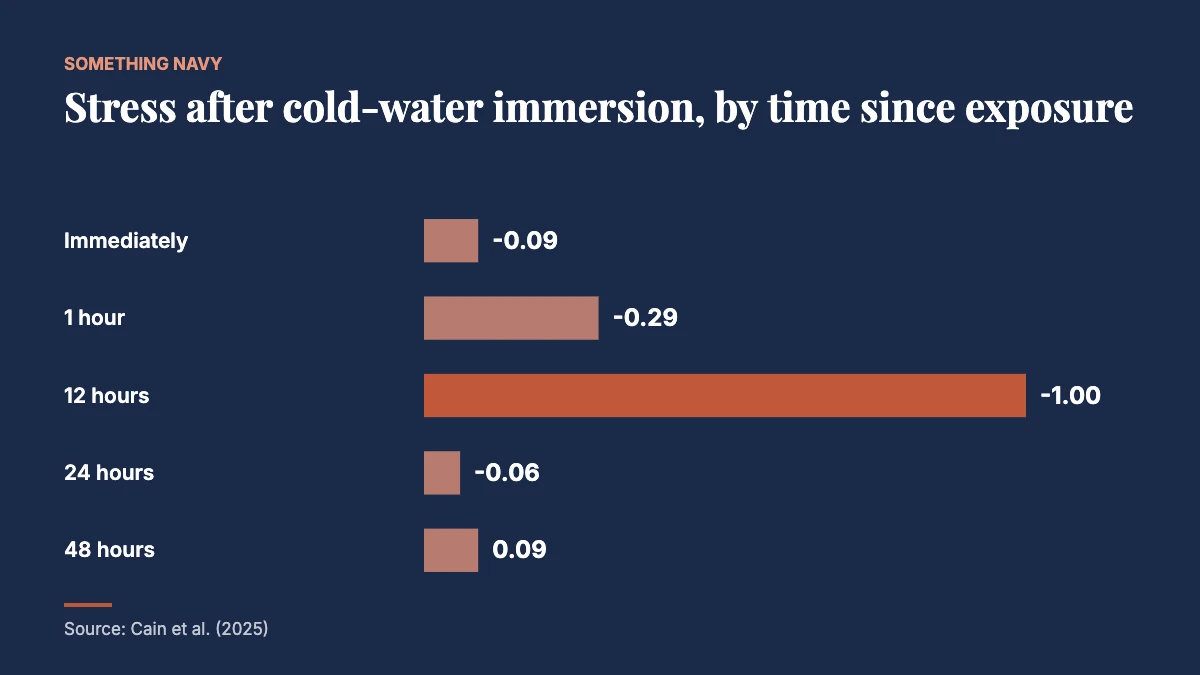
One strong result between four null ones is worth noticing, but it needs repeating before anyone builds a routine on it.
Sleep, mood and quality of life
The sleep evidence comes from one small study of men who had been doing heat training, which found better sleep quality after cold immersion. The same study found no change in mood. The quality-of-life finding is the Dutch result again: a small lift at one month that had gone by three months.
Inflammation goes up, at least at first
One result runs against the wellness messaging. Markers of inflammation rose straight after cold immersion and were still raised an hour later. Ben Singh, a co-author, described this as the body reacting to the cold as a stressor, and the review suggests it may reflect a metabolic response rather than lasting harm. On immunity, the pooled evidence showed no clear effect either way.
The authors’ verdict was blunt: many of the benefits people claim “remain unsubstantiated”. Cain also told the University of South Australia that “there isn’t enough high-quality research to say exactly who benefits most”.
The depression hypothesis that was never tested
Search for cold showers and mental health and you will soon meet a 2008 paper by Nikolai Shevchuk of Virginia Commonwealth University School of Medicine, published in Medical Hypotheses. It proposed that short, “adapted” cold showers might ease depression.
His suggested routine was gentler than most online challenges: about two to three minutes at 20°C, preceded by five minutes of gradually cooling the water, once or twice a day. He reasoned that cold activates the sympathetic nervous system, raises noradrenaline and beta-endorphin, and floods the brain with signals from the many cold receptors in the skin.
It is an interesting idea, and only an idea. The paper describes trying the routine on what it calls a “statistically insignificant number of people”, none of whom had enough symptoms for a depression diagnosis, and it ends by calling for larger, properly designed studies.
Is there any newer research on cold water and mood?
There is a little, and more on the way. A 2026 study in Lifestyle Medicine by Kelly, Davidson and Delaney randomly assigned 140 people with self-reported low mood to a control group or to a single sea dip at about 13.6°C lasting 5, 10 or 20 minutes. Mood scores improved in all three dip groups and barely moved in the controls, and five minutes worked as well as twenty. It was a one-off swim in the sea, though, not a daily shower, and the authors urged caution for people with existing health conditions.
The study that could finally test Shevchuk’s idea is now under way. Ben Singh, now leading a team at Adelaide University, began recruiting in June 2026 for a pilot trial in adults with mild to moderate anxiety or depression symptoms. Half will finish each shower with 90 seconds of cold water for 30 days; the other half will shower as usual. Recruitment is due to run until June 2027, so there are no results yet.
Cold shock and heart conditions: the safety part
None of this is medical advice, and the safety side deserves more than a footnote.
Sudden cold triggers what physiologists call the cold shock response: an involuntary gasp, fast breathing, and a jump in heart rate and blood pressure. In a 2022 editorial in the British Journal of Sports Medicine, Mike Tipton of the University of Portsmouth and colleagues explain that this response is strongest in the first 30 seconds, then settles. In the 2026 sea study above, heart rates rose by an average of 33 beats per minute.
For a healthy person, that is a short, unpleasant spike. For someone with a heart condition, it can be a real risk. Tipton’s group lists high blood pressure, heart rhythm problems, structural or coronary heart disease, Raynaud’s and some medicines among the factors that need care. Chloe MacArthur, a senior cardiac nurse at the British Heart Foundation, warns that cold water makes the heart work harder and raises stress hormones, which may increase the chance of an abnormal rhythm, and advises checking with your doctor or nurse first.
A shower is far milder than jumping into a winter lake. But if you have any heart problem, or you are unsure, speak to your doctor before you try it.
How to try a cold shower safely
- If you have a heart condition, high blood pressure, Raynaud’s or take heart medication, talk to your doctor first.
- Start warm and finish cold, as the Dutch trial did, rather than stepping straight into cold water.
- Turn the dial gradually instead of all at once, and keep your breathing slow through the first 30 seconds.
- Thirty seconds is plenty to start. In the 2016 trial it did as well as 90.
- Stop if you feel dizzy, chest pain or breathlessness that does not settle, and warm up properly afterwards.
So, do cold showers actually do anything?
One large but unblinded trial found that people who ended their showers cold took fewer sick days, without getting ill any less often. A review of 11 trials found a short-lived drop in stress at around 12 hours, a small quality-of-life lift that faded, one small sleep study, and a brief rise in inflammation. The depression idea from 2008 is still a hypothesis, and the first trial designed to test it has only just started.
That leaves cold showers looking less like a medical intervention and more like a small, deliberate challenge you set yourself. If you want to start, a fresh start such as a Monday or the first of the month is as good a moment as any. Just keep your expectations as modest as the evidence.
Frequently asked questions
The evidence does not show that. In the Dutch trial, cold showers did not reduce days of illness, and the 2025 meta-analysis found no clear effect on immune markers.
In the largest trial, 30 seconds of cold at the end of a warm shower worked as well as 60 or 90 seconds for sickness absence. There is no evidence that longer is better.
It has not been shown. The 2008 depression paper was an untested hypothesis, and a pilot trial in Australia only began recruiting in June 2026.
Cold water raises heart rate and blood pressure, which can be risky with heart disease. Speak to your doctor before trying it.
Official links and research
- Buijze, G. A., Sierevelt, I. N., van der Heijden, B. C. J. M., Dijkgraaf, M. G., & Frings-Dresen, M. H. W. (2016). The effect of cold showering on health and work: A randomized controlled trial. PLOS ONE, 11(9), e0161749. DOI
- Cain, T., Brinsley, J., Bennett, H., Nelson, M., Maher, C., & Singh, B. (2025). Effects of cold-water immersion on health and wellbeing: A systematic review and meta-analysis. PLOS ONE, 20(1), e0317615. DOI
- Shevchuk, N. A. (2008). Adapted cold shower as a potential treatment for depression. Medical Hypotheses, 70(5), 995–1001. DOI
- Kelly, J. S., Davidson, N., & Delaney, J. P. (2026). Improved mood following cold-water immersion: A comparison of differing exposure durations. Lifestyle Medicine, 7(2). DOI
- Tipton, M., Massey, H., Mayhew, A., & Morgan, P. (2022). Cold water therapies: Minimising risks. British Journal of Sports Medicine, 56(23), 1332–1334. DOI
- MacArthur, C. (2023, May 31). Cold water swimming. British Heart Foundation. https://www.bhf.org.uk/informationsupport/heart-matters-magazine/activity/cold-water-swimming
- University of South Australia. (2025, February 3). Study explores the effects of cold water immersion on health and wellbeing [Press release, via News-Medical]. https://www.news-medical.net/news/20250203/Study-explores-the-effects-of-cold-water-immersion-on-health-and-wellbeing.aspx
- Adelaide University. (2026). Cold Showers and Mental Wellbeing Study. https://adelaide.edu.au/research/participate-in-research/cold-showers-and-mental-wellbeing-study/
Cover photo: kevin Baquerizo on Unsplash. Charts and graphics: Something Navy, with photography by Nguyễn Hiệp on Unsplash.
How we reported this. Every figure was checked against the 8 sources above. Reviewed by Valentino Adkins, Senior Content Manager. Report an error · How we work