
It is 3pm and your forehead is resting on your forearm, which is resting on the desk, which is somehow warmer than it was an hour ago. The spreadsheet on your screen has gone soft at the edges. You have read the same email four times and could not tell anyone what it says.
You tell yourself you are just closing your eyes for a second. Then someone two rows over laughs, and you jolt upright with the specific shame of a person who has been asleep in public and is not sure for how long.
Here is the odd thing. If that doze lasted about ten minutes, you may now be sharper than the colleague who powered through on a third coffee. If it lasted forty, you might feel worse than before. Researchers have spent three decades timing the difference.
Why you crash in the afternoon: the post-lunch dip explained
The usual suspect is lunch. It is a tidy story, and mostly wrong.
Timothy Monk, a circadian rhythm researcher, reviewed the evidence on the “post-lunch dip” for Clinics in Sports Medicine in 2005. The mid-afternoon slump, he noted, turns up even in people who have skipped lunch and in people with no clue what time it is. That points to the body clock, which seems to carry a secondary 12-hour rhythm alongside the main daily one. Lunch is a supporting actor: a carbohydrate-heavy meal makes the dip worse. Extreme morning types may also be more prone to it. (If you are wired the other way, our piece on night owls and chronotypes explains why your clock runs late.)
It shows up in hard data too. In a 1997 driving simulator study in Psychophysiology, Luise Reyner and James Horne found that driving incidents, self-rated sleepiness and sleepy brain activity all peaked in mid-afternoon. So the 3pm desk-face is not a character flaw. It is a predictable low point, and a nap is one of the few remedies tested head to head against it.
What a nap actually does inside your brain
When you fall asleep, you do not drop straight into deep sleep. You pass through lighter stages first, and only later slide into slow-wave sleep, the deep stage that is hard to wake from. That sequence explains most of what follows. A nap that ends in light sleep tends to leave you refreshed quickly. One that ends after you have gone deep tends to leave you groggy first and refreshed later.
A 2026 look at what changes at the level of brain connections
A study published in NeuroImage in early 2026 suggests a nap can do some of the rewiring usually credited to a full night. Kristoffer Fehér, Christoph Nissen and colleagues at the University of Freiburg’s Medical Center (Nissen is now at Geneva University Hospitals and the University of Geneva) had 20 healthy young adults spend one afternoon napping and another awake. The naps averaged 45 minutes, and the team used magnetic brain stimulation and EEG to estimate synaptic activity indirectly.
After the nap, overall connection strength in the cortex had eased down, a kind of reset, while the brain’s capacity to form new connections improved. Participants were better primed to learn than after the same time awake. Nissen’s summary: “even short periods of sleep enhance the brain’s capacity to encode new information.” It is small and measures physiology, not job performance, but it offers a plausible mechanism.
The NASA nap study: 25.8 minutes in a 747 cockpit
The most famous nap in research history happened over the Pacific. In a study NASA published in 1994, a team at its Ames Research Center led by Mark Rosekind followed three-person Boeing 747-200 crews on a punishing trip pattern: eight transpacific legs in 12 days, each about nine hours long.
Twelve pilots in the Rest Group were given a planned 40-minute nap opportunity during the quiet cruise phase. Nine in the No-Rest Group flew as normal. The window was designed to limit deep sleep, and a 20-minute buffer after waking let any grogginess clear. In the summary published in the Journal of Sleep Research in 1995, the nappers slept on 93% of opportunities, fell asleep in 5.6 minutes on average and slept for 25.8 minutes: the origin of the “26-minute NASA nap”.
Compared with the No-Rest Group, the nappers showed vigilance improvements ranging from 16% in median reaction time to 34% in lapses, those moments when attention simply drops out. The team also counted “microevents”, brief bursts of sleep-like brain activity, over the last 90 minutes of flight, through descent and landing. The No-Rest pilots had about twice the rate, including 22 in the final 30 minutes. The Rest Group had none in that window.
A nap is not a shrunken version of a night’s sleep. It is a different deal, and the length sets the terms.
Two caveats. Twenty-one pilots is a small sample. And the “54% boost in alertness” often attached to this study online does not appear in either the 1994 NASA report or the 1995 paper, so it does not appear here.
Brooks and Lack: which nap length works best?
NASA showed that a nap helps, not how long it should be. For that, the most useful experiment is still one by Amber Brooks and Leon Lack of Flinders University in Adelaide, published in SLEEP in 2006.
They recruited 24 healthy young adults (12 men, 12 women, average age 22.5), good sleepers who did not normally nap. The night before each session, sleep was restricted to five hours, from 2am to 7am. At 3pm, on different days, each person had no nap or exactly 5, 10, 20 or 30 minutes of actual sleep. For three hours afterwards the team measured how quickly they fell asleep again, how sleepy and fatigued they felt, and how they did on symbol-substitution, letter-cancellation and reaction-time tests.
The results, nap by nap
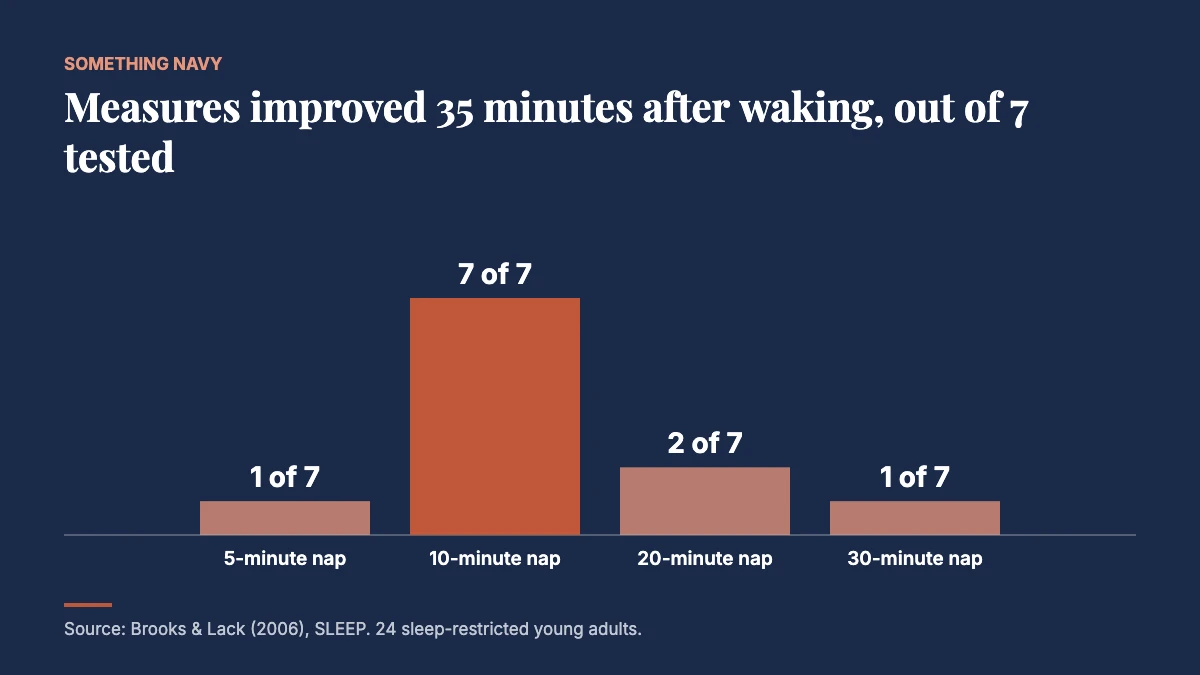
The 5-minute nap did very little. The only measurable gain was on the letter-cancellation task, 35 and 95 minutes later.
The 10-minute nap was the standout. Of seven sleepiness and performance measures, five were significantly better just five minutes after waking, and some benefits lasted up to 155 minutes.
The 20-minute nap worked on a delay: nothing improved at five minutes, gains emerged at 35 and were gone by 155.
The 30-minute nap made things worse first. Alertness and performance dipped right after waking, which the authors identified as sleep inertia, before benefits slowly built.
Why ten minutes beat thirty
The sleep recordings explain it. In the 10-minute naps, just one of 23 participants with usable recordings reached stage 3, the start of slow-wave sleep. In the 30-minute naps, 21 did. Longer naps were not more of the same sleep but a different kind, and waking from it carried a cost. Brooks and Lack judged the 10-minute nap the most effective length they tested.
The limits: these were young, sleep-deprived adults in a lab. And “10 minutes of sleep” is not a 10-minute alarm, since dropping off takes time.


Sleep inertia: why waking from a long nap feels like wading through mud
That foggy, faintly hostile state after a long nap has a name. Cassie Hilditch and Andrew McHill, of the Fatigue Countermeasures Laboratory at San Jose State University Research Foundation and Oregon Health & Science University, reviewed the research in Nature and Science of Sleep in 2019, describing sleep inertia as a temporary spell of sleepiness, disorientation and impaired thinking on waking.
Performance often recovers within 30 minutes, sometimes 15, but full recovery can take an hour or more. In some lab studies, impairment on waking has matched or exceeded that seen after up to 40 hours without sleep. Worth remembering before you drive or answer a sensitive email straight off the sofa.
The link with deep sleep is more mixed than popular articles suggest: older studies found one, many recent studies do not. More consistent is that inertia is likelier after longer naps taken when already short of sleep, so the people who most need a nap are the most likely to wake from a long one feeling dreadful. And the authors found little evidence that anything done after waking (light, temperature or caffeine) immediately clears the worst of the fog.

Does the caffeine nap really work?
The “coffee nap” sounds like a hack dreamed up by an exhausted student, but it has a modest research base. Caffeine takes a while to kick in, so you drink it, sleep briefly, and wake as it arrives.
In their 1997 study, Reyner and Horne gave 12 sleepy participants a 30-minute break before a two-hour afternoon simulator drive. They had caffeine plus a nap of under 15 minutes, 200mg of caffeine alone, or a placebo. Caffeine alone cut the afternoon peak in driving incidents to 34% of placebo levels. The combination cut it to 9%, effectively erasing the peak, even for those whose “nap” was only dozing. Hilditch and McHill’s review agrees that caffeine taken before a short nap of around 20 minutes is the most effective way found so far to blunt sleep inertia.
Twelve drivers is a proof of concept, and a 3pm coffee will not suit everyone’s night. If your evenings already run late, read our pieces on blue light and sleep and revenge bedtime procrastination first.
What these nap studies can and can’t tell you
- The lab trials used small groups of young, sleep-deprived adults.
- The NASA study was realistic but involved only 21 pilots.
- Brain-volume and health-risk studies show patterns, not proof.
- Big datasets often lack basics, such as how long each nap lasted.
Is regular napping good for your brain? The UK Biobank study
In 2023, a Sleep Health study made headlines suggesting habitual nappers have bigger brains. The reality is more careful. Valentina Paz of the University of the Republic in Uruguay and UCL’s MRC Unit for Lifelong Health and Ageing, with Hassan Dashti of Harvard and Massachusetts General Hospital and Victoria Garfield of UCL, used Mendelian randomisation. Some people carry gene variants that make them likelier to nap, fixed at conception before any lifestyle or illness. If those people differ in brain health, it is harder to blame poor health for causing the napping.
The team used 97 variants previously linked to habitual napping in 452,633 UK Biobank participants, then examined data for up to 378,932 people aged 40 to 69, of whom 35,080 had brain scans. Those genetically inclined to nap more often had about 15.8 cubic centimetres more total brain volume per step up in napping frequency, roughly 1.3%, which the authors likened to 2.6 to 6.5 years of brain ageing. There was no difference in the hippocampus, a key memory region, nor in reaction time or visual memory.
Read the small print
The confidence interval ran from 0.25 to 31.34 cubic centimetres, which is wide. One alternative statistical method gave a similar but non-significant estimate, and another pointed the other way. Everyone was of white European ancestry. Crucially, UK Biobank did not record nap length, so a 10-minute nap and a two-hour sleep look the same in this data. Garfield’s suggestion that short naps “may be a part of the puzzle” for brain health is about as far as the evidence goes.
Long daytime naps and health risks: correlation, not cause
In 2015, Tomohide Yamada and colleagues at the University of Tokyo pooled 11 prospective studies of 151,588 people, followed for an average of 11 years, in a meta-analysis for SLEEP. Compared with not napping, habitual naps of 60 minutes or more a day were associated with an 82% higher relative risk of cardiovascular disease and a 27% higher risk of death from any cause. Shorter naps showed no significant association. For heart disease the curve was J-shaped, dipping up to about 30 minutes a day and rising steeply beyond about 45. As the authors put it, “Nap time and cardiovascular disease may be associated via a J-curve relation.”
The reverse causation problem
The catch is that a long daily nap can be a symptom, not a cause. Poor night-time sleep or illness can make people sleep more by day, making napping the smoke rather than the fire.
A study published online in 2022 in Alzheimer’s & Dementia, led by Peng Li and Lei Gao of Brigham and Women’s Hospital and Harvard Medical School with senior authors Kun Hu of Harvard and Yue Leng of the University of California, San Francisco, shows how tangled this gets. It tracked 1,401 older adults, average age 81, for up to 14 years with wrist-worn trackers. Napping grew by about 11 minutes a year in people who stayed cognitively healthy, 24 minutes a year after a diagnosis of mild cognitive impairment, and 68 minutes a year after an Alzheimer’s diagnosis. Among those who started out healthy, napping over an hour a day was linked to a 40% higher risk of later Alzheimer’s. The researchers suspect a two-way relationship, and Leng stressed that causation is not established.
In 2025, Chenlu Gao of Massachusetts General Hospital presented an analysis of 86,565 UK Biobank participants, average age 63, who wore activity trackers for a week and were followed for up to 11 years. Longer naps, more irregular nap lengths and more midday and early-afternoon napping were all associated with higher mortality, even after adjusting for night-time sleep. But this was a conference abstract, not a full paper, trackers detect stillness rather than sleep, and the midday finding contradicts much earlier work. None of it shows that a short nap is risky. It suggests a growing or erratic need for daytime sleep is worth noticing.
So how long should a nap be? A comparison of the evidence
For healthy adults, the picture is fairly clear. The American Academy of Sleep Medicine encourages naps of 20 to 30 minutes in the early afternoon, and the lab evidence suggests the shorter end of that range, or a little below it, pays off fastest.
| Nap length | What it seems to do | How strong is the evidence? |
|---|---|---|
| 5 minutes | Very little | Lab study, 24 adults (Brooks & Lack, 2006) |
| 10 minutes | Immediate gains, some lasting 155 minutes | Same lab study |
| 20 minutes | Gains from 35 minutes after waking | Same lab study |
| About 26 minutes | Faster reactions, fewer lapses | NASA field study, 21 pilots (Rosekind et al., 1995) |
| 30 minutes | Grogginess first, gains later | Lab study, 24 adults (Brooks & Lack, 2006) |
| Under 15 minutes plus caffeine | Driving incidents cut to 9% of placebo | Simulator, 12 drivers (Reyner & Horne, 1997) |
| About 45 minutes | Synaptic “reset”, readier to learn | Lab study, 20 adults (Fehér et al., 2026) |
| 60+ minutes, habitually | Linked to heart and mortality risk | Observational; may reflect illness (Yamada et al., 2015) |
Because the afternoon dip is driven by your body clock, the urge to sleep mid-afternoon is normal. What is worth noticing is a change: needing more daytime sleep than you used to, nodding off when you do not mean to, or feeling exhausted after a full night. Persistent daytime sleepiness like that is a reason to talk to a doctor, not to buy a better eye mask.
As for the person face-down on the desk at 3pm, the evidence is quietly on their side. Ten minutes, no more than about twenty, and ideally not straight before a meeting. The trick is waking up before the brain has gone deep enough to resent it.
Frequently asked questions
In Brooks and Lack’s 2006 lab study, a 10-minute nap improved alertness immediately, while a 30-minute nap caused grogginess first. The American Academy of Sleep Medicine suggests 20 to 30 minutes for healthy adults.
A 2023 UK Biobank genetic study linked habitual napping to slightly larger total brain volume, but not to better reaction time or visual memory, and it could not measure nap length. It hints at a benefit, not proof.
Habitual naps of an hour or more are linked to higher cardiovascular and mortality risk in observational studies, but they may signal poor night-time sleep or illness rather than cause harm. Persistent daytime sleepiness is worth raising with a doctor.
Official links and research
- Brooks, A., & Lack, L. (2006). A brief afternoon nap following nocturnal sleep restriction: Which nap duration is most recuperative? Sleep, 29(6), 831–840. DOI
- Fehér, K. D., Henckaerts, P., Hirsch, V., Bucsenez, U., Kuhn, M., Maier, J. G., Schneider, C. L., Hertenstein, E., Mikutta, C., Riemann, D., Feige, B., & Nissen, C. (2026). A nap can recalibrate homeostatic and associative synaptic plasticity in the human cortex. NeuroImage, 327, 121723. DOI
- Gao, C., et al. (2025). Objectively-assessed napping behaviors predict mortality in middle-to-older aged adults [Abstract 0350]. Sleep, 48(Supplement 1). American Academy of Sleep Medicine release
- Hilditch, C. J., & McHill, A. W. (2019). Sleep inertia: Current insights. Nature and Science of Sleep, 11, 155–165. DOI
- Li, P., Gao, L., Yu, L., Zheng, X., Ulsa, M. C., Yang, H.-W., Gaba, A., Yaffe, K., Bennett, D. A., Buchman, A. S., Hu, K., & Leng, Y. (2023). Daytime napping and Alzheimer’s dementia: A potential bidirectional relationship. Alzheimer’s & Dementia, 19(1), 158–168. DOI
- Monk, T. H. (2005). The post-lunch dip in performance. Clinics in Sports Medicine, 24(2), e15–e23. DOI
- Paz, V., Dashti, H. S., & Garfield, V. (2023). Is there an association between daytime napping, cognitive function, and brain volume? A Mendelian randomization study in the UK Biobank. Sleep Health, 9(5), 786–793. DOI
- Reyner, L. A., & Horne, J. A. (1997). Suppression of sleepiness in drivers: Combination of caffeine with a short nap. Psychophysiology, 34(6), 721–725. DOI
- Rosekind, M. R., Smith, R. M., Miller, D. L., Co, E. L., Gregory, K. B., Webbon, L. L., Gander, P. H., & Lebacqz, J. V. (1995). Alertness management: Strategic naps in operational settings. Journal of Sleep Research, 4(S2), 62–66. DOI
- Yamada, T., Hara, K., Shojima, N., Yamauchi, T., & Kadowaki, T. (2015). Daytime napping and the risk of cardiovascular disease and all-cause mortality: A prospective study and dose-response meta-analysis. Sleep, 38(12), 1945–1953. DOI
Cover photo: Vitaly Gariev on Unsplash. Charts and graphics: Something Navy, with photography by Mykyta Kravčenko and David Mao on Unsplash.
How we reported this. Every figure was checked against the 10 sources above. Reviewed by Brooke Hilland, Senior Content Editor. Report an error · How we work