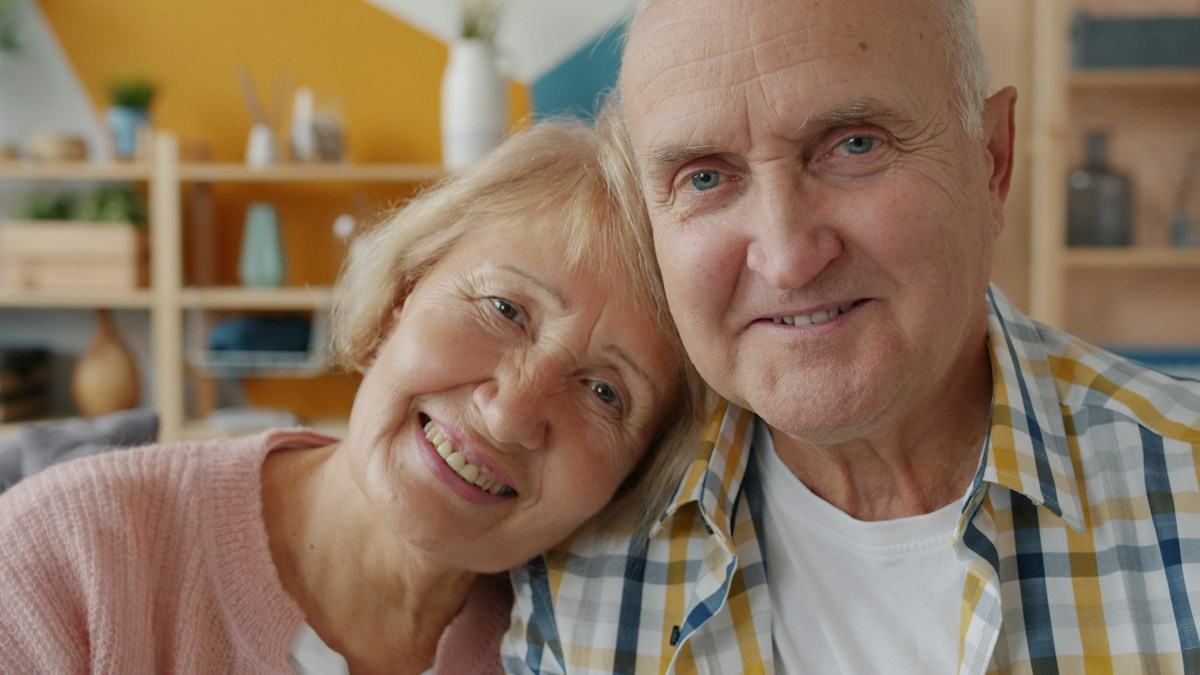
It is a Sunday afternoon and someone has found the wedding album. Your grandparents in 1968, squinting into the sun outside a registry office. Then the ruby anniversary photo, the two of them side by side on a sofa, wearing the same patient half-smile.
“They’ve turned into each other,” somebody says. Everyone nods.
It is one of the most charming bits of folk wisdom about love: stay together long enough and your faces start to merge. Dog owners get told the same thing about their spaniels. It feels true every time you see a couple in their eighties sharing a bench.
But when researchers finally tested it properly, with more than 500 couples and a face-recognition algorithm, the faces did not converge at all. The likeness was already there on the wedding day.
Which is, in its own way, a more interesting story.
The 1987 claim: 12 couples and a lot of wrinkles
The idea got its scientific stamp from Robert Zajonc, the University of Michigan psychologist better known for the mere exposure effect. In 1987 he and three colleagues published a short paper in Motivation and Emotion with a memorable title: “Convergence in the physical appearance of spouses”.
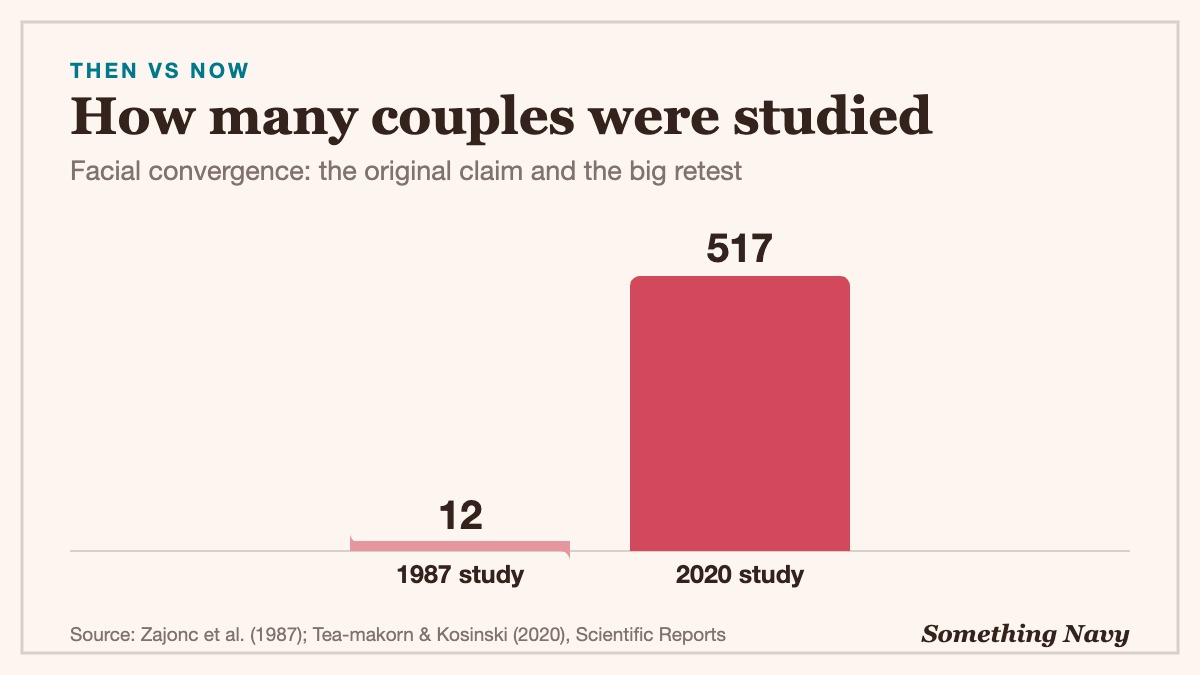
Their sample was small. Twelve married couples, all white, aged 50 to 60, living around Detroit or in rural Wisconsin. Each had a photo from their first year of marriage and another from roughly 25 years later.
The team cropped the photos down to faces and showed them to 110 undergraduates. Judges saw a target face alongside six opposite-sex faces and ranked them by resemblance, or by how likely each pair was to be married. No judge saw the same couple at both ages.
The result: spouses looked more alike in the later photos than in the early ones. In the newlywed pictures, judges could not pick partners out any better than chance. A quarter of a century on, they could.
Empathy, etched into the face
Zajonc’s explanation was poetic. Couples, he argued, spend decades unconsciously mimicking each other’s expressions as they empathise. Smile when your partner smiles, frown when they frown, thousands of times over, and the same lines might gradually settle into both faces.
The team even found that couples whose resemblance had grown the most reported being happier in their marriages. That detail made the finding irresistible. Here was love, literally written on the face.
The researchers did check some boring alternatives. A shared diet, for instance, did not seem to explain it: a check on spouses’ weight pointed the wrong way. But the authors were open that their mechanism was speculative and their sample tiny.
And for the next three decades, nobody replicated it.
An idea that spread much further than its data
That is not unusual in psychology. A tidy, heart-warming result gets picked up by textbooks, then magazines, then dinner-party conversation, and the original caveats quietly fall away.
By the 2010s, “couples grow to look alike” was the kind of thing people said as settled fact. The evidence behind it was still a dozen couples from the American Midwest.
The 2020 test: 517 couples and a machine that reads faces
In 2020, Pin Pin Tea-makorn, then a PhD student in electrical engineering at Stanford, and Michal Kosinski of Stanford Graduate School of Business decided to run the test again at scale. Their paper appeared in Scientific Reports.
Tea-makorn expected an easy win. As she put it in the Stanford press release: “When we started this project, I was convinced that we will easily find evidence for the convergence in facial appearance.”
They gathered photos of 517 married couples from public sources, mostly newspaper anniversary announcements, plus Google searches and a handful of public Ancestry.com profiles. Each spouse had one photo taken within two years of the wedding and another taken 20 to 69 years later. The average marriage in the sample had lasted 49 years.
What the 2020 study did
- Couples: 517 married couples, all white and heterosexual.
- Photos: one within two years of the wedding, one 20 to 69 years later.
- Human judges: 153 online volunteers ranked faces by similarity; a further 117 rated who looked most likely to be married, copying the 1987 design.
- Machine judge: VGGFace2, a face-recognition algorithm that compares faces numerically.
- The test: could the spouse be picked out of a line-up of six faces, and did that get easier with time?
They kept the spirit of Zajonc’s line-up. Each face was shown with six opposite-sex faces of similar age: the real spouse and five strangers. Human judges ranked them by similarity. So did the algorithm, which converts a face into a long string of numbers and measures how close two faces sit.


The faces matched on the wedding day. Then they stayed put
Two things came out clearly.
First, spouses really do look alike. In the early photos, both the human judges and the algorithm ranked the real partner as more similar than chance would predict. Pure guessing would put the spouse at an average rank of 3.5 out of six; human judges put them at 2.75.
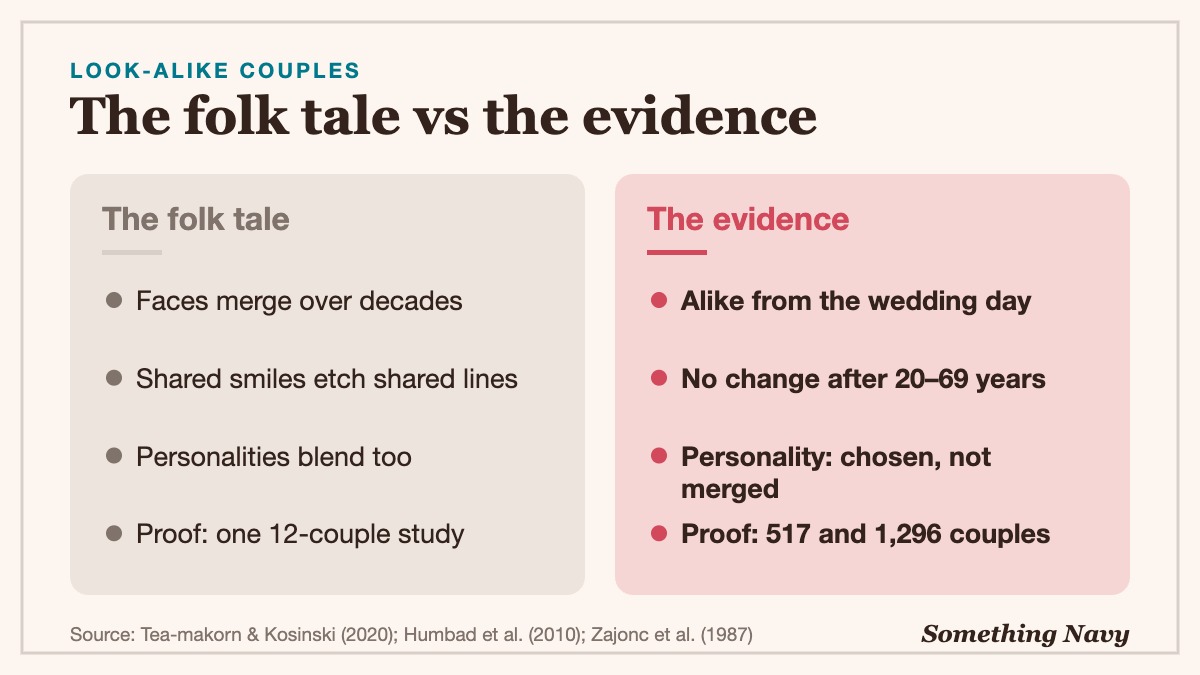
Second, that similarity did not grow. Not after 20 years, not after 50. If anything, human judges rated the spouses as very slightly less alike in the later photos, although the algorithm did not reproduce that small dip. Ratings of who looked married did not change significantly over time either.
“We could not find any evidence for convergence,” Tea-makorn said.
The study was big enough to catch even a small change, which makes the null result more convincing than a shrug. The authors also note its limits: the photos were whatever couples chose to share publicly, with no control over lighting, make-up or expression, and the sample was entirely white heterosexual couples. Still, as they argue, those messy factors would be more likely to exaggerate convergence than hide it.
Couples don’t drift together. They start together.
What’s really going on: we pick a face we already know
If the resemblance is there from the start, the explanation lies in how we choose. Psychologists call it assortative mating: the tendency to pair up with people who are similar to us in age, education, background, values and, it seems, looks.
Some of that is simple geography and social circles. You meet people in your town, your university, your office, and those people tend to share your ancestry and upbringing. Faces come along for the ride.
But there is evidence that something more personal shapes taste too.
Your parents may have set the template
In 2003, a British team including Anthony Little, Ian Penton-Voak and David Perrett looked at hair and eye colour in people, their partners and their parents. Partners’ colouring tended to match the parents’ colouring, and the opposite-sex parent was a stronger predictor than the same-sex parent, even after accounting for people’s own looks.
The authors suggested something loosely like imprinting: growing up around certain faces may tune what feels attractive later. They were careful to say the mechanism is unclear. It is a correlation in the colouring of real couples, not proof that anyone is subconsciously dating their mother.
Familiar, but not too familiar
It would be easy to conclude that we simply fancy our own reflection. The evidence is subtler than that.
In a 2005 study, Lisa DeBruine digitally tweaked opposite-sex faces so they subtly resembled each participant. People rated these look-alike faces as more trustworthy. For a long-term relationship, the resemblance made no difference to attractiveness. For a short-term fling, it made faces less attractive.
DeBruine read this as a kinship cue. Faces like our own say “family”, which builds trust but cools lust. So we are drawn to the familiar, within limits. Similar enough to feel like home, different enough not to feel like a cousin.
Personalities don’t merge either, mostly
The same pattern turns up beyond faces. In 2010, Mikhila Humbad and colleagues at Michigan State University and the University of Minnesota studied 1,296 married couples from the Minnesota Center for Twin and Family Research. They had been married for between 2 and 39 years, 19.8 years on average.
Couples married for decades were no more alike in personality than couples who had just started out. The researchers concluded that similarity was “better explained by selection than gradual convergence.”
There was one notable exception: aggression. Spouses did seem to grow more alike on that trait over time, possibly because hostility invites hostility back. It is a reminder that the habits couples really do pick up from each other are more often in how they treat one another than in how they look. (If that rings a bell, our piece on the four horsemen of relationship conflict is worth a read.)
The Minnesota team also found spouses were most alike on values, such as traditionalism, rather than on broad traits like sociability. That fits with what we know about whether opposites attract: mostly, they don’t.
So why do old couples look so alike?
If the science says no convergence, why does the folk belief feel so right when you look at that anniversary photo?
Part of it is that the resemblance was real all along. You just weren’t comparing the wedding photos side by side with a stranger’s.
Part of it is context. Long-married couples often share a postcode, a wardrobe budget, a hairdresser, a sense of humour about the camera. Matching anoraks do a lot of work. The 2020 study stripped photos back to faces, which is exactly where those shared cues disappear.
And part of it is ageing itself. Grey hair, glasses and softer jawlines make many older faces look more alike in general, not just within couples.
What changes over a long marriage isn’t the face. It’s how well you can read it.
Five things to take to the next family gathering
- The “couples merge” idea came from just 12 couples. It was a fascinating hunch that went unreplicated for over 30 years.
- A test of 517 couples found no convergence. Human judges and an algorithm agreed the likeness was there at the start.
- Resemblance is mostly about choice. We tend to pair up with people like us, in looks, background and values.
- Self-similar faces earn trust, not lust. Looking a bit like you can make a face seem reliable, but less sexy for a fling.
- Personalities stay put too. Except, worryingly, aggression, which can rub off.
Try it on your own photo album
Next time the wedding album comes out, do a quick experiment. Cover the later photos and look only at the wedding pictures. Do the couple already share a jawline, a smile, a way of tilting their heads? Quite often, they do.
It is a nice thing to point out to a couple you love. Not “you’ve grown into each other”, but “you recognised something in each other from the very beginning.”
It also lets you off the hook. If you are newly together and people keep telling you that you look like siblings, the research says that is not a prophecy about the next 40 years. It is just your taste showing.
Kosinski’s takeaway from the project was about science, not romance: “I think that scholars should spend more time validating widespread psychological theories.” Fair. But the romantic reading survives too.
Your grandparents did not slowly become the same person. They found each other in a crowded room in 1968 and, somewhere in that first glance, something looked familiar.
Sources
- Zajonc, R. B., Adelmann, P. K., Murphy, S. T., & Niedenthal, P. M. (1987). Convergence in the physical appearance of spouses. Motivation and Emotion, 11(4), 335–346. DOI
- Tea-makorn, P. P., & Kosinski, M. (2020). Spouses’ faces are similar but do not become more similar with time. Scientific Reports, 10, 17001. DOI
- Stanford Graduate School of Business. (2020, October 12). Spouses’ faces are similar but do not become more similar with time [Press release]. Newswise. Link
- Little, A. C., Penton-Voak, I. S., Burt, D. M., & Perrett, D. I. (2003). Investigating an imprinting-like phenomenon in humans: Partners and opposite-sex parents have similar hair and eye colour. Evolution and Human Behavior, 24(1), 43–51. DOI
- DeBruine, L. M. (2005). Trustworthy but not lust-worthy: Context-specific effects of facial resemblance. Proceedings of the Royal Society B: Biological Sciences, 272(1566), 919–922. DOI
- Humbad, M. N., Donnellan, M. B., Iacono, W. G., McGue, M., & Burt, S. A. (2010). Is spousal similarity for personality a matter of convergence or selection? Personality and Individual Differences, 49(7), 827–830. DOI
Cover photo: Vitaly Gariev on Unsplash. Charts and graphics: Something Navy.
How we reported this. We went back to the original research for this story, 6 sources in all, listed above, and checked every figure against them. If you think we have got something wrong, tell us and we will look at it. Read more about how we work.