The alarm goes off at 7am and, before your feet have found the floor, you are doing three things at once. Reading a message from your sister. Clearing a news alert. Wondering, with half a mind, whether there is milk.
By the end of the day you will have done this hundreds of times, and you will probably feel that you are rather good at it. Most of us do. Juggling is how modern work looks, and being able to keep many plates spinning has become a quiet badge of competence.
Psychologists have been timing that juggling act for decades, in labs, in driving simulators and in brain scanners. Their verdict is unflattering for nearly everyone. There is, however, a small and intriguing group of people for whom the rules seem to bend.
So let’s follow an ordinary workday, hour by hour, and look at what the research says is happening at each moment.
7.45am: the hands-free call on the ring road
You are driving to work and your manager rings. The phone is in a cradle, the call comes through the car speakers, and both hands are on the wheel. This feels like the responsible way to do it.
In 2006, David Strayer, Frank Drews and Dennis Crouch at the University of Utah put that intuition to the test. They recruited 40 adults aged 22 to 34 and had each of them follow a pace car in a driving simulator under several conditions: undistracted, talking on a hand-held phone, talking on a hands-free phone, and, on a separate occasion, after drinking enough vodka and orange juice to reach a blood alcohol level of 0.08%, the legal driving limit in England and Wales. Their results appeared in the journal Human Factors.
Talking on the phone made people about 9% slower to brake and 19% slower to get back up to speed afterwards, according to the University of Utah’s summary of the study. Three drivers rear-ended the pace car. All three were on the phone. None of the drunk drivers crashed, although they drove more aggressively and braked harder.
The crucial detail is that hands-free and hand-held phones made no meaningful difference to how badly people drove. The problem was not the fiddling with a handset. It was the conversation itself, which competes with driving for the same limited pool of attention.
That is the first lesson of the day. What looks like doing two things at once is usually two things competing for one mind.
9.10am: forty unread emails and a report to finish
At your desk, you open a report you need to finish by lunch. You also have the inbox open in another tab. You write a paragraph, answer an email, write another sentence, check a reply.
This pattern, flicking between tasks, is what most of us mean by multitasking. In the lab it has a more precise name: task switching. And it has been measured with some care.
In 2001, Joshua Rubinstein, David Meyer and Jeffrey Evans published four experiments in the Journal of Experimental Psychology: Human Perception and Performance. Young adults either repeated one task or alternated between two. In some experiments they sorted decks of cards by rules such as shape or number; in others they solved arithmetic problems.
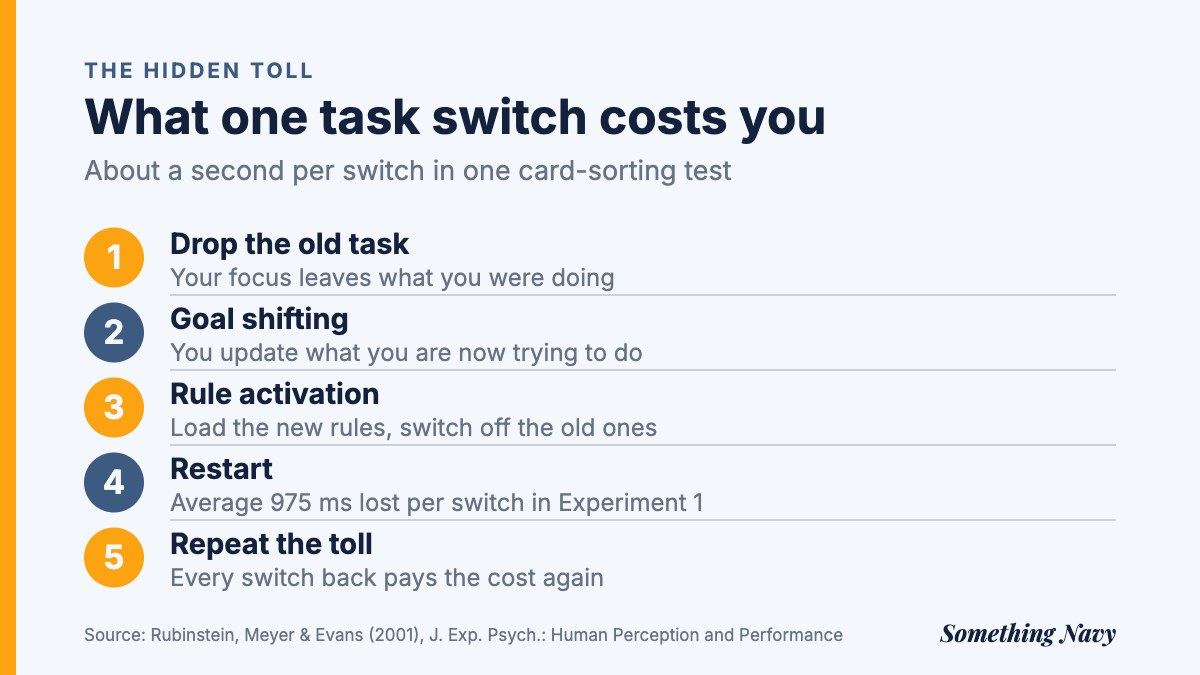
Switching always cost time. In the first experiment, in which 12 undergraduates sorted geometric patterns, the average cost was 975 milliseconds per switch, close to a full second each time the rule changed. The cost grew when the rules were more complex, and it was larger when people switched into an unfamiliar task than into a well-practised one.
Rubinstein and colleagues proposed that every switch involves two stages. First, “goal shifting”: you update in your head what you are now trying to do. Then “rule activation”: you load the rules for the new task and switch off the rules for the old one. A clear cue can help you get the first stage done in advance. The second has to happen each time.
A second here and there sounds trivial. You may have seen the claim, which the American Psychological Association attributes to Meyer, that these mental blocks can cost as much as 40% of someone’s productive time. Treat that as an informed estimate rather than a measured result; it does not come from the 2001 experiments, and the true figure will depend heavily on the work and the person.
The more reliable point is simpler. A switch is never free, and a morning of constant switching is a morning of paying the toll again and again.


10.30am: you knew the switch was coming, and it still cost you
A reasonable response is: fine, but I can plan for it. If I know I will check my inbox at half past, surely I can prepare?
Partly. Stephen Monsell, a cognitive psychologist at the University of Exeter, reviewed the field in a 2003 paper in Trends in Cognitive Sciences. Across many experiments, responses on a switch are slower and more error-prone than on a repeat. Giving people warning and time to get ready shrinks that cost. But in most studies it does not disappear. Researchers call what is left the residual switch cost.
There is also a broader price. When people work in blocks where switches might happen at any moment, they tend to be slower even on the trials where the task stays the same. Keeping two task sets on standby is itself a burden, a bit like holding a door open for someone who may or may not come through it.
If you have ever walked into the kitchen and forgotten why you went there, you know a cousin of this feeling. Our piece on why walking through doorways makes you forget explores how shifts in context reshuffle what the mind keeps to hand.
11.15am: the meeting with the laptop open
The weekly meeting begins. Your laptop is open “to take notes”. Slack is open too. Your phone is face up on the table. You are, in the jargon, a media multitasker: using several streams of media at once.
In 2009, Eyal Ophir, Clifford Nass and Anthony Wagner at Stanford University asked whether people who do this habitually get better at it. They used a questionnaire, the Media Multitasking Index, to estimate how often students used several media at once. Those far above average were classed as heavy media multitaskers, those far below as light ones. Then the groups were tested in the lab.
The researchers expected the heavy multitaskers to be skilled at something. They were not. In the study, published in PNAS, heavy multitaskers were more thrown by irrelevant items on screen, made more false alarms on a memory task, and were slower to switch between tasks, which was the very thing they did all day.
“They’re suckers for irrelevancy,” Nass told Stanford’s news service. “Everything distracts them.” Ophir’s summary was just as blunt: “We kept looking for what they’re better at, and we didn’t find it.”
We kept looking for what they’re better at, and we didn’t find it.
Eyal Ophir, Stanford University, 2009
It was a striking result, and it travelled fast. But the groups were small, around 15 to 22 people each across the experiments, and the design could not say which way the arrow pointed. Perhaps heavy media use weakens focus. Or perhaps people who are already easily distracted are drawn to juggling screens.
12.40pm: lunch, and a decade of second looks
Over a sandwich you scroll through three apps and a podcast. Is this slowly rewiring your attention? Science, sensibly, went back to check.
At the University of Groningen, Wisnu Wiradhany and Mark Nieuwenstein ran two replication studies, one with students in Indonesia and one in the Netherlands, repeating several of the original tasks. They published the results, alongside a meta-analysis, in Attention, Perception, & Psychophysics in 2017.
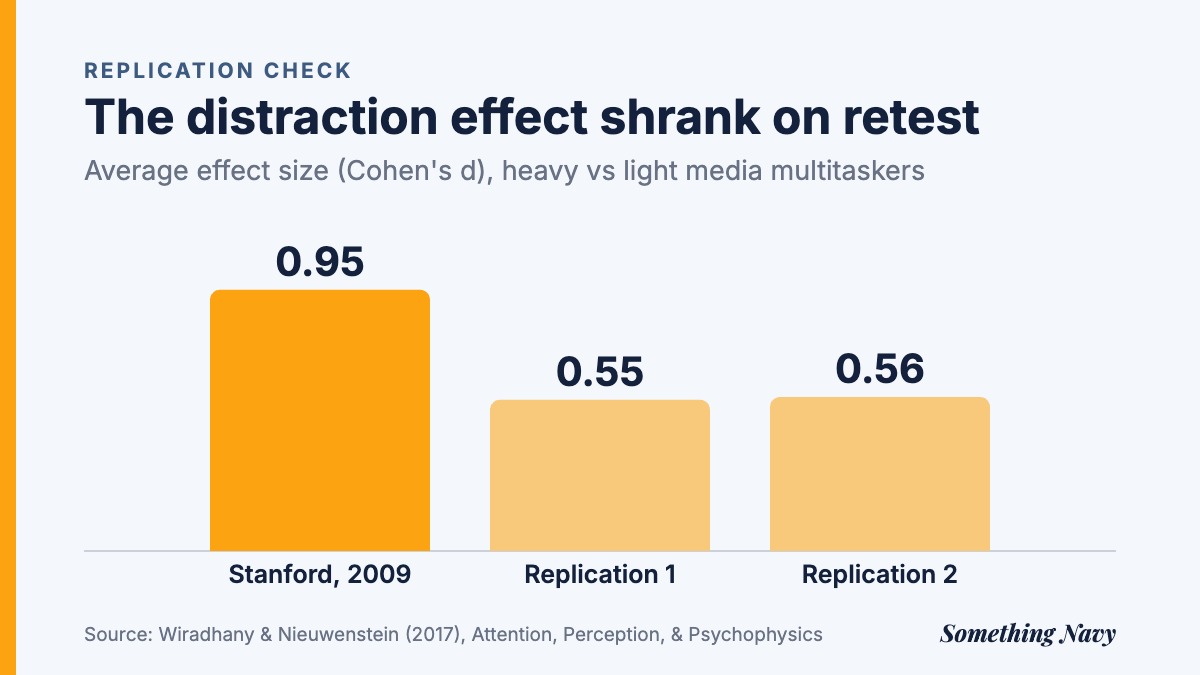
Their two experiments included 14 statistical tests. Only five showed a significant difference in the direction Ophir’s team had reported. The effects pointed the same way, but they were much smaller: an average effect size (Cohen’s d) of 0.55 and 0.56 in the two new studies, against 0.95 in the original work.
Their meta-analysis pooled 39 effect sizes from published studies and their own. It found a weak but significant association between media multitasking and distractibility, which became non-significant once they corrected for the tendency of small studies to report inflated effects. The authors wrote that the findings led them to question whether the association exists at all, at least in laboratory tests of this kind.
This is what healthy science looks like. A vivid first result, then a more cautious picture once more people have looked. It does not mean juggling media is harmless. It means the strong version of the story, that screens are visibly breaking our brains, is not well supported.
3.30pm: the slump, and what the brain data actually say
Mid-afternoon. The report is still not finished and you have read the same paragraph twice. You check your phone without deciding to.
In 2018, Melina Uncapher of the University of California, San Francisco, and Anthony Wagner, one of the original Stanford authors, reviewed roughly a decade of work in a PNAS review. Their reading was more nuanced than either the headlines or the sceptics.
In about half of the studies, heavy media multitaskers did significantly worse on tests of working memory and sustained attention. In the other half there was no significant difference. Crucially, Wagner said, no published paper had found that heavier multitaskers had better working memory.
The pair suggested a specific explanation: heavy multitaskers may have more frequent lapses of attention. That fits an odd pattern in the data, where they sometimes struggled more on easy, low-demand tasks than on hard ones, the kind of moment when a mind is most likely to wander. It also fits the feeling of a 3.30pm slump.
Wagner was careful about cause and effect. “I would never tell anyone that the data unambiguously show that media multitasking causes a change in attention and memory,” he told Stanford Report. The honest position is a correlation worth taking seriously, not a proven harm.
Something smaller is easier to act on. Even an idle phone on the desk seems to tug at us, which we look at in our piece on whether a phone nearby drains your brainpower.
5.45pm: the drive home, and the 1 in 40
Back in the car. Another call. And here the story takes its most interesting turn.
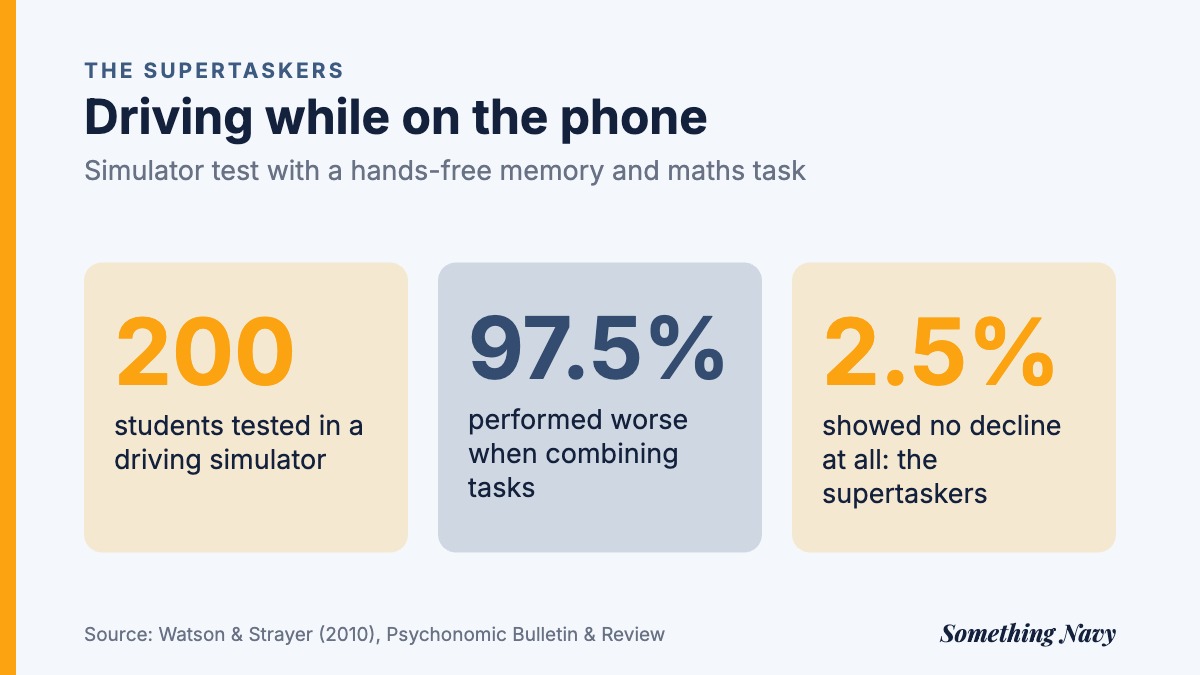
In 2010, Jason Watson and David Strayer at the University of Utah tested 200 undergraduates in a high-fidelity driving simulator. Each did two things separately and then together: drive behind a braking lead car, and complete a demanding auditory memory test called OSPAN, in which you solve simple maths problems while remembering a list of words. In the combined condition, the test came through a hands-free phone.
For most people, the result was predictable. Their driving got worse and so did their memory scores. Reporting on the study, Time noted that most participants took about 20% longer to brake while on the phone.
But five people, 2.5% of the sample, showed no decline at all on any measure. The researchers called them supertaskers. They were not people who had coasted on easy settings: in the single-task conditions they already scored in the top quarter on every driving and memory measure. Simulations suggested that this many flawless performers was unlikely to be a statistical fluke.
The findings, published in Psychonomic Bulletin & Review, come with real caveats. Five people is a tiny group. The tasks were specific, and nobody yet knows how well the ability carries over to an open-plan office or a family kitchen.
And there is a catch worth keeping in mind on the drive home. Most of us cannot tell which group we are in. “Most of us are in the 97.5% who will be impaired when we talk and drive,” Watson told Time. The feeling of being in control is not evidence that you are.


7.30pm: two screens on the sofa
Evening. A series on the television, your phone in your hand, a half-read article in another tab. Nothing much is at stake, and that matters.
The research does not say that doing two things at once is always a mistake. Some combinations interfere very little: walking and chatting, folding laundry and listening to the radio. The trouble comes when two tasks draw on the same mental resources, especially language and working memory, or when one of them is dangerous to get wrong.
Listening to a podcast while washing up is fine. Holding a conversation while merging onto a motorway is not. Writing an email during a meeting means you are, in effect, half-attending to both, and the switch cost lands on the one you care more about.
It is also worth noticing what the unfinished report does to your evening. Half-done tasks have a way of nagging, a phenomenon psychologists have studied for nearly a century, as we explain in our piece on the Zeigarnik effect.
What a better day looks like
None of this calls for a monastic life. The aim is simply to pay the switching toll less often, and on purpose.
How to batch your day
- Group like with like. Answer emails in two or three set windows rather than as they arrive. Switching between similar tasks is cheaper than switching between different ones.
- Protect one deep block. Give your hardest task 60 to 90 minutes with notifications off and the inbox closed, ideally when you are most alert.
- Leave a cue for your return. When you must stop, jot down the next step. It does some of the “goal shifting” in advance and makes restarting quicker.
- Put the phone out of sight. Not face down on the desk; in a drawer or another room.
- Make driving single-task. Hands-free does not remove the risk. Let calls go to voicemail and ring back once you have parked.
- Pair only easy with easy. Podcasts with chores are fine. Two tasks that both need words or memory are not.
The deeper message from 25 years of research is almost reassuring. If multitasking feels draining, that is not a personal failing. It is how attention works for 39 people in 40. The five Utah volunteers who sailed through without a single slip are fascinating precisely because they are so rare.
For the rest of us, the most productive thing to do with two tasks may be the oldest advice of all. Pick one. Finish it. Then pick up the other.
Sources
- Monsell, S. (2003). Task switching. Trends in Cognitive Sciences, 7(3), 134–140. DOI
- Ophir, E., Nass, C., & Wagner, A. D. (2009). Cognitive control in media multitaskers. Proceedings of the National Academy of Sciences, 106(37), 15583–15587. DOI
- Rubinstein, J. S., Meyer, D. E., & Evans, J. E. (2001). Executive control of cognitive processes in task switching. Journal of Experimental Psychology: Human Perception and Performance, 27(4), 763–797. DOI
- Strayer, D. L., Drews, F. A., & Crouch, D. J. (2006). A comparison of the cell phone driver and the drunk driver. Human Factors, 48(2), 381–391. DOI
- Uncapher, M. R., & Wagner, A. D. (2018). Minds and brains of media multitaskers: Current findings and future directions. Proceedings of the National Academy of Sciences, 115(40), 9889–9896. DOI
- Watson, J. M., & Strayer, D. L. (2010). Supertaskers: Profiles in extraordinary multitasking ability. Psychonomic Bulletin & Review, 17(4), 479–485. DOI
- Wiradhany, W., & Nieuwenstein, M. R. (2017). Cognitive control in media multitaskers: Two replication studies and a meta-analysis. Attention, Perception, & Psychophysics, 79(8), 2620–2641. DOI
Cover photo: Plann on Unsplash. Charts and graphics: Something Navy.
How we reported this. We went back to the original research for this story, 7 sources in all, listed above, and checked every figure against them. If you think we have got something wrong, tell us and we will look at it. Read more about how we work.