In the early hours of 13 March 1964, Catherine Genovese, known to everyone as Kitty, parked her car near her home in Kew Gardens, Queens. She was 28, managed a bar in Hollis, and had just finished a late shift. As she walked towards her apartment on Austin Street, a man named Winston Moseley attacked her with a knife.
She died of her wounds. Two weeks later, on 27 March, the New York Times ran a story by the reporter Martin Gansberg under the headline “37 Who Saw Murder Didn’t Call the Police”. The article itself put the number at 38: respectable, law-abiding neighbours who, it said, had watched from their windows for more than half an hour and done nothing.
That story became one of the most retold in modern psychology. It appears in textbooks, lectures, sermons and corporate training. It gave a name to a fear many of us carry: that if something terrible happened to us in a crowded place, everyone would simply watch.
The fear has some basis in science. The story it grew from has very little.
A murder that became a parable
It is worth pausing on who Kitty Genovese was before she became a symbol. She was a young woman with a job she was good at, friends, and a family who loved her. Her brother William spent years trying to understand what had really happened that night, work that became the documentary The Witness.
The “38 witnesses” version turned her death into a morality tale about urban apathy. In that telling, she was almost a prop: the victim whose suffering proved how cold city people had become. The real events are sadder in some ways and more human in others.
According to later accounts, the attack took place in two parts. A neighbour, Robert Mozer, shouted from his window during the first assault, and Moseley ran off. He returned some minutes later and found Genovese, badly injured, in a hallway at the back of her building, where he attacked her again. Few of the people who heard something that night could see that hallway at all.
What the later reporting found
Doubts about the Times account surfaced over the decades, but the most influential academic challenge came in 2007. Rachel Manning, Mark Levine and Alan Collins, psychologists then based in the UK, went back to the trial records and contemporary sources and published their analysis in American Psychologist, the flagship journal of the American Psychological Association.
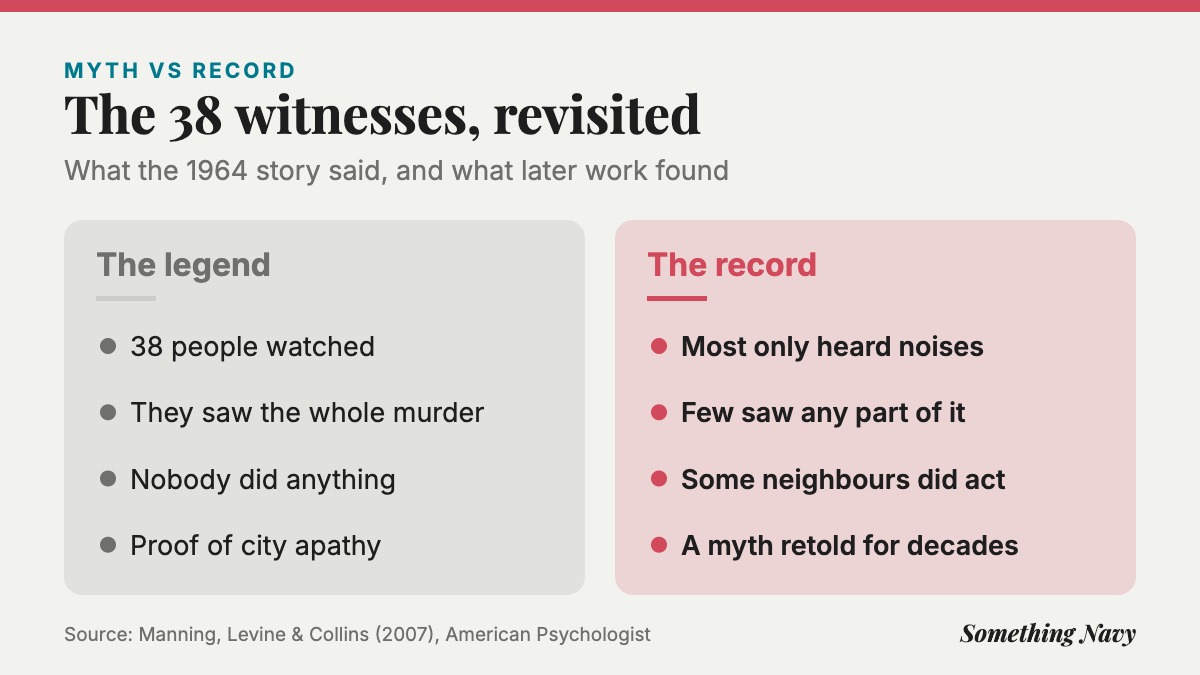
Their conclusion was blunt. They found no evidence that there were 38 witnesses, that the witnesses actually saw the murder, or that they all stayed inactive. Most people had heard noises or a cry in the night, and many could reasonably have taken it for a drunken quarrel outside a bar. Only a small number saw any part of the attack, and nobody saw all of it.
Some neighbours did act. Mozer shouted. According to later reporting, another neighbour, Sophia Farrar, went to Genovese after the second attack and held her as she lay dying. There are also accounts that police were called, though the details of who called, and when, remain disputed.
The Times itself has since revised the record. Its obituary of Moseley, who died in prison in 2016 at the age of 81, stated that the original article “grossly exaggerated the number of witnesses and what they had perceived.” An editor’s note now attached to the 1964 story online says later reporting has called significant elements of the account into question.
None of this makes the night less terrible. A woman was killed metres from her home, and at least one man who saw part of the attack did not intervene. But the story most people learned, of a crowd of spectators watching a murder like television, does not match the evidence.
Two psychologists and a seizure over the intercom
The odd thing is that the myth produced some genuinely good science. Two young social psychologists in New York, John Darley of New York University and Bibb Latané of Columbia University, were struck by the Genovese coverage. Rather than accept the explanation that New Yorkers were simply callous, they wondered whether the sheer number of witnesses might itself have been the problem.
In a study published in 1968 in the Journal of Personality and Social Psychology, they recruited 72 introductory psychology students at NYU. Each sat alone in a small room and took part in what they were told was a discussion about student life, conducted over an intercom so that nobody would feel embarrassed. In reality, the other voices were tape recordings.
Partway through, one “student” began to stammer and choke, describing what sounded like an epileptic seizure and asking for help. The question was simple: would the participant leave the room to find the experimenter?
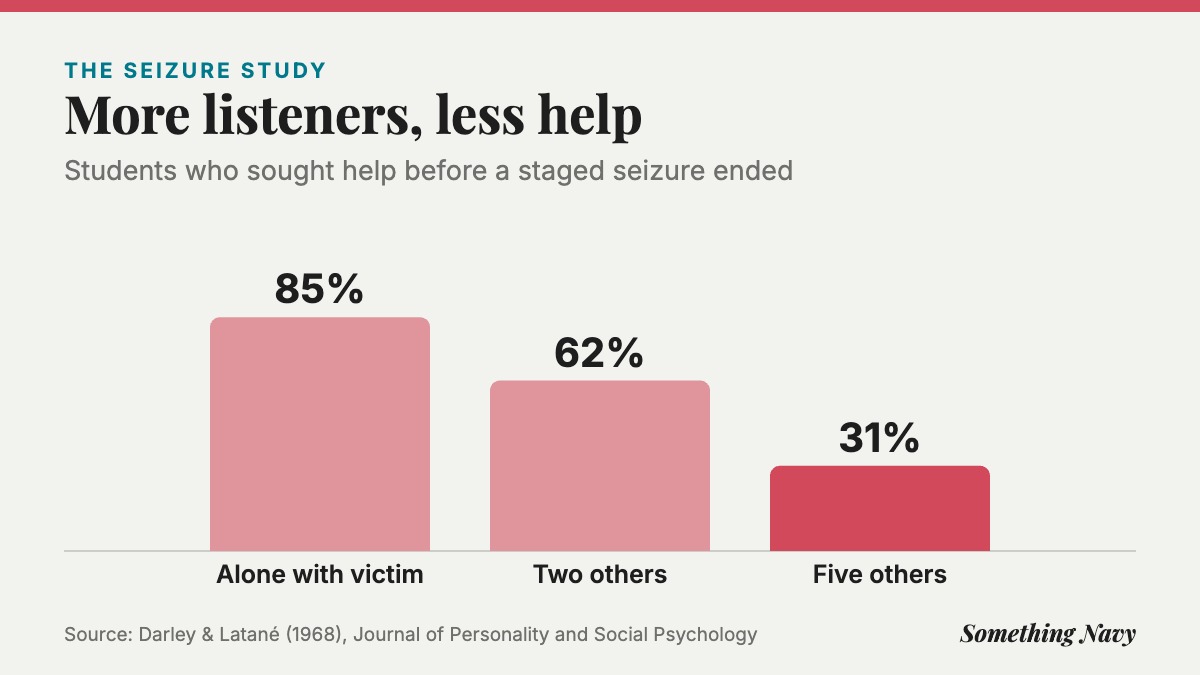
It depended on how many other people they believed were listening. Of those who thought they were the only other person on the call, 85% went for help before the seizure ended. When they believed there were two others, the figure fell to 62%. When they believed there were five others, it dropped to 31%.
Crucially, the students who stayed put did not look indifferent. Darley and Latané reported that many were visibly anxious, with trembling hands and sweating palms. They were not callous. They were stuck.
Smoke under the door
The same year, Latané and Darley ran a second, now famous experiment. Students at Columbia sat filling in a questionnaire in a waiting room when white smoke began to pour through a wall vent. Within a few minutes the room was thick enough with it to make seeing difficult.
Sitting alone, 75% of participants got up and reported the smoke. In groups of three genuine participants, people reported it in only 38% of groups. When a participant was seated with two actors instructed to ignore the smoke entirely, just 10% reported it. The rest kept coughing, rubbing their eyes and filling in forms.
Asked afterwards, the non-reporters had explanations ready. Perhaps it was steam, or air-conditioning vapour. Perhaps it was harmless. Seeing others stay calm, they concluded there was nothing to worry about, while those others were very likely doing exactly the same calculation.

Diffusion, ambiguity and the fear of looking foolish
From these and other studies, Latané and Darley built a model of helping as a series of hurdles. A bystander has to notice the event, interpret it as an emergency, decide it is their responsibility, work out what to do, and then actually do it. Fail at any step and help does not arrive.
Other people can trip us at several of those hurdles. The best known is diffusion of responsibility: when there are many potential helpers, each person’s share of the obligation feels smaller. If you are the only one who heard the cry, it is clearly up to you. If 20 people heard it, surely someone has already called.
The second is what psychologists call pluralistic ignorance. In an ambiguous situation, we look to others for clues. If everyone is quietly checking everyone else, and nobody wants to overreact, the group can talk itself into calm. The smoke study is the textbook case.
The third is plain social anxiety: the worry of making a scene over nothing. We tend to overestimate how closely others are judging us, a bias explored in our piece on the spotlight effect, and an emergency is a moment when that fear can cost precious time.
The meta-analysis that complicated the picture
By the 2000s there were dozens of bystander studies, and the question was how robust the effect really was. In 2011, a team led by the German psychologist Peter Fischer pooled them in a meta-analysis published in Psychological Bulletin. It combined 105 independent effect sizes from more than 7,700 participants.
The bystander effect was real. On average, the presence of others did reduce the likelihood that any individual would help. But the size of the effect depended heavily on the situation.
When an emergency was clearly dangerous, for instance when a perpetrator was present or a victim was obviously in serious trouble, the effect was weaker. In some of these dangerous situations, it disappeared altogether. Fischer and colleagues suggested that dangerous emergencies are recognised faster and less ambiguously, which raises arousal and makes helping more likely. Other bystanders can also become allies: someone to back you up, rather than someone to hide behind.
In other words, the classic effect is strongest in exactly the kinds of situations that the classic experiments created: ambiguous, low-stakes, among strangers who cannot talk to each other. It is weakest in the kind of violent, unmistakable emergency that the Genovese myth was supposed to illustrate.
What the cameras actually saw
Laboratory experiments can only tell us so much. People in a study know, at some level, that they are in a study. So in 2020 a team led by Richard Philpot of Lancaster University and the University of Copenhagen, working with Lasse Suonperä Liebst, Mark Levine, Wim Bernasco and Marie Rosenkrantz Lindegaard, looked at real life instead.
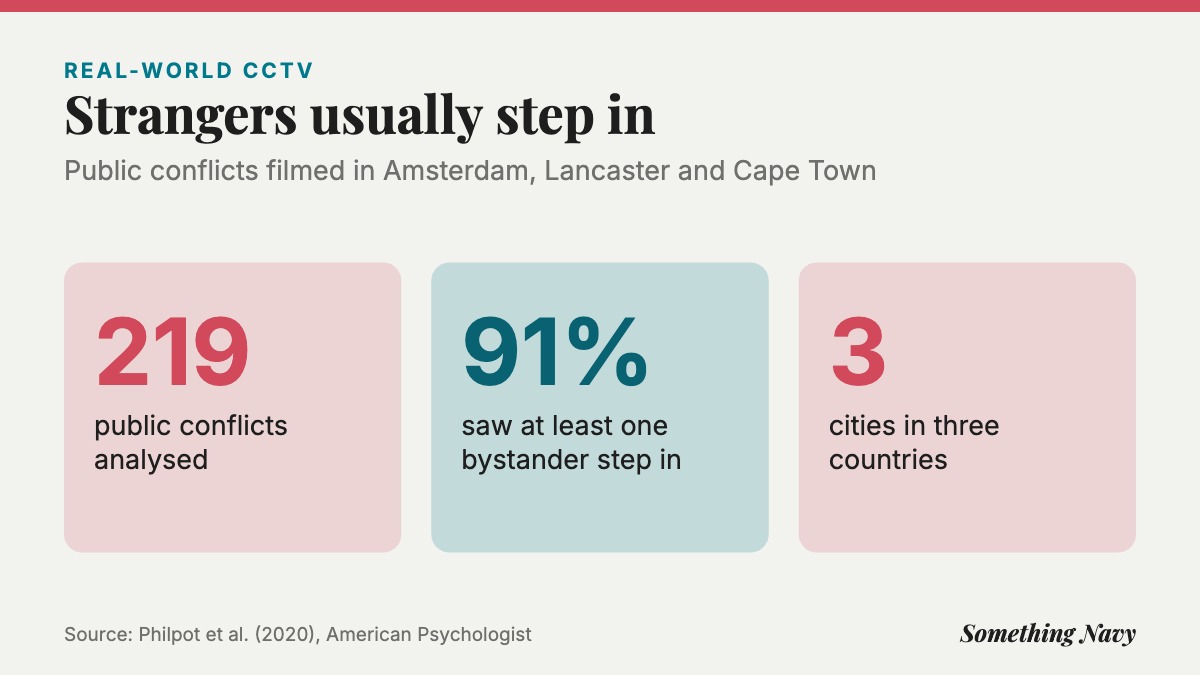
They analysed CCTV footage of 219 aggressive public conflicts, from arguments to physical assaults, recorded in city centres in Amsterdam in the Netherlands, Lancaster in the UK, and Cape Town in South Africa. Coders counted the bystanders and noted anyone who stepped in, whether by gesturing to calm things down, physically separating people, pulling an aggressor away or tending to someone who was hurt.
The results, published in American Psychologist, overturned the popular picture. In 91% of the conflicts, at least one bystander intervened, and usually several did. The pattern held across all three countries, despite their very different levels of perceived public safety.
And the number of bystanders worked in the opposite direction to the legend. The more people were present, the more likely it was that someone would help. “The fact that bystanders are much more active than we think is a positive and reassuring story,” Philpot said in a Lancaster University release.
How both findings can be true
At first glance this looks like a contradiction. Did the bystander effect fail to replicate? Not quite. The two lines of research are measuring different things.
The lab studies ask about the individual: if you are one of many, are you personally less likely to act? Often, yes. The CCTV study asks about the victim: will anyone help me? Because each extra bystander is another chance that somebody steps in, a slightly lower individual likelihood can still produce a higher overall chance of help. A crowd of hesitant people still contains a few who act.
The CCTV study has its own limits, which the authors acknowledge. Its definition of intervention was broad, including calming gestures and touches. The locations were nightlife districts where alcohol may have shaped behaviour. And as an observational study, it shows associations, not cause and effect. Still, it is the closest thing we have to watching what people really do when a fight breaks out in front of them.
So the honest summary is this. Group presence can make each of us hesitate, especially when a situation is unclear. But the image of the frozen crowd, watching passively while someone is hurt, describes neither the night Kitty Genovese died nor most public emergencies since.
Breaking the spell of the crowd
Understanding the mechanism is useful, because each part of it has a counter. If ambiguity is the problem, check. Ask the person directly: “Are you all right? Do you need help?” A clear answer removes the guesswork that keeps a group frozen.
If diffusion of responsibility is the problem, take the responsibility, or hand it to someone specific. First-aid training commonly teaches people to point at an individual and say, “You, in the blue coat, call an ambulance,” rather than shouting into a crowd. A named person is no longer one of many.
If the fear of embarrassment is the problem, remember that the downside of being wrong is usually small: an awkward moment, a polite “I’m fine, thanks”. The downside of being right and doing nothing can be enormous. Deciding in advance what you would do, a technique close to if-then planning, can shrink the hesitation when the moment comes.
If you witness an emergency
- Notice and check. If something looks wrong, ask the person directly whether they need help.
- Call the emergency services. In the UK dial 999 (or 112). Do not assume someone else has.
- Point and name. Give specific jobs to specific people: “You, call 999. You, find a defibrillator.”
- Keep yourself safe. If there is violence, you can still help from a distance by calling for help, alerting staff or getting others involved.
- Team up. Others are more likely to step in once one person has. Catch someone’s eye and act together.
- Stay with the person until help arrives, and tell responders what you saw.
Remembering Kitty Genovese well
For decades, a young woman’s death was used to teach the lesson that people do not care. The evidence now points to something different: that people often do care, but can be held back by confusion, by each other and by the stories they have absorbed about what crowds do.
The story of the 38 may even have made things worse, by teaching generations to expect apathy from strangers. Expectations shape behaviour. If you assume nobody will help, you may not bother asking, and if you assume everyone else is watching, you may not bother acting.
A better way to honour her is to replace the myth with the truer picture. In most real emergencies, someone steps forward. The most useful thing any of us can do is decide, before the moment arrives, that it will be us.
Frequently asked questions
Yes, in the sense that individuals in groups are often less likely to help, particularly in ambiguous or low-danger situations. But the effect is weaker in clearly dangerous emergencies, and in real public conflicts victims usually do receive help.
No. Later investigations found that most neighbours only heard parts of the attack, few saw any of it, and some did respond. The New York Times has acknowledged that its 1964 account exaggerated the number of witnesses and what they perceived.
It is the tendency to feel less personally obliged to act when other people could also help. Each witness assumes, often wrongly, that someone else has it in hand.
Single someone out. Make eye contact with one person, describe them (“you in the red jacket”) and tell them exactly what you need, such as calling an ambulance.
Sources
- Darley, J. M., & Latané, B. (1968). Bystander intervention in emergencies: Diffusion of responsibility. Journal of Personality and Social Psychology, 8(4), 377–383. DOI
- Latané, B., & Darley, J. M. (1968). Group inhibition of bystander intervention in emergencies. Journal of Personality and Social Psychology, 10(3), 215–221. DOI
- Manning, R., Levine, M., & Collins, A. (2007). The Kitty Genovese murder and the social psychology of helping: The parable of the 38 witnesses. American Psychologist, 62(6), 555–562. DOI
- Fischer, P., Krueger, J. I., Greitemeyer, T., Vogrincic, C., Kastenmüller, A., Frey, D., Heene, M., Wicher, M., & Kainbacher, M. (2011). The bystander-effect: A meta-analytic review on bystander intervention in dangerous and non-dangerous emergencies. Psychological Bulletin, 137(4), 517–537. DOI
- Philpot, R., Liebst, L. S., Levine, M., Bernasco, W., & Lindegaard, M. R. (2020). Would I be helped? Cross-national CCTV footage shows that intervention is the norm in public conflicts. American Psychologist, 75(1), 66–75. DOI
- Lancaster University. (2019). Bystanders will intervene to help victims of aggressive public disputes. Link
How we reported this. We went back to the original research for this story, 6 sources in all, listed above, and checked every figure against them. If you think we have got something wrong, tell us and we will look at it. Read more about how we work.
Cover photo: Christopher Burns on Unsplash. Charts and graphics: Something Navy.