
Your alarm goes off in the dark. It is January, the radiator ticked on an hour ago, and the window has been shut tight since October because who opens a window in January? You lie there, and the thought you are reaching for does not quite arrive.
You get up. Your head feels padded, as if stuffed with the duvet. The room’s air has a flat, used quality you only notice when you step onto the landing and the hallway feels cool and sharp.
By the time you have made coffee you feel more or less human. But the question lingers. Did you just spend eight hours breathing the same air back and forth, and does that do something to a brain?
Researchers have been asking almost exactly that, in sealed chambers, dorm rooms and mock offices. The answers are messier than the headline everyone remembers.
The Harvard study that made indoor CO2 famous
In November 2014, 24 office workers spent six working days in a specially built lab at the Syracuse Center of Excellence in New York state. Architects, programmers, engineers and managers did their normal jobs from nine to five, Tuesday to Thursday, over two weeks. The air was quietly altered each day, and neither the workers nor the people scoring their tests knew how.
The study, led by Joseph Allen of the Harvard T.H. Chan School of Public Health with colleagues from SUNY Upstate Medical University and Syracuse University, was published in Environmental Health Perspectives (online in 2015, in print in 2016). Known as the COGfx study, it sits behind many of the “stuffy rooms make you stupid” headlines since.
What the researchers changed
On a “Conventional” day, the room got 20 cubic feet per minute of outdoor air per person, and the team hid sources of volatile organic compounds (VOCs), the chemicals given off by building materials, adhesives, cleaning products and office supplies, inside the floor vents. VOC levels were set around the limit allowed by the LEED green building standard. On a “Green” day, the ventilation stayed at 20 cubic feet per minute but the VOCs were removed. On “Green+” days, outdoor air was doubled to 40 cubic feet per minute and VOCs stayed low.
On two further days the team kept 40 cubic feet per minute of fresh air but raised carbon dioxide alone, to about 945 ppm on one day and about 1,400 ppm on another. (ppm means parts per million. Outdoor air is now a little above 420 ppm, according to NOAA’s figure for 2024.)
Each afternoon the workers sat the Strategic Management Simulation, a computer-based test that scores nine areas of higher-level thinking, from crisis response to strategy.
The 61% and 101% results
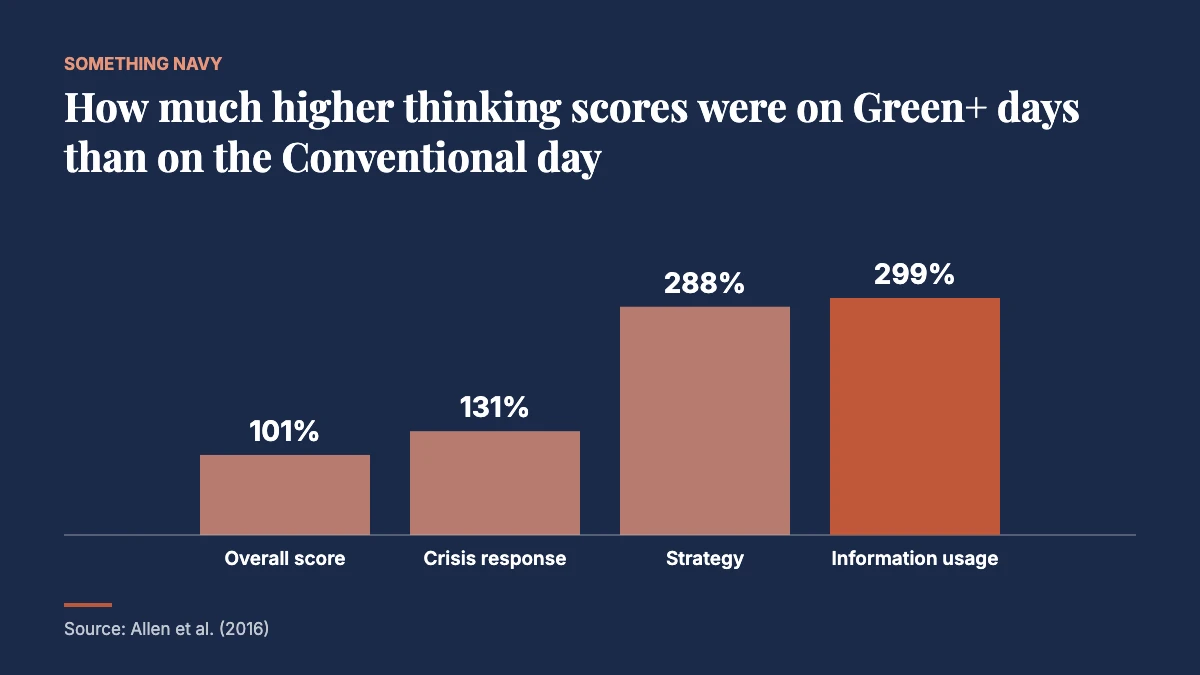
Compared with the Conventional day, average cognitive scores were 61% higher on the Green day and 101% higher on the Green+ days. Under Green+ conditions every one of the nine areas was significantly better. Some areas moved further still: information usage scores were 299% higher under Green+ and strategy scores 288% higher.
Carbon dioxide alone also appeared to matter. At about 945 ppm, scores were roughly 15% lower than on Green+ days; at about 1,400 ppm, roughly 50% lower. The researchers estimated that each 400 ppm rise in CO2 went with a drop of about 21%.
Why the numbers need a pinch of salt
The design was careful: double-blind, the same people under every condition, and parallel versions of the test so nobody could learn the answers. But 24 people is a small group, tested over six days in one building. The work was funded by a gift from United Technologies to Harvard’s Center for Health and the Global Environment; the paper says the company had limited input on design and no role in the analysis.
There is a subtler point too. The Strategic Management Simulation is an unusual, demanding test, and a 101% rise in a simulation score is not the same as becoming twice as clever at your desk.
The 2012 experiment linking pure CO2 to poorer decisions
COGfx did not come from nowhere. In 2012, Usha Satish of SUNY Upstate Medical University and William Fisk’s team at Lawrence Berkeley National Laboratory published a smaller study in the same journal, with a provocative title: “Is CO2 an Indoor Pollutant?”
Twenty-two participants, mostly university students, worked in groups of four in a test chamber. Each sat three two-and-a-half-hour sessions in one day. The researchers held temperature and ventilation steady and injected ultrapure CO2 into the incoming air to reach 600, 1,000 or 2,500 ppm.
At 1,000 ppm, six of the nine decision-making scales dropped significantly compared with 600 ppm, by between 11% and 23%. At 2,500 ppm, seven of nine fell, by between 44% and 94%. The authors suggested the effects could be economically important, but were candid about how much one experiment could carry: “Confirmation of these findings is needed.”
That caveat turned out to matter.
The contrary evidence: when pure CO2 did nothing
The intuitive story is that CO2 builds up in a closed room and the gas itself fogs the brain. The trouble is that we release far more than carbon dioxide. Human bodies give off a cocktail of other compounds too, which researchers call bioeffluents. In a real room, CO2 and bioeffluents rise together. So which one is doing the damage?
Separating CO2 from everything else we exhale
A group at the Technical University of Denmark (DTU) and Shanghai Jiao Tong University set out to pull the two apart. In a paper published in Indoor Air in 2017, Xiaojing Zhang, Pawel Wargocki, Zhiwei Lian and Camilla Thyregod exposed the same 25 people to five conditions, each lasting 255 minutes.
The baseline had plenty of fresh air and CO2 at 500 ppm. In two conditions the fresh air stayed high, so bioeffluents were removed, but the team added chemically pure CO2 to reach 1,000 or 3,000 ppm. In the other two they reduced the outdoor air supply and let the occupants’ own exhaled CO2 and bioeffluents build up to the same levels.
Adding pure CO2, even to 3,000 ppm, had no statistically significant effect on how people rated the air, on their symptoms or on their thinking. When the room reached 3,000 ppm through reduced ventilation, people judged the air worse, reported more headache, fatigue, sleepiness and difficulty thinking clearly, and did worse on some tasks, including mental addition.
What people were reacting to was not CO2 itself but the stale-air package that comes with it.
5,000 ppm and still no effect
An earlier, smaller study by Zhang and colleagues went further. Didong Chen of UCL’s Institute for Environmental Design and Engineering, summarising the evidence in the REHVA Journal in 2025, describes it as exposing 10 students to 500 and 5,000 ppm of CO2 for two and a half hours, with no effect on speed or accuracy in typing, addition or a reasoning test. Five thousand ppm is a common occupational exposure limit, and well above anything a home normally reaches.
A UCL replication with 69 students
Chen’s own work, published with Gesche Huebner, Emmanouil Bagkeris, Marcella Ucci and Dejan Mumovic in Building and Environment in 2023, is one of the larger recent tests. Sixty-nine healthy university students each spent 70 minutes alone in a chamber on three separate occasions, at 600, 1,500 and 2,100 ppm. The ventilation rate stayed fixed and high; only pure CO2 changed.
Across ten standard tests, accuracy did not differ on any. On two, students actually responded faster at higher CO2, which the authors suspect reflects slightly raised alertness or a fluke of multiple comparisons. Their conclusion: no clear link between pure CO2 below 2,100 ppm and thinking.
The team listed honest limits: 70 minutes may be too short, the test battery was designed mainly to detect toxic exposures rather than complex judgement, and students in their mid-twenties are not everyone.
Why the studies disagree, according to the reviews
In 2020, Bowen Du, Marlie Tandoc, Michael Mack and Jeffrey Siegel reviewed 37 experiments in Indoor Air that had manipulated CO2, by adding the pure gas or changing ventilation, and measured thinking objectively.
When they looked only at the strongest, most consistent studies, pure CO2 at typical indoor levels affected just one thing: high-level decision-making in people who were not specialists, as measured by the Strategic Management Simulation. Lower ventilation, with all the pollutants that build up alongside CO2, tended to slow various kinds of thinking down without making people less accurate. Inconsistent methods, differing participants and uncertain doses, they wrote, limit what anyone can conclude.
That helps explain the puzzle. Both Satish’s and Allen’s dramatic results came from the same unusual decision-making test. The Danish and UCL studies, which found little or nothing from pure CO2, used more conventional tasks such as addition, typing and attention tests. Perhaps pure CO2 nudges a narrow kind of complex judgement; perhaps the early results were inflated by small samples. The evidence cannot yet say which.
What every camp accepts is the practical bit: poor ventilation is bad news, whether CO2 is the culprit or the messenger.
| Study | Who and how long | What changed | What they found |
|---|---|---|---|
| Satish et al. (2012) | 22 adults, 2.5 hours per condition | Pure CO2 at 600, 1,000 and 2,500 ppm | Decision-making scores fell at 1,000 and 2,500 ppm |
| Allen et al. (2016) | 24 office workers, six full workdays | Ventilation, VOCs, and CO2 at about 945 and 1,400 ppm | Scores 61% and 101% higher in Green and Green+ conditions |
| Zhang et al. (2017) | 25 adults, 255 minutes per condition | Pure CO2 vs stale-air CO2, each at 1,000 and 3,000 ppm | Pure CO2 had no effect; stale air at 3,000 ppm worsened symptoms and some tasks |
| Chen et al. (2023) | 69 students, 70 minutes per condition | Pure CO2 at 600, 1,500 and 2,100 ppm | No loss of accuracy; slightly faster on two of ten tests |
| Kang et al. (2024) | 32 young adults, two nights per condition | Bedroom ventilation giving about 770, 1,020 and 1,300 ppm | Lower sleep efficiency and more time awake at about 1,000 ppm and above |
Bedroom CO2 and sleep: the overnight evidence
Back to that foggy winter morning. A shut bedroom is an ideal place for stale air to pile up: one or two people, a small room, eight hours, no draught. Here the research points more consistently in one direction.
The Danish dorm-room experiments
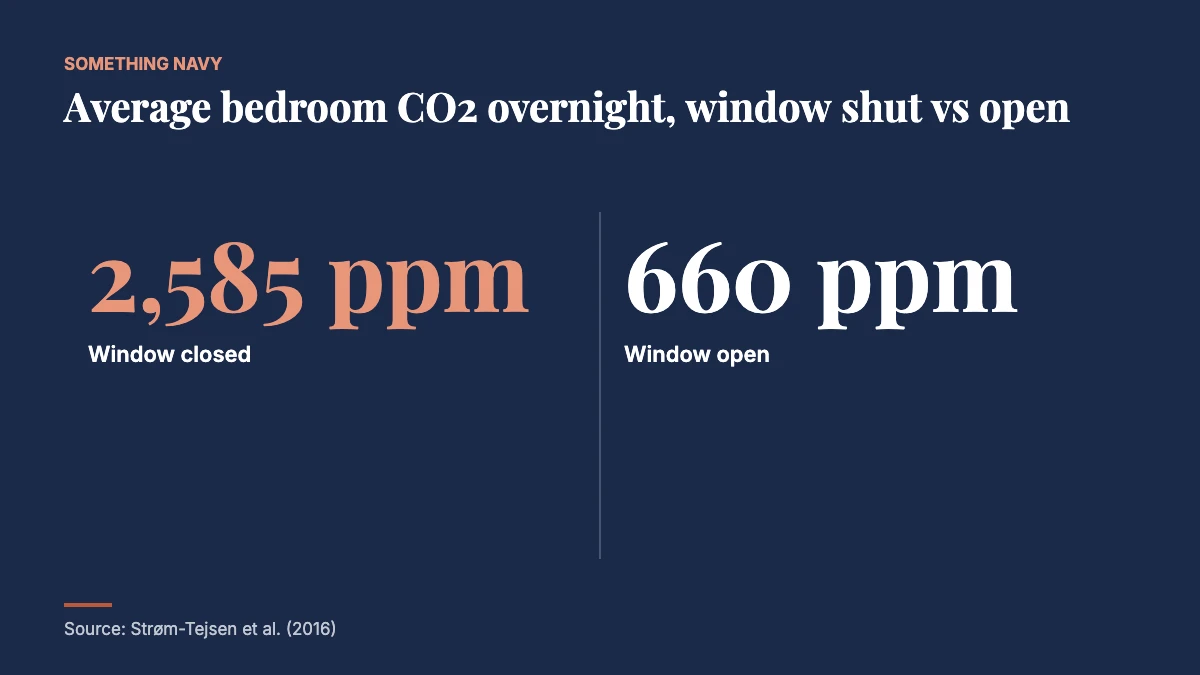
In 2016, a DTU team of P. Strøm-Tejsen, D. Zukowska, Pawel Wargocki and David Wyon published two field experiments in Indoor Air, run in identical single-occupancy student rooms. In a pilot, 14 students with usable data slept for a week with the window open and a week with it shut. With the window closed, average CO2 overnight was 2,585 ppm. With it open, 660 ppm.
In the main experiment, 16 students from 12 countries slept in rooms where a fan brought in outdoor air whenever CO2 climbed above roughly 900 ppm, or stayed off all night. Students were not told about the change. Average CO2 was 835 ppm with the fan on and 2,395 ppm with it off.
Wrist sensors showed people fell asleep faster with the window open, and spent more of their time in bed asleep with the fan on. Taken across both experiments, the fresher nights brought better sleep as measured by the wrist sensors, fresher-feeling air, and students who reported less next-day sleepiness and a better ability to concentrate. Logical reasoning scores edged up too, though only slightly: median scores of 13.4 against 13.0 in the pilot, and 14.3 against 14.0 in the main study. A second test showed no difference.
These were small groups and only a week per condition, so the size of the benefit is uncertain, but the direction was consistent.
A 2024 lab study at 1,000 ppm
A team from Shanghai Jiao Tong University and DTU, led by Mengyuan Kang and Li Lan, tested this more precisely in a simulated bedroom, reporting in Building and Environment in 2024. Thirty-two healthy adults aged 18 to 33 each spent seven nights in the lab: one to settle in, then two nights at each of three ventilation rates. Temperature was held at 20°C. Average CO2 levels came out at 771, 1,021 and 1,305 ppm.
Compared with the best-ventilated nights, sleep efficiency fell from 87.2% to 85.9% at around 1,000 ppm and to 85.4% at around 1,300 ppm. Time spent awake during the night rose from 60.9 minutes to 65.9 and 68.7 minutes. At the highest level, deep sleep was 76.7 minutes against 83.4 on the freshest nights.
These are modest changes. Participants did not report sleeping worse, and next-day test scores did not differ by condition, although individuals who slept less well tended to perform less well. The researchers still argued that bedroom standards should keep CO2 below 1,000 ppm, while noting that they studied only young, healthy sleepers and did not measure other pollutants.
(If your afternoons are the weak spot rather than your mornings, our guide to how long a nap should be picks up where this leaves off.)
A 2025 review proposes a bedroom target
The most recent synthesis appeared in 2025. Mizuho Akimoto of Waseda University, working with Wargocki, Lan, Wyon and others on a project sponsored by ASHRAE, reviewed 17 studies covering 22 experimental datasets in Science and Technology for the Built Environment.
Sleep was disturbed once ventilation was low enough for CO2 to reach 1,000 ppm. The highest level with no apparent effect was 850 ppm, though the authors declined to call this a safe threshold, citing sensor accuracy and the need for a safety margin. They proposed a bedroom target of 800 ppm or below, treating CO2 as a marker of how much fresh air the room is getting rather than as a poison in itself. Keeping to that target would need about 8 litres of outdoor air per second per person, which is at least double what many current residential standards prescribe.
Akimoto put it plainly in Waseda’s press release: current minimum rates “may provide inadequate ventilation for bedrooms”.

What this means for your home
So, does stuffy air make you think worse? Breathing in pure carbon dioxide at the levels found in homes probably does little to your everyday thinking, and the dramatic early figures have not held up well when CO2 was isolated. But a room stuffy enough to reach high CO2 is also full of everything else people and homes give off, and that combination has been linked to headaches, sleepiness and, in bedrooms, slightly poorer sleep.
Think of CO2 as a smoke alarm for stale air rather than the fire itself, and a cheap one to read.
Using a CO2 monitor sensibly
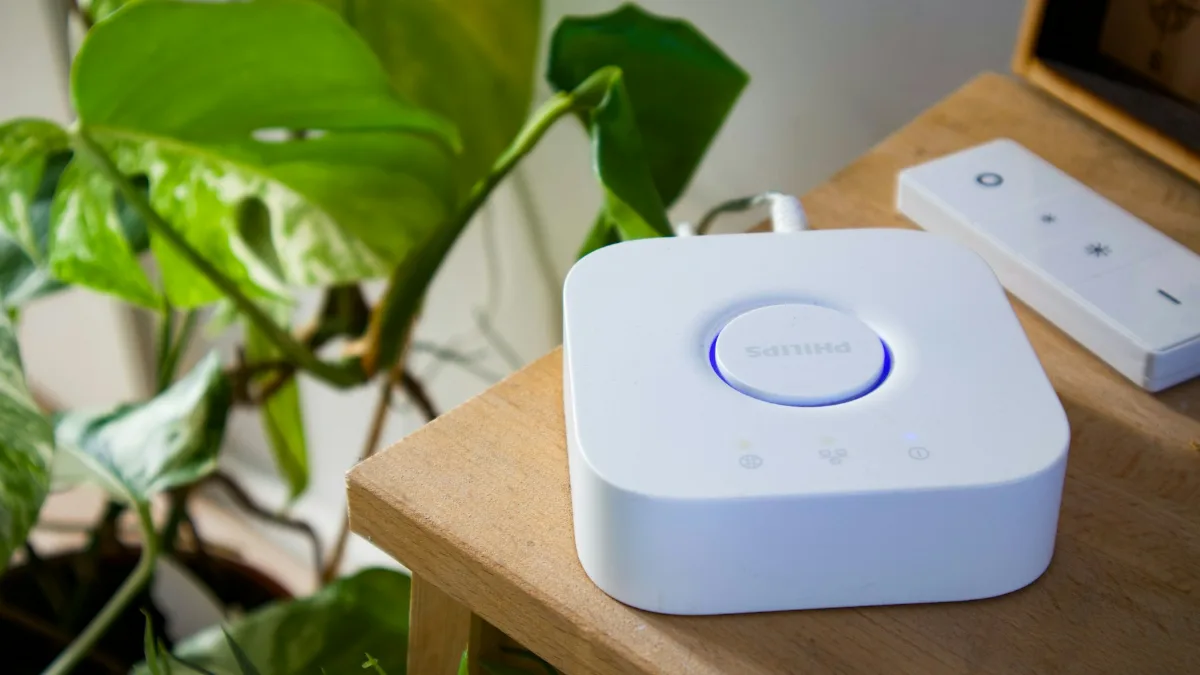
Britain’s Health and Safety Executive, writing about workplaces, recommends monitors that use NDIR (non-dispersive infrared) sensors, and suggests placing them at head height, away from windows, doors and vents, and more than 50 cm from people, because breath directly on the sensor inflates the reading. The HSE treats CO2 consistently above 1,500 ppm in an occupied room as a sign of poor ventilation, and stresses that readings are a broad guide rather than proof that a room is safe.
For bedrooms, the 2025 review’s 800 ppm target is a useful aspiration, even if few homes hit it every winter night. A monitor’s real value is showing patterns: how fast the room climbs after you close the door, and how much a cracked window pulls it back.
Small changes that make a difference
Most effective fixes are dull and free. Open the window wide for a few minutes when you get up. Leave trickle vents (the slotted vents built into many window frames) open, even in winter. If two people share a small bedroom, see whether a window can stay open a crack overnight, as in the Danish experiments.
None of this needs to make a room feel bleak. Much of what makes a room feel cosy comes from light, texture and warmth, and a short burst of fresh air does not undo any of it. And if it is your workplace that leaves you foggy, our look at open-plan offices is another reminder that buildings shape how we think.
Home ventilation checklist
- Open bedroom windows fully for a few minutes each morning to flush out overnight air
- Keep trickle vents open year-round, and vacuum them if they are clogged with dust
- Use extractor fans while cooking and showering, and for a while afterwards
- Try a window open a crack or the bedroom door ajar overnight, especially when sharing a room
- If you buy a CO2 monitor, choose an NDIR sensor and place it at head height, away from windows and your pillow
- Treat readings as a pattern to learn from, not a pass or fail score

The honest bottom line on indoor air and thinking
Allen’s COGfx experiment is real and carefully done, but its biggest numbers came from 24 people, one building and one unusual test. Experiments that isolated carbon dioxide, in Denmark and at UCL, mostly found no harm from the gas alone. The reviews land in the middle: CO2 by itself is probably a minor player, stale air as a whole is not, and sleep may be where it shows up most.
That foggy winter morning has many possible causes, from a late night to a cold coming on. A sealed bedroom might be one of them. Opening the window costs nothing, and it is one of the easiest explanations to test.
Frequently asked questions
Outdoor air is now a little above 420 ppm. HSE guidance treats readings consistently above 1,500 ppm in an occupied room as a sign of poor ventilation, and a 2025 review proposed 800 ppm or below as a target for bedrooms.
The evidence is mixed. Early studies using a complex decision-making test found drops at 1,000 ppm, but some later experiments that added pure CO2 while keeping the air otherwise fresh found no effect, even at 3,000 to 5,000 ppm.
Small studies in student rooms and a 2024 lab study found slightly better sleep efficiency and less time awake with better bedroom ventilation. The effects were modest, and noise, cold or outdoor pollution may outweigh them in some homes.
Official links and research
- Akimoto, M., Fan, X., Lan, L., Sekhar, C., Tanabe, S., Wyon, D. P., & Wargocki, P. (2025). New research on bedroom ventilation and sleep quality suggests that building standards should be revisited (ASHRAE 1837-RP). Science and Technology for the Built Environment, 31(8), 905-916. DOI
- Allen, J. G., MacNaughton, P., Satish, U., Santanam, S., Vallarino, J., & Spengler, J. D. (2016). Associations of cognitive function scores with carbon dioxide, ventilation, and volatile organic compound exposures in office workers: A controlled exposure study of green and conventional office environments. Environmental Health Perspectives, 124(6), 805-812. DOI
- Chen, D. (2025). Direct impact of short-term exposure to pure carbon dioxide levels on cognitive performance. REHVA Journal, (3), 26-31. Link
- Chen, D., Huebner, G., Bagkeris, E., Ucci, M., & Mumovic, D. (2023). Effects of short-term exposure to moderate pure carbon dioxide levels on cognitive performance, health symptoms and perceived indoor environment quality. Building and Environment, 245, Article 110967. DOI
- Du, B., Tandoc, M. C., Mack, M. L., & Siegel, J. A. (2020). Indoor CO2 concentrations and cognitive function: A critical review. Indoor Air, 30(6), 1067-1082. DOI
- Health and Safety Executive. (n.d.). Ventilation in the workplace: Using CO2 monitors. HSE
- Kang, M., Yan, Y., Guo, C., Liu, Y., Fan, X., Wargocki, P., & Lan, L. (2024). Ventilation causing an average CO2 concentration of 1,000 ppm negatively affects sleep: A field-lab study on healthy young people. Building and Environment, 249, Article 111118. DOI
- Satish, U., Mendell, M. J., Shekhar, K., Hotchi, T., Sullivan, D., Streufert, S., & Fisk, W. J. (2012). Is CO2 an indoor pollutant? Direct effects of low-to-moderate CO2 concentrations on human decision-making performance. Environmental Health Perspectives, 120(12), 1671-1677. DOI
- Strøm-Tejsen, P., Zukowska, D., Wargocki, P., & Wyon, D. P. (2016). The effects of bedroom air quality on sleep and next-day performance. Indoor Air, 26(5), 679-686. DOI
- Zhang, X., Wargocki, P., Lian, Z., & Thyregod, C. (2017). Effects of exposure to carbon dioxide and bioeffluents on perceived air quality, self-assessed acute health symptoms, and cognitive performance. Indoor Air, 27(1), 47-64. DOI
Cover photo: Tom Paolini on Unsplash. Charts and graphics: Something Navy, with photography by James Sestric and User_Pascal on Unsplash.
How we reported this. Every figure was checked against the 10 sources above. Reviewed by Valentino Adkins, Senior Content Manager. Report an error · How we work