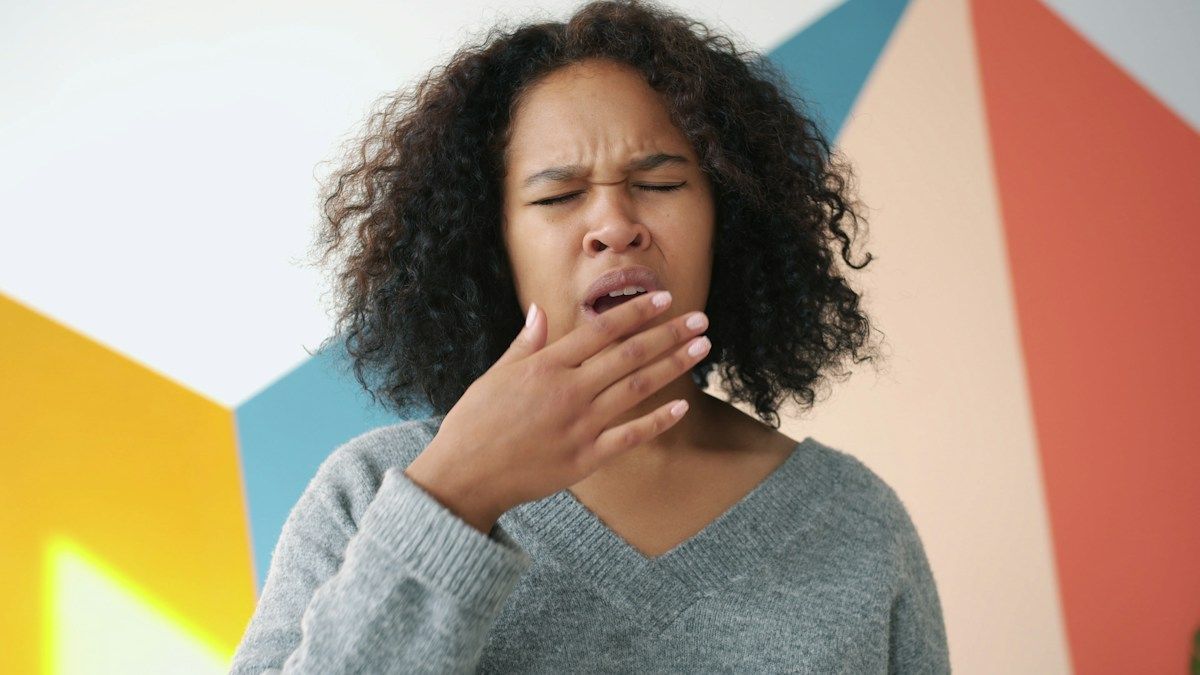
Somebody across the train carriage stretches their jaw wide, eyes squeezed shut, and lets out that long, shuddering breath. Two seconds later your own throat tightens and you feel it coming.
You try to stop it. You clamp your teeth. It escapes anyway, sideways, behind your hand.
Here is the odd part. You do not need to see anyone at all. Psychologists have shown that simply reading about yawning is enough to set some people off, which means this article is, technically, a hazard.
If you have yawned already, you are in excellent scientific company. Keep going: we will try to explain what just happened to you.
The yawn that jumps off the page
Much of what we know about catching yawns traces back to Robert Provine, a neuroscientist at the University of Maryland, Baltimore County, who spent decades studying behaviours most of his colleagues considered too ordinary to bother with. He called yawning a window into the social brain, and he tested it with the simplest tools available.
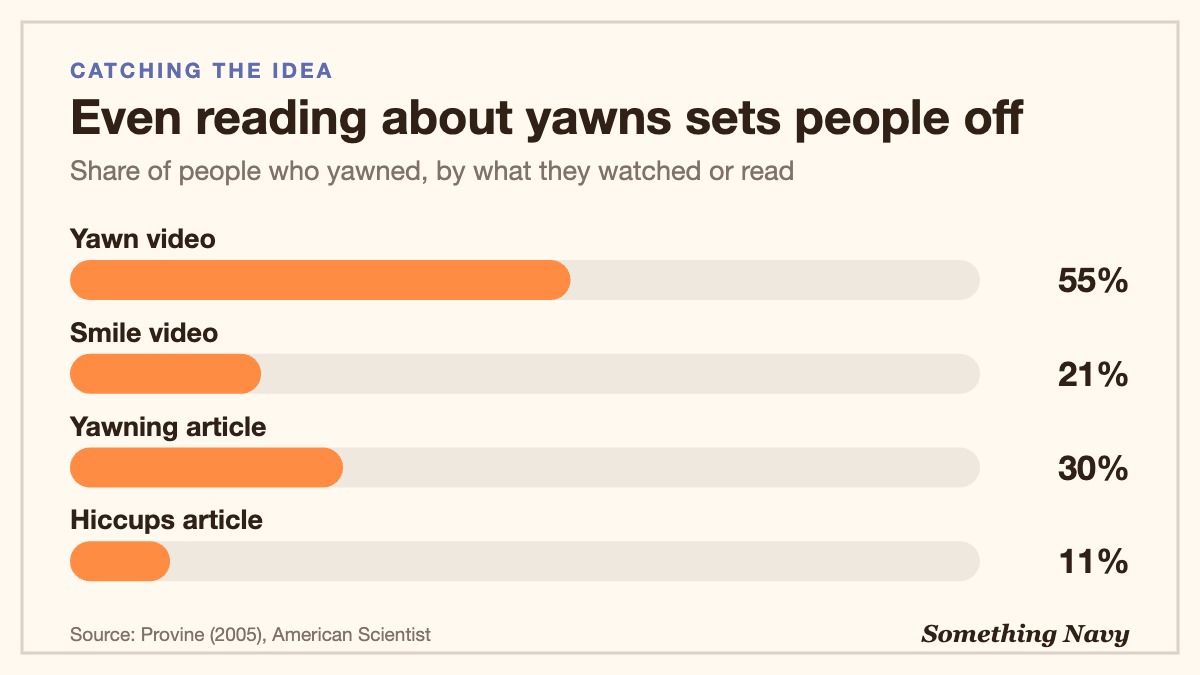
In one set of experiments, described in American Scientist in 2005, volunteers watched a five-minute video of a man yawning 30 times. Some 55% of them yawned while watching. A comparison group who watched a man smiling yawned 21% of the time.
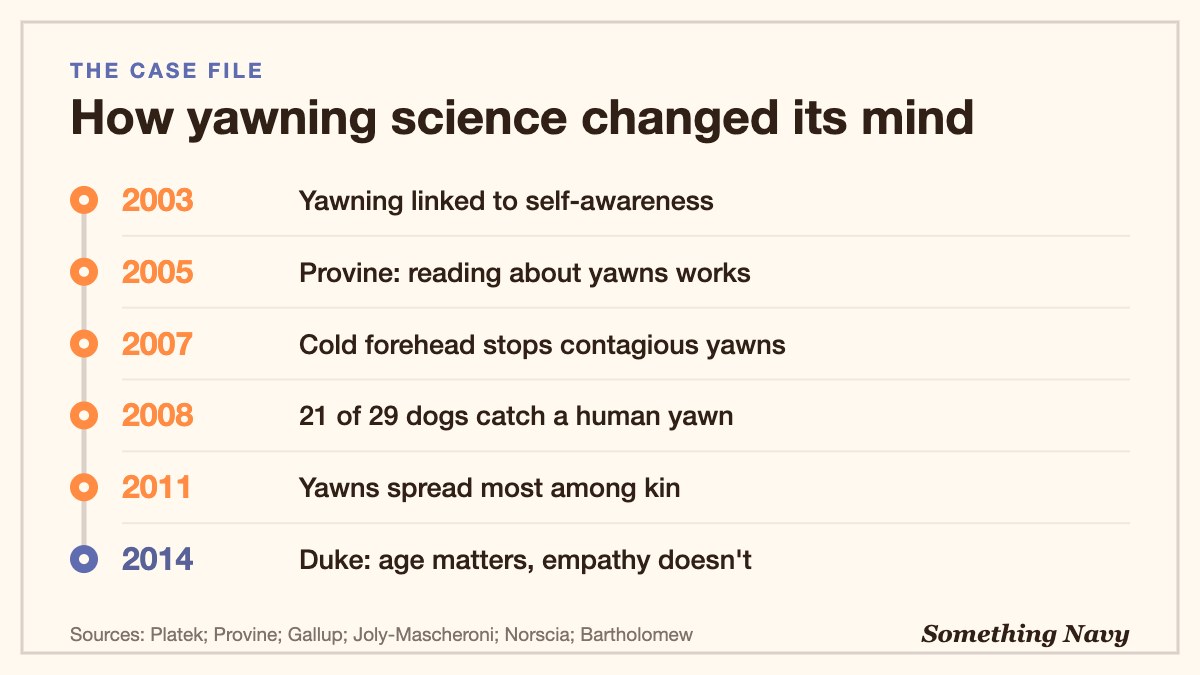
Then Provine took the faces away. He asked people to read a short article about yawning for five minutes. 30% reported yawning, compared with 11% of people who read an equally dull piece about hiccups. When he also counted the people who said they were tempted to yawn, the yawning-article figure rose to 75%.
The trigger, in other words, is not a sight or a sound. It is the idea of a yawn.
Provine found something else that still puzzles researchers. A yawning face with the mouth blanked out worked just as well as a full face. A yawning mouth on its own, floating without eyes or cheeks, was no better than the smiling control. Whatever your brain is detecting, the gaping mouth itself is not the key ingredient.
A reflex you had before you were born
Yawning is ancient. According to Provine, a human foetus begins yawning by the end of the first trimester, with spontaneous yawns seen as early as the 12th week of pregnancy. A typical adult yawn lasts about six seconds.
Catching a yawn from someone else is a different matter. Provine notes that contagious yawning was not detected in children until several years after birth. Babies yawn all the time; they just do not seem to take the hint from anyone else’s.
That gap is the reason scientists got so excited. A behaviour that appears only once children begin to understand other minds looked like a clue. Perhaps catching a yawn says something about how tuned in we are to the people around us.
2003: the empathy theory takes off
In 2003 Steven Platek and colleagues, including the evolutionary psychologist Gordon Gallup Jr., published a study in Cognitive Brain Research that put the social idea to the test. They showed 65 undergraduates videos of people yawning and compared their reactions with videos of other facial expressions.
About 41.5% of the students yawned in response to the yawning clips. The yawners also tended to score lower on a questionnaire measuring schizotypal traits, which include social detachment, and did slightly better on a task about recognising social blunders in short stories. A small subgroup who yawned were quicker to identify their own face in a reaction-time test.
The authors argued that contagious yawning might be tied to self-awareness and to the ability to imagine other people’s mental states. It was a modest set of correlations in a small student sample, but the story was irresistible: we yawn together because we feel together.


Restaurants, offices and waiting rooms
The most charming support for the empathy story came from outside the laboratory. Ivan Norscia and Elisabetta Palagi, then at the University of Pisa, simply watched people going about their lives in places such as restaurants, workplaces, waiting rooms and homes. Their 2011 study in PLoS ONE logged 480 yawning bouts among 109 adults from Europe, North America, Asia and Africa.
After each yawn, they noted whether anyone nearby yawned within the next three minutes and how that person was related to the first yawner. The pattern formed a neat ladder. Yawns spread most readily between relatives, then friends, then acquaintances, and least of all between strangers. Strangers who did catch a yawn also tended to take longer to do it.
Whether the yawn was seen or only heard made no difference. Emotional closeness was the factor that mattered.
It is a lovely finding, and it may be true. But there is an obvious catch, one later critics would press hard: you probably spend more time looking at your sister’s face than at a stranger’s. Attention, not empathy, could explain much of that ladder.
Then Duke tested 328 people
In 2014 Alex Bartholomew and Elizabeth Cirulli at Duke University set out to do what earlier studies had not: test a large, varied group and measure many possible influences at once. Their study in PLoS ONE recruited 328 healthy volunteers and showed each a roughly three-minute video packed with yawning clips, asking them to count every yawn they produced.
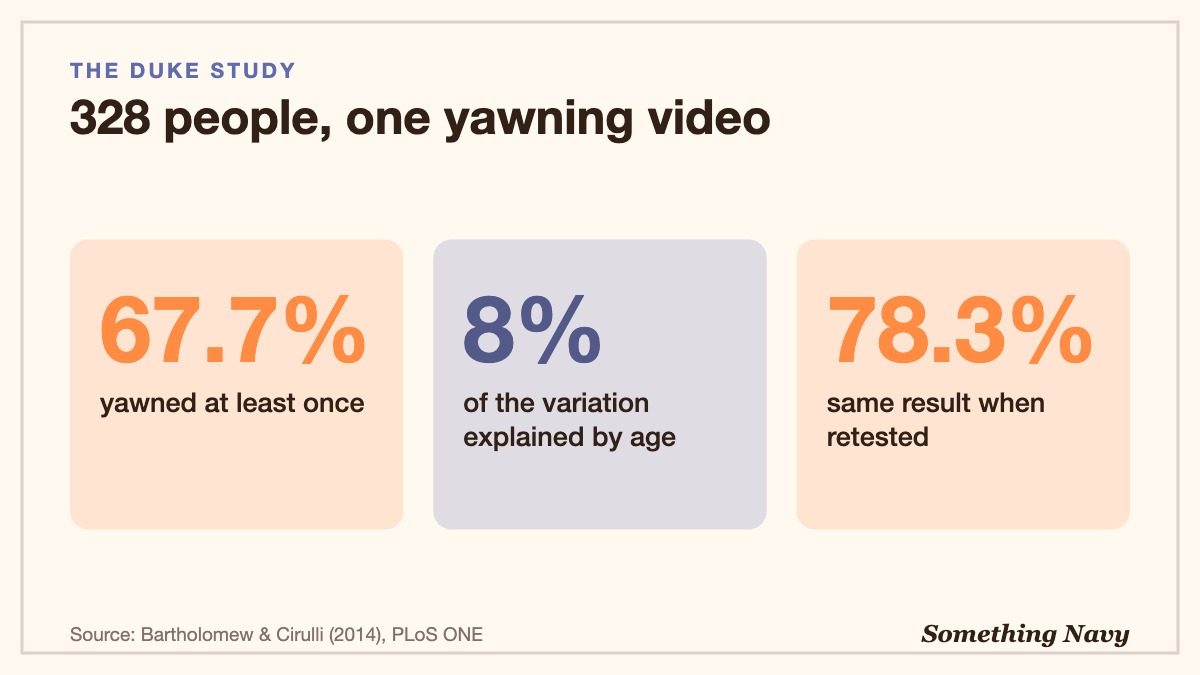
Two-thirds of the participants (222 people, or 67.7%) yawned at least once. The range was striking: from 0 to 15 yawns. The volunteers also completed questionnaires on empathy, energy levels, sleepiness and more.
Once the researchers accounted for age, empathy made no detectable difference. Neither did tiredness or how energetic people felt. Age was the only factor that held up: the older the volunteer, the less likely they were to catch a yawn. Even so, age explained only about 8% of the variation between people.
The authors wrote that “the vast majority of the variability” in this trait remained unexplained.
What they did find was consistency. When 129 participants repeated the test, 78.3% landed in the same category of yawner or non-yawner the second time. Your tendency to catch yawns looks like a stable personal trait. We just do not know what drives it.
This is not the end of the empathy idea, but it badly dented it. In a 2017 review, the researchers Massen and Gallup concluded that the evidence linking contagious yawning and empathy was inconsistent and inconclusive, and that confounds such as visual attention had not been ruled out.
A cold pack on the forehead
If not empathy, then what? The psychologist Andrew Gallup has spent most of his career on a more physical explanation: yawning cools the brain.
The logic runs like this. A deep yawn stretches the jaw, pulls in a large breath of usually cooler air and increases blood flow to the head. If brains work best within a narrow temperature range, a well-timed yawn could act like a small fan.
In a 2007 study in Evolutionary Psychology, Andrew and Gordon Gallup, then at the University at Albany, showed college students videos of people yawning while changing what they did with their faces. Those told to breathe normally or through their mouths yawned at a rate of 50%. Those told to breathe through their noses did not yawn at all. In a second test, students holding a cold pack to their foreheads did not yawn, while those holding warm or room-temperature packs yawned normally.
Nose breathing and a chilled forehead both cool the blood heading to the brain, the authors argued, so the yawn was simply no longer needed.
On this view, catching a yawn might have helped groups stay alert together. When one member’s brain needed a quick reset, the signal rippled out to the others.
Mice, camels and the six-second human
Gallup later took the cooling idea across the animal kingdom. In a 2016 paper in Biology Letters, his team at the State University of New York at Oneonta timed yawns of mammals filmed in online videos, from mice to African elephants.
Mice had the shortest yawns, at around 0.8 seconds. Humans had the longest, at about 6.5 seconds. Across species, longer yawns went with heavier brains and with more neurons in the cortex. Body size and jaw shape did not explain the pattern.
This fits the cooling theory: bigger, busier brains might need a longer gust of air. It does not prove it. The data came from online videos, and correlations across species can hide many other differences between animals.
Still, it is a pleasing thought. That enormous yawn you produced in a dull meeting is, among mammals, a record.
Your dog may be watching your mouth
If yawn contagion is a social signal, does it cross the species line? In 2008 Ramiro Joly-Mascheroni, Atsushi Senju and Alex Shepherd tested 29 dogs. A stranger sat in front of each dog for five minutes and yawned whenever the dog made eye contact. In a separate five-minute session, the same stranger simply opened and closed their mouth.
Of the 29 dogs, 21 (about 72%) yawned during the yawning session. None yawned during the mouth-opening session.
It was a headline-friendly result, and follow-ups have been mixed. A 2009 study in Animal Cognition by Aimee Harr and colleagues played videos of human yawns to 15 dogs and found that only one yawned significantly more to yawns than to open-mouth clips. A 2013 study from the University of Tokyo reported that dogs yawned more after their owners yawned than after a stranger did, with no sign of a stress response in their heart rates.
Live people seem to work better than screens, familiar people better than strangers, and the effect is far from guaranteed. If your dog ignores your yawn tonight, it is not a verdict on your relationship.
What you can do with all this
Contagious yawning is not a disorder or something you need to fix. But a few things from the research are genuinely useful.
Try this
- To stop a yawn in a meeting: breathe slowly through your nose. In the Gallups’ 2007 study, nose-breathers watching yawning videos did not yawn at all. It is one small study, but it is free to test.
- Cool down: a cool drink, a cold hand on your forehead or a less stuffy room may help, if the cooling theory is right.
- Do not read it as boredom or disrespect: catching a yawn is largely involuntary, and in the Duke study it had nothing to do with how empathetic people were.
- Run your own experiment: yawn, deliberately, in front of a friend and a near-stranger. Note who catches it. Then remember that one round proves nothing.
That third point matters more than it sounds. We are quick to read meaning into tiny social signals, and we often misjudge how others see us, as research on the liking gap and the spotlight effect shows. The colleague who did not catch your yawn is not cold. The one who did is not necessarily your soulmate.
An unsolved mystery in plain sight
Decades of research have produced a strange situation. We know contagious yawning is real, common and surprisingly stable within each person. We know it can be triggered by a face, a sound or a sentence. We know age seems to dampen it.
What we do not know is why some people catch nearly every yawn and others almost none. The empathy theory explained too much too quickly. The cooling theory is elegant but still debated. Most likely the answer involves several ingredients at once, including where we are looking, how warm our heads are and how closely we are paying attention to the people beside us.
A yawn is one of the few things you can catch from a stranger that does you no harm at all.
So the next time a yawn rolls down the train carriage, or across the dinner table, watch where it goes. You will be watching one of the oldest and oddest bits of human behaviour, still unexplained, passing quietly from mouth to mouth. And if you are reading this on the train right now and yawning, say hello to the stranger who just caught it.
Sources
- Bartholomew, A. J., & Cirulli, E. T. (2014). Individual variation in contagious yawning susceptibility is highly stable and largely unexplained by empathy or other known factors. PLoS ONE, 9(3), e91773. DOI
- Gallup, A. C., & Gallup, G. G., Jr. (2007). Yawning as a brain cooling mechanism: Nasal breathing and forehead cooling diminish the incidence of contagious yawning. Evolutionary Psychology, 5(1). University at Albany summary: Link
- Gallup, A. C., Church, A. M., & Pelegrino, A. J. (2016). Yawn duration predicts brain weight and cortical neuron number in mammals. Biology Letters, 12(10), 20160545. DOI
- Joly-Mascheroni, R. M., Senju, A., & Shepherd, A. J. (2008). Dogs catch human yawns. Biology Letters, 4(5), 446–448. DOI
- Norscia, I., & Palagi, E. (2011). Yawn contagion and empathy in Homo sapiens. PLoS ONE, 6(12), e28472. DOI
- Platek, S. M., Critton, S. R., Myers, T. E., & Gallup, G. G., Jr. (2003). Contagious yawning: The role of self-awareness and mental state attribution. Cognitive Brain Research, 17, 223–227. DOI
- Provine, R. R. (2005). Yawning. American Scientist, 93, 532–539. Link
Cover photo: Vitaly Gariev on Unsplash. Charts and graphics: Something Navy.
How we reported this. We went back to the original research for this story, 7 sources in all, listed above, and checked every figure against them. If you think we have got something wrong, tell us and we will look at it. Read more about how we work.