
You lift the lid on a pan, and suddenly you are seven years old, standing on a chair in your grandmother’s kitchen. Onions, cardamom, something burnt at the edges. The radio is on. You can almost feel the lino under your socks.
Or it happens in a hotel bathroom a thousand miles from home. You unwrap a small bar of soap, and before you have even turned on the tap, you are back in a holiday flat from 1994, sand in the bed, your dad singing badly in the next room.
Nobody asked you to remember any of it. The smell simply opened a door.
For a long time this was treated as a writer’s fancy, named after Marcel Proust and his famous cake dipped in tea. Then psychologists started testing it, and they found something stranger than the legend: the memories a smell drags up tend to be some of the oldest you own, and they arrive with more feeling attached.
The cake, the tea and a century of “involuntary memory”
In In Search of Lost Time, Proust’s narrator tastes a crumb of madeleine softened in lime-blossom tea and is flooded with his childhood in the village of Combray. It is, strictly speaking, a moment of taste and smell together, which is how most flavour reaches us anyway.
The scene gave researchers a name for the experience, the “Proust phenomenon”, and a set of testable claims. Are smell-triggered memories really older? Are they more emotional? Do they feel more like stepping back in time, or do we just remember the dramatic ones?
Here is what five lines of research found.
Finding one: your nose reaches further back than your eyes
The clearest early test came from Simon Chu and John Downes at the University of Liverpool. In a 2000 study in Cognition, they recruited 33 people aged 65 to 83. Twenty-two of them sniffed 27 different odours with their eyes closed. The other 11 were simply given the names of those same odours.
Each person described any personal event that came to mind and dated it. The two groups produced almost the same number of memories (242 from smells, 247 from words). What differed was when those memories came from.
Memories cued by words peaked between the ages of 11 and 25, the familiar “reminiscence bump” that shows up in most memory research. Memories cued by smells peaked earlier, between 6 and 10.
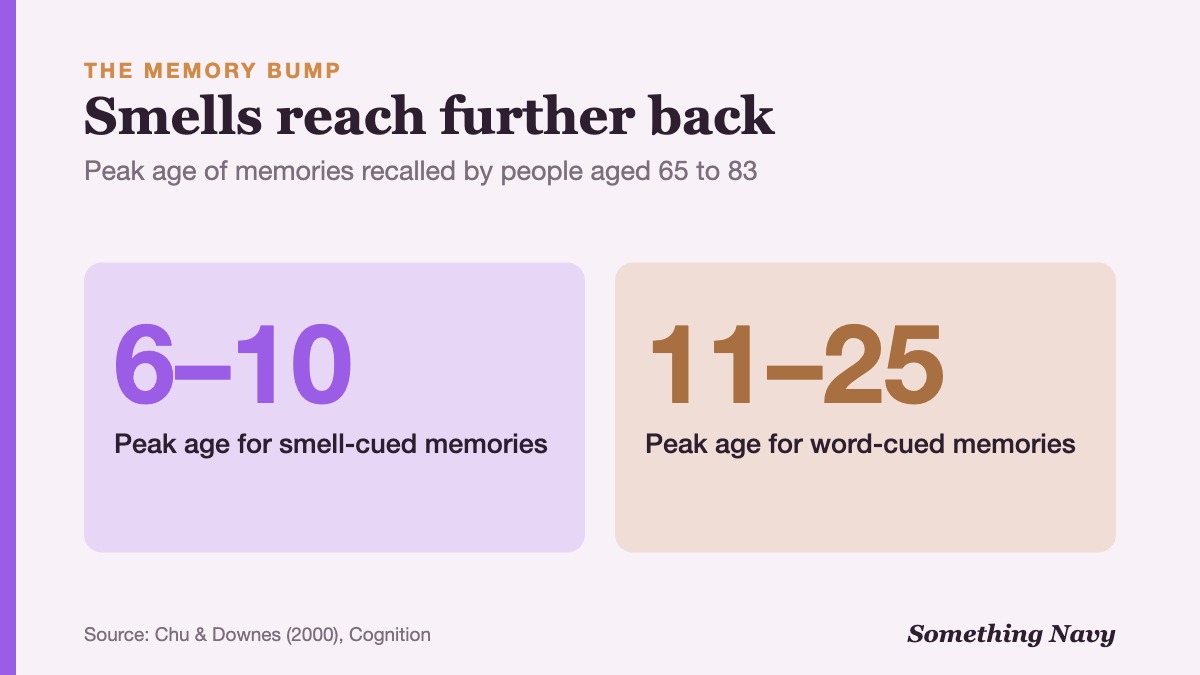
Six years later, Johan Willander and Maria Larsson of Stockholm University ran a larger version with 93 older adults, published in Psychonomic Bulletin & Review. Each person got cues as words, pictures or smells. Again, most smell-cued memories came from the first decade of life, while word and picture cues peaked in the years between 11 and 20.
Two other details from that study are worth keeping. People said smell-cued memories gave them a stronger feeling of being brought back in time. And they reported having thought about those memories less often before.
Your nose, in other words, has been keeping a diary you rarely read.


Finding two: a smell feels more like going back
Rachel Herz, a psychologist at Brown University, has spent much of her career on this question. With Jonathan Schooler, then at the University of Pittsburgh, she took the experiment out of the lab and into the Exploratorium science museum in San Francisco.
In their 2002 study, 45 adult visitors aged 18 to 65 were first given the name of a nostalgic product, such as Crayola crayons, Coppertone suntan lotion, Play-Doh, Vicks VapoRub or Johnson’s baby powder. Each person recalled a memory linked to it. Then they met the item again, either as its smell in an opaque bottle or as a colour photograph, and recalled the same memory.
On a nine-point scale, memories recalled with a smell were rated as more emotional (4.61) than those recalled with a photo (2.68). Smells also made people feel more “brought back” to the original moment (5.61 against 4.40).
The surprise was what did not change. The memories were no more vivid and no more specific. The smell did not add facts. It added feeling.
Finding three: more emotion, not more detail
Herz tested that idea again with a bigger crowd. In a 2004 study in Chemical Senses, 70 visitors to a brain exhibition at the Smithsonian Institution were cued with three everyday things: a campfire, fresh-cut grass and popcorn. Each came as a word, a picture, a sound or a smell.
The pattern held. Memories triggered by smells were rated as significantly more emotional and more evocative than those triggered by the same things seen, heard or named. Vividness and specificity, once more, did not differ.
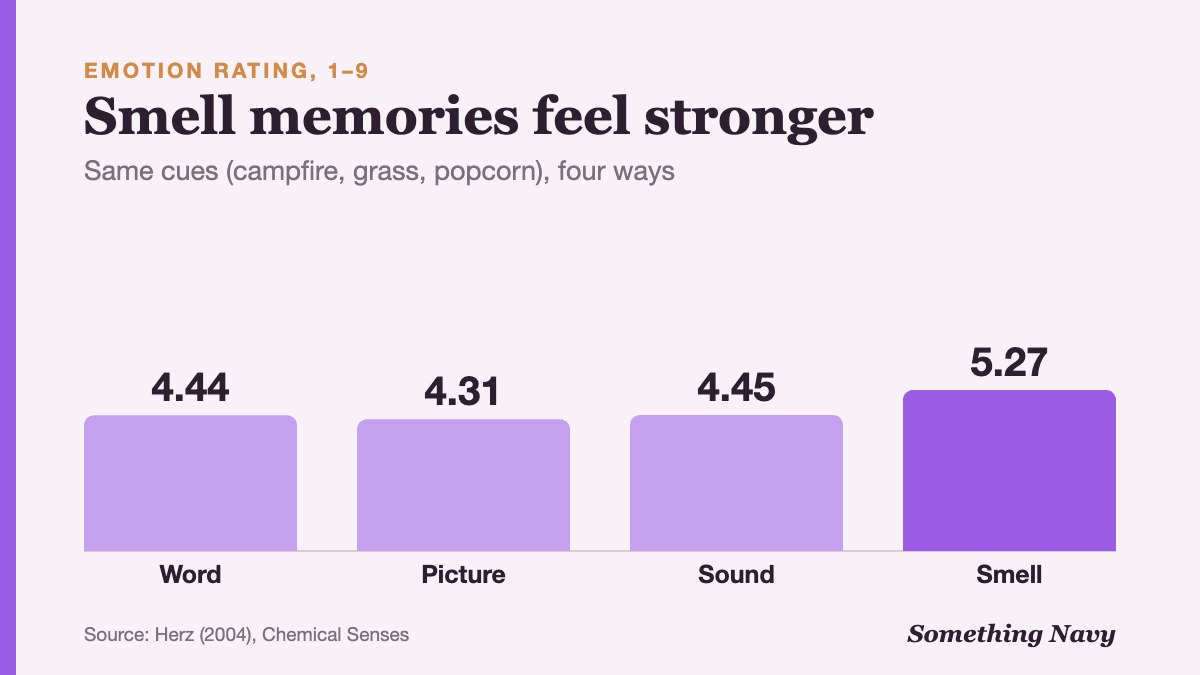
This is a useful correction to how we usually describe the Proust effect. A smell does not hand you a sharper photograph of the past. It hands you the mood of the room.
Herz also found that age, sex and where people lived changed which cues worked, which makes sense. Popcorn means something different if you grew up with it at every cinema trip. Smell memories are built from your own history, not from the smell itself.
Finding four: the wiring is unusually short
Why would smell behave differently from sight or sound? Part of the answer is anatomy.
Smells are picked up by receptors in the nose and processed first in the olfactory bulb, which sits under the front of the brain. From there, as the Harvard Gazette explains, odours take a direct route into the limbic system, including the amygdala, which handles emotion, and the hippocampus, which is central to forming memories of events.
The olfactory signals very quickly get to the limbic system.
Venkatesh Murthy, Harvard University
Herz and colleagues looked for this in the brain itself. In a 2004 brain-scanning study in Neuropsychologia, five women each chose a perfume tied to a happy personal memory. Inside an fMRI scanner, smelling their own perfume produced stronger activity in the amygdala and hippocampal regions than the comparison cues, including a photo of the same bottle.
Five people is a tiny sample, all of them women, so treat this as a striking early picture rather than a settled map. But it fits neatly with the behavioural results: smell seems to have privileged access to the brain’s emotional and memory machinery.
Finding five: the effect is real, but smaller and stranger than the legend
If you only read the studies above, you might think every whiff is a time machine. A more recent experiment is a good reality check.
Alexandra Ernst and colleagues built a “Proust Machine” for public science nights in France in 2015 and 2016. Around 400 adults aged 18 to 80 tried cues for all five senses. The smells were ylang-ylang and tobacco. Their results, published in Frontiers in Psychology, were messy.
Smells produced more “nothing comes to mind” responses than other cues, and when memories did come, they were less detailed and, on average, less emotionally intense than memories cued by pictures, textures or words. There was no special early-childhood pattern for smell in this group, whose average age was about 31.
The authors are frank that this was a busy public event, not a controlled lab, with small effects and volunteers who chose to take part. Still, it lines up with a theme across the field: most smells, most of the time, trigger nothing at all. The Proust moment is rare.
That rarity may be the point.


Why the oldest memories hide behind a smell
Think about how you usually revisit your past. You tell stories, look at photos, hear old songs on the radio. Each retelling reshapes the memory a little and ties it to words and pictures. It is part of why childhood seems to stretch so long in hindsight: those early years are full of firsts you have replayed again and again.
A smell from age seven gets almost none of that rehearsal. You cannot easily call it up on purpose, and you rarely meet it again. So the memory sits untouched, with its original emotional colour intact, until the exact molecule drifts past.
That would explain why Willander and Larsson’s volunteers had thought about smell-cued memories less often, and why those memories felt more like being transported. It also explains the misfires in Ernst’s study. A generic smell with no personal history attached has nothing to bring back.
A smell doesn’t remind you of the past so much as reopen it.
Using scent at home on purpose
None of these studies tested a home-fragrance routine, so be wary of anyone promising that a candle will “boost your memory”. What the research does support is a simpler idea: smells pick up meaning from what happens around them, and the ones tied to a specific stretch of life are the ones that later carry you back.
Hotels already act on this. According to the Harvard Gazette, they often pump signature scents through rooms and lobbies so the place stays with you. You can borrow the logic for your own life, more honestly.
Try this
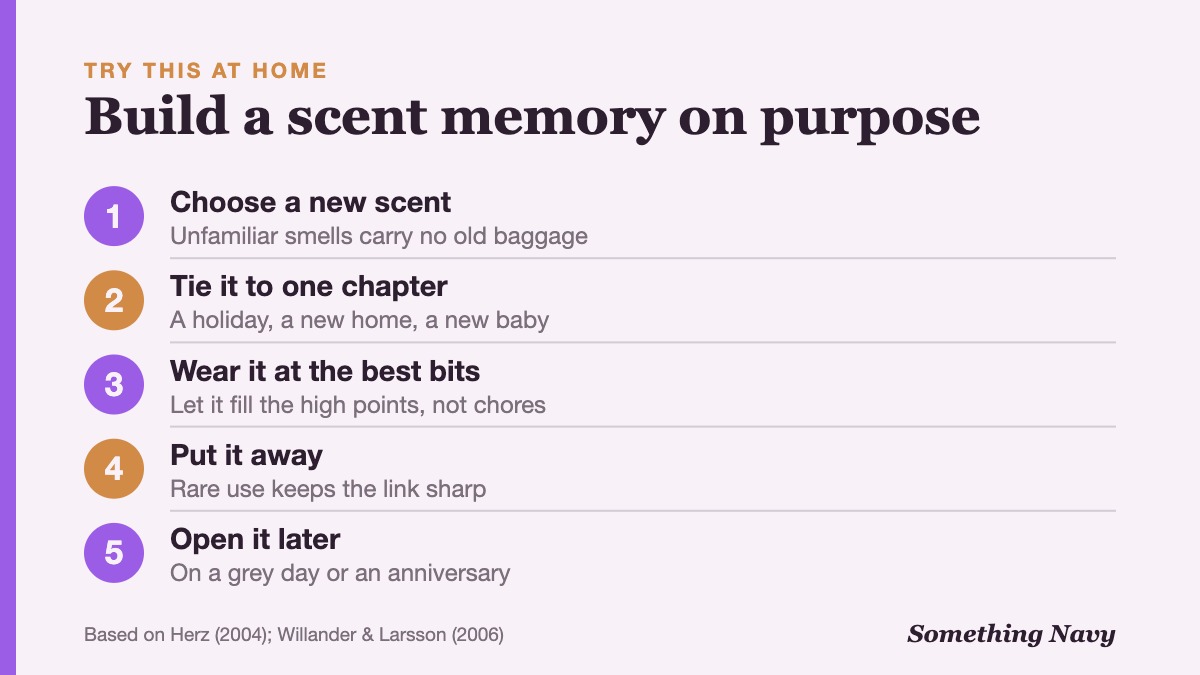
- Pick something new. A smell you already know is loaded with old associations. An unfamiliar soap, oil or candle has a blank slate.
- Use it only for one chapter. A summer holiday, a baby’s first months, the first year in a new flat. Then put it away.
- Bring it back sparingly. Open it on a grey February day, or on an anniversary. Overuse will tie it to ordinary Tuesdays instead.
- Keep the old smells too. A jar of your grandmother’s spice mix, a parent’s aftershave, the brand of washing powder from home. They are cheap archives.
The emotional side matters as well. Because the moments you most remember tend to be the high points and the endings, it is worth letting a holiday scent fill the best evening, not just the stressful airport morning.
One honest caveat: smell memories are not always kind. Scents linked to illness, grief or a frightening event can return with the same force. If a particular smell brings back something painful, there is nothing wrong with keeping it out of your home.
And a gentler one: your sense of smell is personal. What sends you back may do nothing for your partner, which is why shared spaces often work best with something mild in the hallway and the strong stuff in your own drawer.
A diary written in the air
You cannot choose which smells will matter to you in 30 years. That is decided by ordinary afternoons you are not paying attention to.
But you can choose some of what is in the room right now. The coffee you make on Sunday mornings, the soap by the sink, the herbs on the windowsill. Somewhere in there, without asking permission, your nose is already writing the first line of a memory you will meet again when you are old.
Frequently asked questions
Smell-cued memories are often ones you rarely revisit through stories or photos, so they stay unrehearsed. Meeting the exact smell again can bring them back with their original feeling still attached.
Not according to the evidence. Studies by Rachel Herz found smell-cued memories were more emotional but no more vivid or specific than those cued by pictures or words.
Most people recognise it, but it is unpredictable. In large public tests, many smells triggered no memory at all, because the effect depends on your own history with a particular scent.
There are no trials of this at home, but pairing a new, distinctive scent with one period of your life and then using it sparingly follows how smell associations seem to form.
Sources
- Chu, S., & Downes, J. J. (2000). Long live Proust: The odour-cued autobiographical memory bump. Cognition, 75(2), B41–B50. DOI
- Ernst, A., Bertrand, J. M. F., Voltzenlogel, V., Souchay, C., & Moulin, C. J. A. (2021). The Proust Machine: What a public science event tells us about autobiographical memory and the five senses. Frontiers in Psychology, 11, 623910. DOI
- Herz, R. S. (2004). A naturalistic analysis of autobiographical memories triggered by olfactory, visual and auditory stimuli. Chemical Senses, 29(3), 217–224. DOI
- Herz, R. S., Eliassen, J. C., Beland, S. L., & Souza, T. (2004). Neuroimaging evidence for the emotional potency of odor-evoked memory. Neuropsychologia, 42(3), 371–378. Link
- Herz, R. S., & Schooler, J. W. (2002). A naturalistic study of autobiographical memories evoked by olfactory and visual cues: Testing the Proustian hypothesis. American Journal of Psychology, 115(1), 21–32. Link
- Walsh, C. (2020, February 27). What the nose knows. Harvard Gazette. Link
- Willander, J., & Larsson, M. (2006). Smell your way back to childhood: Autobiographical odor memory. Psychonomic Bulletin & Review, 13(2), 240–244. DOI
Cover photo: Elly Johnson on Unsplash. Charts and graphics: Something Navy.
How we reported this. We went back to the original research for this story, 7 sources in all, listed above, and checked every figure against them. If you think we have got something wrong, tell us and we will look at it. Read more about how we work.