
On four evenings in November 1983, 46 undergraduates at Southern Methodist University in Dallas sat down, picked up a pen and wrote for 15 minutes. Some described the shoes they were wearing. Others wrote about the worst thing that had ever happened to them.
The second group left the room feeling worse. Their blood pressure was up and their mood was down. Yet over the following months, according to the university’s health centre records, they were the ones who visited the doctor least.
That small, odd result launched one of the most studied ideas in modern psychology: that putting difficult feelings into words, privately and on paper, might be good for you. Four decades and hundreds of experiments later, the answer is more interesting than either the enthusiasts or the sceptics suggest.
Four evenings in Dallas
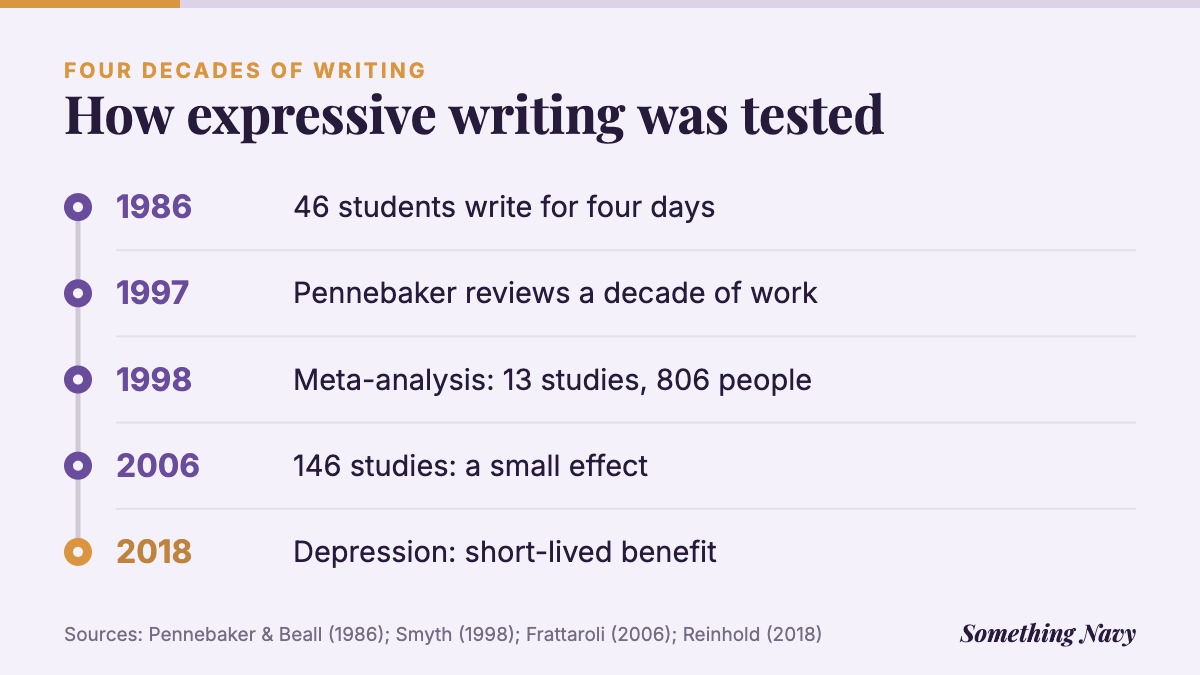
The experiment was run by the psychologist James Pennebaker and his student Sandra Beall, and published in the Journal of Abnormal Psychology in 1986. Pennebaker was interested in a hunch about secrets: that the effort of holding back upsetting thoughts might wear the body down over time.
The design was simple. Introductory psychology students were split into four groups. A control group wrote about trivial subjects, such as their living room, as objectively as possible. The other three wrote about a traumatic or upsetting experience, but in different ways.
One trauma group was told to write only about the facts of the event, with no feelings. Another was told to write only about their feelings, without describing what happened. The last group was asked to do both: describe the event and explore how they felt about it, then and now.
Each student wrote for 15 minutes on four consecutive evenings. Pennebaker and Beall measured blood pressure and mood around every session, then later checked the students’ visits to the campus health centre for illness.
Facts alone were not enough
Right after writing, the group who combined facts and feelings felt the most upset of anyone. In the months that followed, though, something reversed. Illness visits rose in the control, facts-only and feelings-only groups, by roughly one visit per student. In the combined group, they did not rise at all.
A health questionnaire sent four months later pointed the same way. Students who had written about their emotions reported fewer health problems than the control and facts-only groups.
It is worth being honest about how fragile this was. Each group had only 11 or 12 students, and the key statistical result for health centre visits was marginal rather than clear cut. Pennebaker and Beall themselves described the findings as preliminary.
What made the study matter was what came next. It was replicated, extended and tested on very different people, and the pattern kept appearing often enough to be taken seriously.
From the student clinic to the unemployment office
By 1997, when Pennebaker (by then at the University of Texas at Austin) reviewed the first decade of work in Psychological Science, the method had spread well beyond American undergraduates. Benefits had been reported in children and older adults, in honours students and maximum-security prisoners, and in studies run in Belgium, Mexico City and New Zealand.
One of the most striking studies involved senior professionals who had recently been made redundant. Those who wrote about their thoughts and feelings around losing their job found new work more quickly than those who wrote about neutral topics or did not write at all. The writing did not appear to make them search harder. Instead, it seemed to change how they felt about their old employer and about looking for work.
Researchers also tried to find out who benefited most. Surprisingly, sex, age, anxiety and a tendency to hold things in did not reliably predict who gained. And the original theory, that the active work of suppressing secrets was what made people ill, never quite held up: writing about secrets helped about as much as writing about things people had already told others.


Counting the words that heal
If simply getting things off your chest was not the whole story, what was? Pennebaker’s answer came from an unusual source: the words people actually used.
With colleagues, he developed a computer program, Linguistic Inquiry and Word Count (LIWC), that sorted the words in each essay into categories. Analysing the essays from six writing studies, the team found that people who used more positive emotion words tended to show better health afterwards. Negative emotion words followed a curve: a moderate amount was linked to better outcomes, while very many or very few were linked to worse ones.
The strongest predictor, though, was change. People who increasingly used causal words (“because”, “reason”) and insight words (“realise”, “understand”) from the first day to the last were the ones whose health improved most. Independent judges rated these writers’ stories as moving from disorganised to coherent over the four days.
Health gains appear to require translating experiences into language.
James Pennebaker, Psychological Science (1997)
Making meaning, not just venting
This is the heart of the modern view. Expressive writing seems to work less like a pressure valve and more like an editor. A painful experience often sits in the mind as a jumble of images, sensations and half-finished thoughts that keep resurfacing, a little like the unfinished tasks that nag at us until we deal with them.
Turning that jumble into sentences forces some structure on it. You have to decide what happened first, why you reacted as you did, and what it means now. The writers who benefited were not those who poured out the most anguish, but those whose writing gradually made sense of what had happened to them.
That also explains why the facts-only and feelings-only groups in 1986 gained little. Facts without feelings is a police report. Feelings without facts is a howl. It is putting the two together, and building a story, that seems to do the work.
What happens when you pool 146 studies
Single experiments can mislead, so psychologists combine them. The first major review came from Joshua Smyth, then at the State University of New York at Stony Brook. His 1998 meta-analysis pooled 13 randomised experiments involving 806 healthy participants and reported a moderate average benefit across physical health, psychological wellbeing and general functioning. It also confirmed the uncomfortable part: writing reliably made people more distressed in the short term.
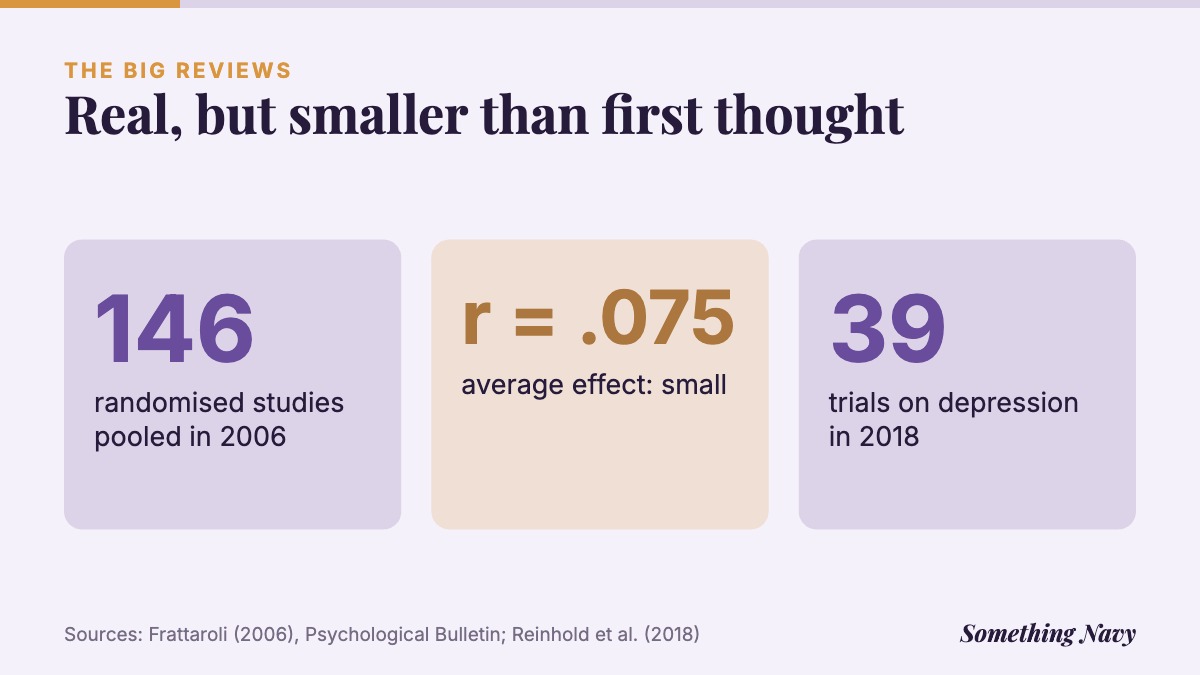
Eight years later, Joanne Frattaroli carried out a far larger analysis for Psychological Bulletin. She gathered 146 randomised studies, including unpublished ones, and used more conservative statistics. Disclosure still came out as effective, but the average effect was small: a correlation of about r = .075.
Frattaroli also looked at what made the difference. Later researchers summarising her analysis note that larger effects tended to appear when people wrote at least three times, for at least 15 minutes, with fairly specific instructions, and at home or somewhere private. Benefits also looked bigger for people under more stress, although those comparisons rested on few studies.
The smaller picture since
More recent work has been tougher still. In 2018, Monika Reinhold and colleagues at the University of Münster published a meta-analysis in Clinical Psychology: Science and Practice focused on one outcome: depressive symptoms. They analysed 39 randomised controlled trials containing 64 comparisons between writing and control groups.
They found a small but significant drop in depressive symptoms immediately after the writing period. At later follow-ups, the difference was no longer statistically significant. Their conclusion was blunt: on this evidence, short, self-guided expressive writing should not be relied on to reduce depression. Effects were somewhat larger with more sessions and more specific writing topics.
None of this means the 1986 study was a fluke. It means the effect is smaller than early headlines suggested, varies a lot from person to person, and depends on what you measure. Pennebaker himself has said as much, looking back in 2018 on both the successes and the failures to replicate.
There are also gaps. As Pennebaker pointed out in 1997, most early studies did not include people with major mental or physical health problems, so the findings cannot simply be stretched to cover them.
A modest tool, honestly described
So where does that leave the rest of us? The fairest reading is this. For many generally healthy people going through a stressful patch, a few short sessions of structured writing about what is bothering them carries a small chance of a real benefit, at almost no cost.
It is not therapy and it is not a treatment for depression. It is closer to a mental tidy-up: cheap, private, sometimes uncomfortable, and occasionally surprisingly useful. That framing is also how Pennebaker and Smyth present it in their practical guide, Opening Up by Writing It Down, whose third edition (2016) includes advice on when it may not help.
If you want to try it, here is how to do it in a way that matches what the studies actually tested.
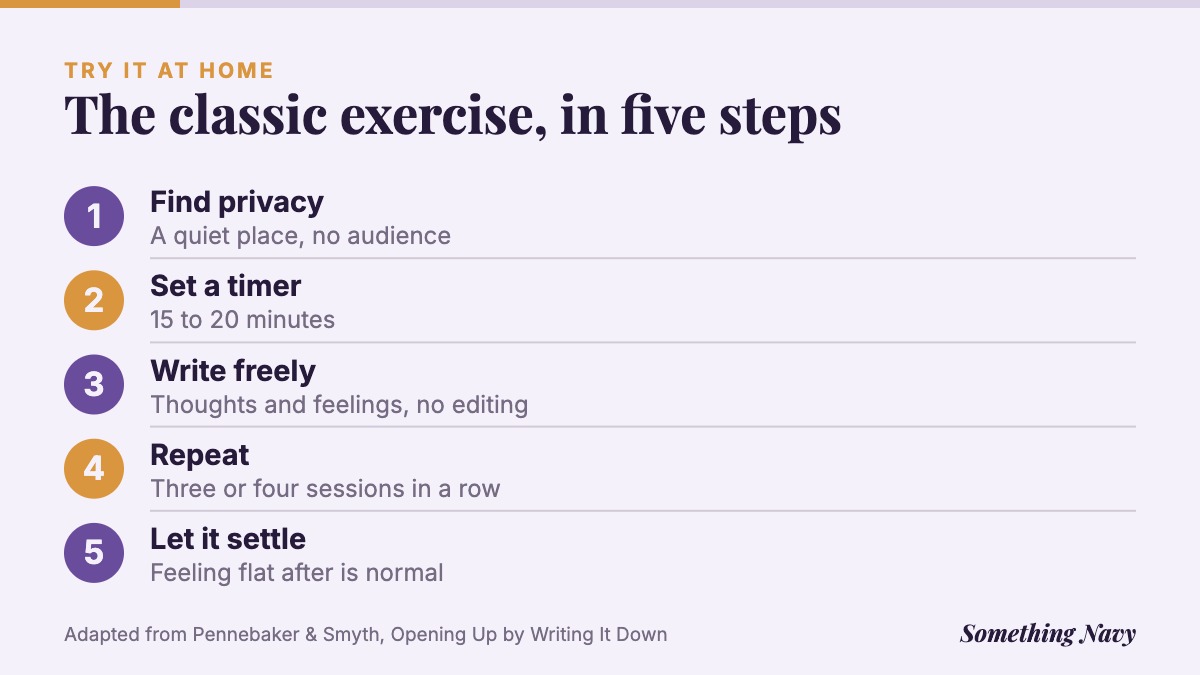
How to try it: five steps
Step 1: Choose something that still bothers you
Pick an experience or worry that you think about a lot, that stirs strong feelings, or that you have not really talked through. It does not have to be the worst thing in your life. A conflict, a loss, a decision or a stressful change all count. If it feels too big to handle right now, choose something else.
Step 2: Book four short, private sessions
Set aside 15 to 20 minutes on four days, ideally close together. Find somewhere you will not be interrupted, and decide in advance that nobody will read what you write. Some people find it helps to make a simple plan, such as “after dinner, I’ll sit at the kitchen table and write”.
Step 3: Write without stopping
Once you start, keep going until the time is up. Ignore spelling, grammar and neatness. If you run out of things to say, repeat yourself until something new comes. Pen or keyboard both work; what matters is that it stays private.
Step 4: Join the facts to the feelings
This is where 1986 still matters. Describe what happened, then how you felt then and how you feel now. Try to connect it to other parts of your life: your relationships, your past, who you want to be. Let yourself ask why. Words like “because” and “I realise” are not a trick to insert, but they are a sign you are making sense of things.
The original instructions, in short
- Write for about 15–20 minutes a day, on three or four days in a row.
- Explore your deepest thoughts and feelings about something upsetting or important to you, not just the facts.
- You can link it to your childhood, relationships, work, or who you are and want to be.
- You can stay with one topic or switch to a different one each day.
- Keep writing the whole time. Spelling and grammar do not matter.
- It is for your eyes only. Keep it, hide it or throw it away.
Step 5: Close the notebook and let it settle
Expect to feel a little flat or sad straight afterwards; in the studies, that was the norm rather than a sign of failure. Give yourself a few quiet minutes before plunging back into the day. You do not need to reread what you wrote. A week or two later, notice whether anything has shifted in how you think or feel about the subject.
When to put the pen down
Because the exercise deliberately stirs things up, it is not for every moment or every person. Guidance from the US Department of Veterans Affairs, which offers expressive writing within its Whole Health programme, gives some useful limits.
- Not straight after a trauma. In the raw early days after a major shock, the advice is to wait several weeks before writing about it in depth. Focus on getting support and getting through.
- Stop if it overwhelms you. If writing about something feels like it will push you over the edge, do not write about it. Choose a topic you can manage now.
- Watch for rumination. If you keep going over the same ground day after day without any shift, or feel worse rather than briefly low, more writing is unlikely to help.
- Talk to a professional if distress grows. If difficult feelings linger or intensify, speak to your GP, a counsellor or a psychologist. In a crisis, contact emergency services or a helpline such as Samaritans (116 123 in the UK and Ireland).
People living with serious depression, post-traumatic stress or other mental health conditions should treat expressive writing as something to discuss with their clinician, not a substitute for care. This article is about everyday wellbeing, not medical advice.
What 15 minutes can and cannot do
It is tempting to want a clean verdict: journaling works, or journaling is a myth. Forty years of research refuses to give one. The average effect is small, some people gain nothing, and the benefits for depression may fade.
But the core insight from that Dallas classroom has survived every round of scrutiny. Venting is not the point, and neither is a neat record of events. The value, when there is value, comes from the slow work of turning a mess of feeling into a story you can understand.
You do not need a special notebook or a fresh start on a Monday to test that for yourself. Four evenings, a pen, and a willingness to ask “why” is all the original students had.
Sources
- Frattaroli, J. (2006). Experimental disclosure and its moderators: A meta-analysis. Psychological Bulletin, 132(6), 823–865. DOI
- Pennebaker, J. W. (1997). Writing about emotional experiences as a therapeutic process. Psychological Science, 8(3), 162–166. DOI
- Pennebaker, J. W. (2018). Expressive writing in psychological science. Perspectives on Psychological Science, 13(2), 226–229. DOI
- Pennebaker, J. W., & Beall, S. K. (1986). Confronting a traumatic event: Toward an understanding of inhibition and disease. Journal of Abnormal Psychology, 95(3), 274–281. DOI
- Pennebaker, J. W., & Smyth, J. M. (2016). Opening up by writing it down: How expressive writing improves health and eases emotional pain (3rd ed.). Guilford Press. Link
- Reinhold, M., Bürkner, P.-C., & Holling, H. (2018). Effects of expressive writing on depressive symptoms: A meta-analysis. Clinical Psychology: Science and Practice, 25(1), e12224. DOI
- Smyth, J. M. (1998). Written emotional expression: Effect sizes, outcome types, and moderating variables. Journal of Consulting and Clinical Psychology, 66(1), 174–184. DOI
How we reported this. We went back to the original research for this story, 7 sources in all, listed above, and checked every figure against them. If you think we have got something wrong, tell us and we will look at it. Read more about how we work.
Cover photo: Cathryn Lavery on Unsplash. Charts and graphics: Something Navy.