

It is Tuesday, a little after ten. You are at the kitchen table with a laptop propped on a chopping board to lift the screen, a mug going cold by the fruit bowl, and two spreadsheets open that you have finally made sense of. No one has stopped by to ask about the weekend. The washing machine has just started its spin cycle.
Then the email lands. Subject line: “Office days from January.” Your manager is being friendly about it, but the message is clear. The company wants people in three days a week, possibly four, because it believes teams simply do better work together.
You look at the spreadsheets. You did better work this morning than on most office days you can remember. Or did you? It is hard to know, because the only person measuring is you, and you have every reason to want the answer to be yes.
Your manager has reasons too. Somewhere between those two hunches sits a surprisingly solid body of research, including several genuine experiments, and it does not tell either of you quite what you want to hear.
Why the remote work productivity debate is so hard to settle
A lot of arguments about working from home rest on how productive people feel. That tells you little, because feeling productive and being productive are different things, and both staff and managers have a stake in the answer.
The second problem is selection. People who choose remote work are not a random slice of the workforce, so comparing them with office workers means comparing different people, not different places.
That is why economists prize randomised trials, where a lottery decides who works where. Alongside them sit “natural experiments”, where something outside anyone’s control, such as a pandemic lockdown, forces a switch overnight. Those are messier, because everything else changed at the same time, but they cover far larger groups of workers.
The two kinds of evidence point in different directions, and the reasons why are the most useful part of the story.
The Ctrip experiment: 13% more productive at home
The study that started the modern debate was run at Ctrip, a Chinese travel agency listed on NASDAQ with about 16,000 staff. The company has since been renamed Trip.com Group. In late 2010 its co-founder, James Liang, who holds an economics PhD from Stanford, set up a trial with Nicholas Bloom of Stanford University and two colleagues, John Roberts and Zhichun Jenny Ying.
The firm asked call-centre staff in its airfare and hotel departments whether they would like to work from home. Of 994 employees, 503 volunteered. Only 249 met the rules, which required at least six months at the company, broadband at home and a private room to work in, such as their own bedroom. Then came the lottery: staff with even-numbered birthdays went home and those with odd-numbered birthdays stayed in the office. That left 131 home workers and 118 office workers.
The trial ran for nine months, from December 2010 to August 2011, with home workers spending four days a week at home and one in the office. The results appeared in the Quarterly Journal of Economics in 2015.
Where the 13% came from
Home workers’ performance rose by 13%, and the detail matters. About nine percentage points came from working more minutes per shift, because people took fewer breaks and fewer sick days. The other four points came from handling more calls per minute. The J-PAL summary of the trial says call quality did not change.
Home workers also skipped a commute that averaged about 80 minutes a day.
Attrition was the other headline. Over the nine months, 35% of the office group quit, compared with 17% of the home group. In a call centre, halving the quit rate is worth a great deal.
The catch: promotions and loneliness
Two findings tend to get lost. First, home workers were less likely to be promoted than office colleagues who performed just as well. Being out of sight seemed to matter, even when the numbers were good.
Second, when the trial ended, Ctrip offered home working to everyone in those departments and let the original volunteers choose again. About half the home group went back to the office. The most common reason, in both groups, was the loneliness of working from home. Those who returned were typically the people who had done relatively badly at home, and once staff could sort themselves, the performance gain for home workers rose to 22%.
Working from home suited some people and not others, and letting them choose made the average look better still.

The Trip.com hybrid trial: two days at home, no hit to performance
The obvious objection to the Ctrip study is that call-centre work is easy to measure and easy to do alone. Most office jobs involve far more collaboration. So, a decade later, Bloom and Liang went back to the same company with a different question.
This time the trial covered 1,612 employees at Trip.com, many of them software engineers, of whom 395 were managers and 1,217 were not. From August 2021 to January 2022, half were randomly allowed to work from home on Wednesdays and Fridays. The other half stayed in the office five days a week. Bloom, Liang and Ruobing Han published the results in Nature in June 2024.
The findings were strikingly undramatic on performance. Performance reviews over the following two years showed no difference between the groups. Nor did promotions. Among the 653 software engineers, the number of lines of code written was unchanged. The researchers used a statistical method designed to test whether there was genuinely no effect, rather than merely failing to find one, and the null result held.
What did change was quitting. Hybrid workers quit at a rate about one-third lower than their full-time office colleagues. The effect was concentrated among people who stood to gain most from fewer commutes.
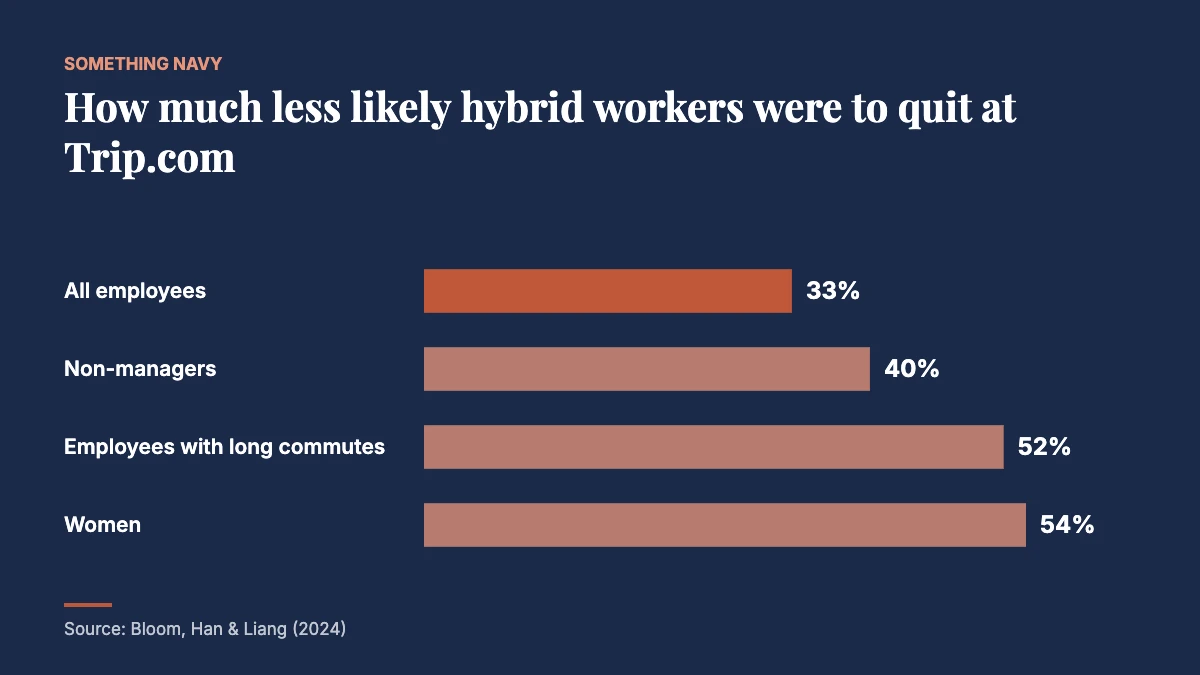
Perhaps the most revealing result concerned the managers. Before the experiment, they predicted that hybrid working would cut productivity by about 2.6%. After six months of watching their own teams, their estimate moved to a gain of about 1.0%. Bloom put it bluntly in Stanford’s announcement of the paper: “There are almost only winners.”
That is a strong line, and it deserves some caution. This was one company, in one country, with a fairly modest hybrid arrangement of two home days a week. But it is a randomised trial on more than 1,600 people, and its result is hard to wave away.
The managers did not change their minds because of a memo. They changed them because they watched their own teams for six months.
When working from home did cost productivity
If the Trip.com studies were the whole story, this would be a short article. Several careful studies have found that remote work does carry a real cost, and they help explain where it comes from.
A US call centre and the problem of who chooses remote jobs
The economists Natalia Emanuel and Emma Harrington studied the call centres of a US Fortune 500 company, where remote and on-site staff did exactly the same job. Their paper was published in American Economic Journal: Applied Economics in 2024.
Before the pandemic, remote workers handled 12% fewer calls per hour than on-site workers. That looks like a damning verdict on home working, until you ask who those remote workers were. When COVID-19 closed the call centres and sent everyone home, the productivity of the formerly on-site staff fell by 4% relative to colleagues who had been remote all along.
That means about a third of the original gap came from working remotely itself. The rest, roughly 8%, came from the kind of people who had chosen remote jobs in the first place. The authors call this negative selection: when only some roles are remote, they can attract workers who are, on average, less productive.
The costs were not only about speed. Call quality fell, especially for inexperienced staff, and promotion rates dropped for workers who went remote. Their cost-benefit analysis suggested that lower staff turnover and savings on office rent could outweigh the productivity loss itself, but not the cost of attracting weaker applicants.
An Indian IT firm in lockdown
A larger study looked at more than 10,000 skilled professionals at a big Indian IT services company. Michael Gibbs of the University of Chicago’s Booth School of Business, with Friederike Mengel and Christoph Siemroth, compared personnel and analytics data from before the pandemic with the period when everyone worked from home. It appeared in the Journal of Political Economy Microeconomics in 2023.
Hours went up, including an 18% rise in work outside normal business hours. Output stayed roughly flat or fell slightly. Put those together and productivity, measured as output per hour, fell by between 8% and 19%.
The authors traced much of the decline to the cost of communicating. Staff spent more time in coordination and meetings, and their stretches of uninterrupted work shrank considerably. They networked with fewer people and fewer business units, and had fewer one-to-one meetings with their supervisors. The working-paper version also reported that people with children at home increased their hours more and saw a bigger fall in productivity.
This was not a randomised trial. It captured an abrupt, unplanned switch during a public health emergency, with no time to prepare. That makes it a good picture of forced, fully remote work in 2020, and a weaker guide to a planned hybrid week in 2026.


What remote work does to collaboration and learning
Productivity figures measure output today. Some research looks at what remote work might do to how people connect and learn.
Microsoft’s 61,182 employees
In September 2021, a team including Longqi Yang of Microsoft and David Holtz, who did the work as an MIT Sloan doctoral intern at the company, published an analysis of anonymised emails, calendars, instant messages, calls and working hours for 61,182 US Microsoft employees over the first six months of 2020. It appeared in Nature Human Behaviour and was printed in the journal’s January 2022 issue.
When the company went fully remote, its collaboration network became more static and more siloed, with what the authors described as “fewer bridges between disparate parts” of the organisation. People talked more within their own groups and less across them. Real-time communication such as meetings and calls fell, while asynchronous messages such as email and chat rose. If you have ever felt your inbox swell while your actual conversations dried up, that is the pattern, and it is one reason the habit of checking email less gets harder to keep when you are remote.
The authors’ worry was not that people did less work that day. It was that siloed networks could make it harder for employees to pick up and share new information across the company.
Junior staff and the value of sitting nearby
A related study by Emanuel, Harrington and Amanda Pallais, first released as a National Bureau of Economic Research working paper in November 2023, followed software engineers at a Fortune 500 firm from 2019 to 2024. Using the 2020 office closures and later return-to-office mandates as natural experiments, they found that sitting near teammates increased the feedback engineers received on their code by 18.3%, and improved code quality.
The gains went mainly to younger and less experienced engineers. Their senior colleagues paid a price: experienced engineers wrote less code when they sat near their teams, the apparent cost of all that feedback. That is the hidden trade at the heart of the office debate. Mentoring is real work, but it rarely shows up in anyone’s productivity numbers.
None of this means the office is automatically a collaborative paradise. As our look at open-plan offices explores, simply putting everyone in one big room does not guarantee better collaboration. Proximity seems to help when it puts the right people within easy reach.
| Study | Who and where | Design | What changed | Main finding |
|---|---|---|---|---|
| Bloom et al. (2015) | 249 call-centre staff, Ctrip, China | Randomised trial, 9 months | 4 days a week at home | Performance up 13%; quits roughly halved; fewer promotions |
| Bloom, Han & Liang (2024) | 1,612 staff, Trip.com, China | Randomised trial, 6 months | 2 days a week at home | No change in performance or promotions; quits down a third |
| Emanuel & Harrington (2024) | Call-centre staff, US Fortune 500 firm | Natural experiment (office closures) | Fully remote | Remote work itself cut calls per hour by about 4%; quality fell |
| Gibbs et al. (2023) | 10,000+ IT professionals, India | Before and after lockdown | Fully remote | Productivity per hour down 8% to 19%; more meetings |
| Yang et al. (2022) | 61,182 Microsoft staff, US | Natural experiment (firm-wide shift) | Fully remote | Networks more siloed; fewer cross-team links |
| Emanuel, Harrington & Pallais (2023) | Software engineers, US Fortune 500 firm | Natural experiments (closures and mandates) | Sitting near teammates or not | Proximity raised code feedback by 18.3%, mostly for juniors |
How many people in Britain work hybrid now
While researchers argue, working patterns have settled. The latest figures from the Office for National Statistics, published in June 2025, found that 28% of working adults in Great Britain were hybrid workers, splitting their time between home and a workplace. The data come from the Opinions and Lifestyle Survey, covering 5,494 working adults between January and March 2025.
According to the ONS, the hybrid share has risen since March 2022, while the share who only ever travel to work has fallen and the share working purely from home has stayed broadly the same.
Hybrid working is also heavily skewed towards better-paid jobs. Among people earning £50,000 or more, 45% worked hybrid, compared with 8% of those earning under £20,000. It was most common among 30 to 49 year olds, at 36%, against 19% of those aged 16 to 29. Workers with a degree were far more likely to work hybrid than those without one, at 41% compared with 21% of those qualified below degree level.
That matters, because hybrid workers are concentrated in professional and managerial roles, where output is hardest to count.
What return-to-office mandates have actually achieved
In recent years, a string of large employers have ordered staff back to their desks for more days each week. The rigorous evidence on what those mandates achieve is still thin and mostly comes from working papers, but the early signs are not flattering.
Mark Ma and Yuye Ding of the University of Pittsburgh studied S&P 500 companies that announced return-to-office mandates, comparing employee ratings on Glassdoor before and after. Their 2024 working paper found that the mandates lowered staff ratings of job satisfaction, work-life balance and senior management, and did not improve the companies’ financial performance.
A follow-up paper, by Ding and Ma with Zhao Jin of Cheung Kong Graduate School of Business, Betty Xing of Baylor University and Yucheng Yang of the Chinese University of Hong Kong, tracked the LinkedIn employment histories of more than 3 million workers at 54 large technology and finance firms in the S&P 500 that announced mandates between 2020 and 2023. Turnover rose by an average of around 13 to 14% after the announcements. The rise was larger among women, senior staff and the most skilled employees. Firms also took longer to fill vacancies, with the average time a post stayed open rising from 51 to 63 days, according to Baylor’s summary of the work.
Two caveats are worth keeping in mind. These are not randomised trials, so firms that impose mandates may differ from those that do not in ways the analysis cannot fully capture. And both were released as working papers, not as peer-reviewed journal articles. Still, the pattern echoes the Trip.com result from the other side: flexibility seems to keep people, and taking it away seems to push some of the most valuable ones out of the door.
So, does working from home make people less productive?
The honest answer is that it depends on how much, for whom, and how the work is organised.
Fully remote work, especially when it is sudden and unplanned, has measurable costs. The Indian IT study, the US call centres and the Microsoft data all point to more meetings, weaker networks, less mentoring and, in some cases, lower output per hour. Those costs fall hardest on newer, younger staff, who learn by watching and asking.
Hybrid work looks very different. A randomised trial of 1,612 people found that two days a week at home had no measurable effect on performance or promotions and cut quitting by a third. The original Ctrip trial found that some people thrive at home and others are miserable there, and that letting them choose pushed the average gain higher.
There is also a quieter point running through all of this research. Productivity is easier to measure in a call centre than in most offices, so a lot of the confident claims on both sides are really claims about trust. Managers who cannot see work worry it is not happening. Staff who are working hard may resent being watched. The trials that changed managers’ minds did it by measuring, not by arguing, much as the four-day week trials shifted the conversation by tracking what actually happened to output.
So back to the kitchen table. Your sense that you did good work this morning is probably right, at least for that kind of task. Your manager’s worry is probably not baseless either, particularly for the junior colleague who has not yet worked out who to ask for help. The research suggests the useful question is not office or home. It is which work is best done where, and whether the office days are planned around the things that genuinely need people in a room.
Frequently asked questions
It depends on the setup. A randomised trial at Ctrip found that call-centre staff working from home four days a week were 13% more productive, but studies of fully remote work during the pandemic found productivity per hour fell in some firms, partly because of extra meetings and coordination.
In a large randomised trial at Trip.com in China, staff who worked from home two days a week had the same performance reviews and promotion rates over two years as full-time office staff. They were about a third less likely to quit.
The Office for National Statistics found that 28% of working adults in Great Britain were hybrid workers in January to March 2025. Hybrid working was far more common among higher earners and graduates.
There is little evidence that they do. Working papers on large US firms found that mandates lowered job satisfaction, did not improve financial performance and were followed by higher staff turnover, especially among senior and highly skilled employees.
Official links and research
- Bloom, N., Han, R., & Liang, J. (2024). Hybrid working from home improves retention without damaging performance. Nature, 630(8018), 920–925. DOI
- Bloom, N., Liang, J., Roberts, J., & Ying, Z. J. (2015). Does working from home work? Evidence from a Chinese experiment. The Quarterly Journal of Economics, 130(1), 165–218. DOI
- Ding, Y., Jin, Z., Ma, S., Xing, B., & Yang, Y. (2024). Return-to-office mandates and brain drain [Working paper]. SSRN. DOI
- Ding, Y., & Ma, S. (2024). Return-to-office mandates [Working paper]. SSRN. DOI
- Emanuel, N., & Harrington, E. (2024). Working remotely? Selection, treatment, and the market for remote work. American Economic Journal: Applied Economics, 16(4), 528–559. DOI
- Emanuel, N., Harrington, E., & Pallais, A. (2023). The power of proximity to coworkers (NBER Working Paper No. 31880). National Bureau of Economic Research. DOI
- Gibbs, M., Mengel, F., & Siemroth, C. (2023). Work from home and productivity: Evidence from personnel and analytics data on information technology professionals. Journal of Political Economy Microeconomics, 1(1), 7–41. DOI
- Office for National Statistics. (2025, June 11). Who has access to hybrid work in Great Britain? ONS
- Yang, L., Holtz, D., Jaffe, S., Suri, S., Sinha, S., Weston, J., Joyce, C., Shah, N., Sherman, K., Hecht, B., & Teevan, J. (2022). The effects of remote work on collaboration among information workers. Nature Human Behaviour, 6(1), 43–54. DOI
Cover photo: vahid karimi on Unsplash. Charts and graphics: Something Navy, with photography by Vitaly Gariev and Adolfo Félix on Unsplash.
How we reported this. Every figure was checked against the 9 sources above. Reviewed by Brooke Hilland, Senior Content Editor. Report an error · How we work