

The band is into its third love song and the reception hall sounds like the inside of a dishwasher. You are leaning in towards the cousin on your left, nodding at a story about a kitchen extension, catching perhaps half of it.
Then, from somewhere behind you, past the dance floor and a table of shrieking bridesmaids, a voice says your name.
You turn before you have decided to. Nobody is looking at you. The cousin has carried on, and you have lost the thread of the extension.
It is one of the oddest everyday feats your brain performs, and seventy years of research suggest you were never ignoring the room as completely as you thought.
Where the cocktail party effect began: Colin Cherry’s two-ear experiments
The story starts in 1953 with E. Colin Cherry, a scientist then working between Imperial College London and the Research Laboratory of Electronics at the Massachusetts Institute of Technology. His question: how does a listener pick out one voice when several people talk at once?
In his paper in The Journal of the Acoustical Society of America, each ear received a different message through headphones. Listeners repeated one aloud as they heard it, a technique known as shadowing, and ignored the other.
People shadowed well. As Andrew Conway and colleagues later summarised it, they could report physical features of the ignored ear, such as whether the speaker was a man or a woman, but little or nothing of what was said.
That fitted the psychologist Donald Broadbent’s 1958 theory: the brain screens out irrelevant sound early, on physical cues alone, before meaning gets a look in. It did not last long.
Moray’s 1959 finding: your name gets through
In 1959, Neville Moray published a short paper in the Quarterly Journal of Experimental Psychology that cracked Broadbent’s filter.
Moray used the same shadowing set-up, but slipped participants’ own names into the ear they were supposed to be ignoring. About a third of them noticed. If the filter discarded everything but voice and pitch, the name should have vanished with the rest.
This is what most people mean by the cocktail party effect. What gets lost in the retelling is that two-thirds of Moray’s listeners did not notice their name at all.
Did it replicate? Wood and Cowan’s 1995 study
Plenty of 1950s findings have wobbled under modern scrutiny, so it matters that this one was retested. In 1995, Noelle Wood and Nelson Cowan repeated Moray’s study and published it in the Journal of Experimental Psychology: Learning, Memory, and Cognition.
Their figure was strikingly close to the original: 34.6% of participants reported hearing their own name in the message they were meant to ignore. Two studies, almost four decades apart, both landed on roughly one person in three. Which raised the obvious question: why that third?
Why some people hear their name and others don’t: working memory
In 2001, Andrew Conway, Nelson Cowan and Michael Bunting tested two possibilities in Psychonomic Bulletin & Review. Perhaps the people who caught their name had spare mental capacity to monitor the ignored channel. Or perhaps they were the least able to keep distractions out.
The team measured working memory capacity, roughly your ability to hold information in mind while doing something else, using a task called operation span. From a larger pool of students at the University of Illinois at Chicago they picked 40: 20 from the top quarter of scores and 20 from the bottom quarter.
Wearing headphones, each person shadowed a woman’s voice in the right ear and ignored a man’s voice in the left. After four or five minutes, the researchers digitally swapped one word in the ignored passage for the participant’s first name.
The result
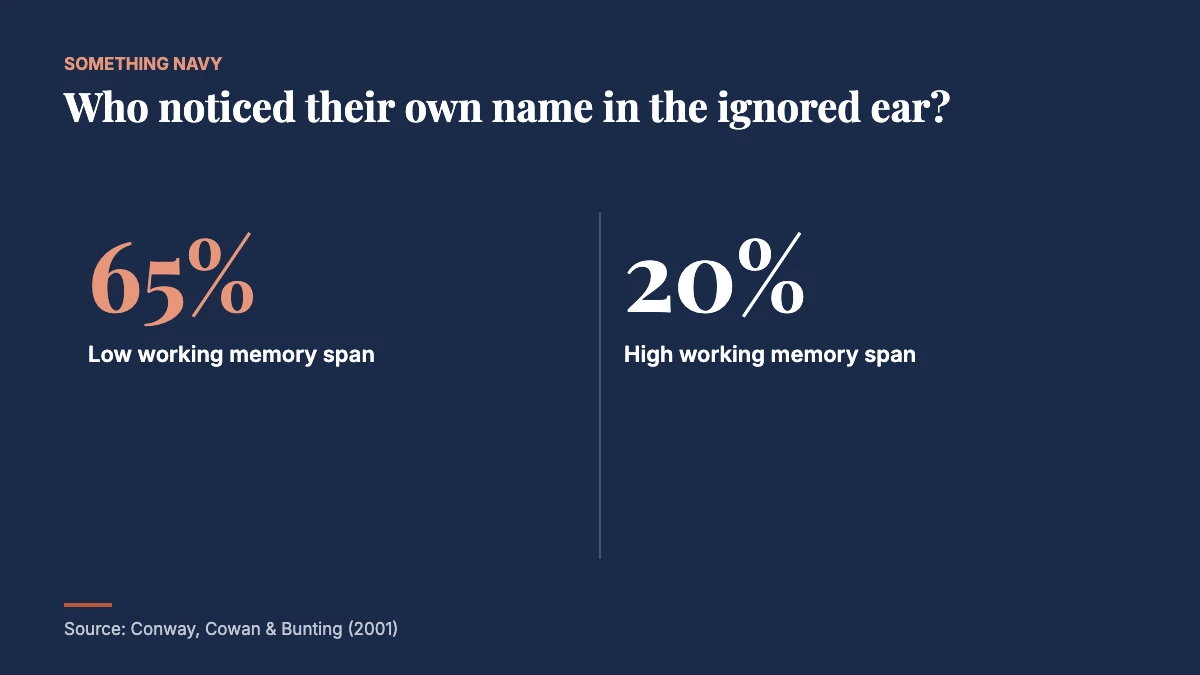
The gap was large. Among low-span participants, 65% reported hearing their name. Among high-span participants, only 20% did. Nobody in either group reported hearing a comparison name used as a control.
The shadowing data told the same story. Low-span participants made more errors overall, averaging about 21 against 10 for the high-span group. People who heard their name, in either group, stumbled on the next two words of the passage they were repeating, then recovered. The name grabbed them, briefly, and let go.
So catching your name across the room is not, on this evidence, a sign of superior multitasking. It looks more like a leak. The authors argued that the key ability is blocking irrelevant information, and that high-span people are simply better at it. If you have read our piece on why multitasking mostly means switching badly, the idea will feel familiar.
The limits matter. This was one study of 40 students, drawn from the extremes of the range, which tends to exaggerate differences. It shows an association, not cause, and the authors noted they had not measured inhibition directly.


What the brain is doing: Mesgarani and Chang’s 2012 study
Behavioural studies cannot show the filtering as it happens. In 2012, Nima Mesgarani and Edward Chang at the University of California, San Francisco, got unusually close.
Their participants were three people with severe epilepsy awaiting surgery, who had up to 256 electrodes placed on the brain’s surface for about a week to map their seizures. That gave a rare, direct view of the temporal lobe, home to the auditory cortex.
The patients heard two speakers talking at once and were asked to report the words spoken by one of them. When the team decoded the brain signals, they found the auditory cortex was mainly representing the speaker the person was attending to, as though the other voice had been turned down. The decoding could tell which speaker and words someone was focused on, and spot when attention drifted. Chang said in a UCSF release that the work “opens a window into the subjective experience of the mind”.
The study, published in Nature, was tiny, and the patients were not typical listeners. But it showed that attention reshapes what the hearing brain represents in the moment, not just what we remember afterwards.
Newer research: the name gets in, even when you don’t turn round
A 2023 study in the Journal of Neuroscience by researchers at Bar-Ilan University in Israel tried something closer to real life. Fifty participants sat in a virtual café, listening to a character at their table, while a barista in the background called out orders. Some of those orders contained the participant’s own name.
The results suggest the ignored voice is processed more deeply than people let on. Brain recordings showed a distinct response to the person’s own name, compared with someone else’s, of the sort usually linked to processing meaning. Skin conductance, a measure of arousal, rose slightly more for their own name, a small-to-moderate effect. Yet people rarely looked towards the barista. When asked in debriefing, 94% mentioned hearing their name without being prompted. The set-up differs from Moray’s in many ways, so the jump from a third to almost everyone is not a simple correction.
A 2024 study in Cognitive Research: Principles and Implications, involving Penelope Sanderson of the University of Queensland, measured the pull of a name in milliseconds. Students at Lingnan University sorted words on a screen while names played. Hearing their own name slowed them down: an average of 772 milliseconds per decision, against 669 when they heard another name. All 37 participants analysed in the first experiment reported hearing their name, perhaps unsurprising given that each of them heard it ten times. When names were sped up to a quarter of their normal length, the slowdown disappeared. The team’s interest was hospital speech alarms. Your name, it seems, needs to sound like your name to grab you.
Hearing loss and the noisy restaurant problem
For people with good hearing, the cocktail party effect is a curiosity. For people with hearing loss, the wider cocktail party problem, following one voice among many, is often the main complaint. Virginia Best of Boston University put it plainly in a 2025 university release: their biggest struggle is “trouble communicating in noisy environments.”

The scale is not small. The World Health Organization’s March 2026 fact sheet says more than 430 million people worldwide have disabling hearing loss, and projects that nearly 2.5 billion will have some degree of hearing loss by 2050. It lists social isolation and loneliness among the effects when hearing loss goes unaddressed. A loud restaurant is where that withdrawal often starts: you stop asking people to repeat themselves, then you stop going.
Technology is trying to borrow the brain’s tricks. In 2025, Alexander Boyd, Virginia Best and Kamal Sen published a study in Communications Engineering testing a brain-inspired sound-separation algorithm called BOSSA with young adults who had sensorineural hearing loss. In their tests it improved word recognition by up to 40 percentage points compared with a standard hearing aid approach. That is a lab result, not a product on a shelf, but it is a promising one.
Noise wears on everyone else too, as our look at what open-plan offices do to concentration found.
How to hear better at a loud table
- Choose your seat: ask for a table away from the speakers, the bar and the kitchen doors.
- Face the person you want to hear, and let them know you are struggling. Most people are happy to lean in.
- Ask staff whether the music can come down a notch. Venues cannot fix a problem they don’t hear about.
- If you leave restaurants exhausted from listening, a hearing check is worth booking. WHO’s free hearWHO app is one way to start.
- Don’t read too much into catching, or missing, your name. In the classic shadowing studies, most people missed it.
What your name tells you about attention
A better picture than a filter is a busy receptionist: most callers are put on hold, but a few words, your name chief among them, get waved through, more easily for some people than others. Curiously, your name works as a lever inside your own head too, as our article on talking to yourself by name explains.
So the next time a voice across the wedding reception snags your attention, you can take it as proof that you were never fully ignoring the room. You were just keeping it on hold.
Frequently asked questions
It is the ability to focus on one conversation in a noisy setting while still noticing important sounds, such as your own name, in the voices you are ignoring. The research behind it began with Colin Cherry’s listening experiments in 1953.
Not in classic lab studies. Moray in 1959 and Wood and Cowan in 1995 both found that only about a third of people noticed their name in a message they were told to ignore, though more realistic recent set-ups report higher figures.
In a 2001 study of 40 students, people with lower working memory capacity were more likely to hear their name (65% against 20%), suggesting it reflects weaker blocking of distraction. It was a small study and shows an association, not a diagnosis.
Official links and research
- Boyd, A. D., Best, V., & Sen, K. (2025). A brain-inspired algorithm improves “cocktail party” listening for individuals with hearing loss. Communications Engineering, 4(1), Article 75. DOI
- Brown, A., Pinto, D., Burgart, K., Zvilichovsky, Y., & Zion-Golumbic, E. (2023). Neurophysiological evidence for semantic processing of irrelevant speech and own-name detection in a virtual café. Journal of Neuroscience, 43(27), 5045–5056. DOI
- Cherry, E. C. (1953). Some experiments on the recognition of speech, with one and with two ears. The Journal of the Acoustical Society of America, 25(5), 975–979. DOI
- Conway, A. R. A., Cowan, N., & Bunting, M. F. (2001). The cocktail party phenomenon revisited: The importance of working memory capacity. Psychonomic Bulletin & Review, 8(2), 331–335. DOI
- Li, S. Y. W., Lee, A. L. F., Chiu, J. W. S., Loeb, R. G., & Sanderson, P. M. (2024). Attention capture by own name decreases with speech compression. Cognitive Research: Principles and Implications, 9, Article 29. DOI
- Mesgarani, N., & Chang, E. F. (2012). Selective cortical representation of attended speaker in multi-talker speech perception. Nature, 485(7397), 233–236. DOI
- Moray, N. (1959). Attention in dichotic listening: Affective cues and the influence of instructions. Quarterly Journal of Experimental Psychology, 11(1), 56–60. DOI
- Wood, N., & Cowan, N. (1995). The cocktail party phenomenon revisited: How frequent are attention shifts to one’s name in an irrelevant auditory channel? Journal of Experimental Psychology: Learning, Memory, and Cognition, 21(1), 255–260. DOI
- World Health Organization. (2026, March 3). Deafness and hearing loss [Fact sheet]. WHO
- University of California, San Francisco. (2012, April). How selective hearing works in the brain [News release]. UCSF
Cover photo: Helena Lopes on Unsplash. Charts and graphics: Something Navy, with photography by Daniel on Unsplash.
How we reported this. Every figure was checked against the 10 sources above. Reviewed by Valentino Adkins, Senior Content Manager. Report an error · How we work