Remember the first evening with your new phone? The glass felt impossibly smooth, the camera made your kitchen look like a film set, and you kept picking it up just to admire it.
Now it is a slab with a cracked corner that you unlock dozens of times a day without a flicker of feeling.
Nothing went wrong with the phone. Something happened to you. Psychologists call it hedonic adaptation: the quiet, efficient process by which the mind turns a thrill into wallpaper. It explains why a bigger house stops feeling big, why a new car becomes “the car”, and why a pay rise feels like a raise for about two payslips.
The surprising part is not that joy fades. It is how predictable the fading is, and how much of it you can slow down once you see the machinery.
So let’s take the questions people actually ask, one at a time.
Is it really true lottery winners end up no happier?
This is the study everyone half remembers. In 1977, Philip Brickman, Dan Coates and Ronnie Janoff-Bulman interviewed 22 people who had won big on the Illinois State Lottery. Seven had won $1 million; the rest had taken home between $50,000 and $400,000. The researchers compared them with 22 people who had not won, and with 29 people who had been left paraplegic or quadriplegic after accidents.
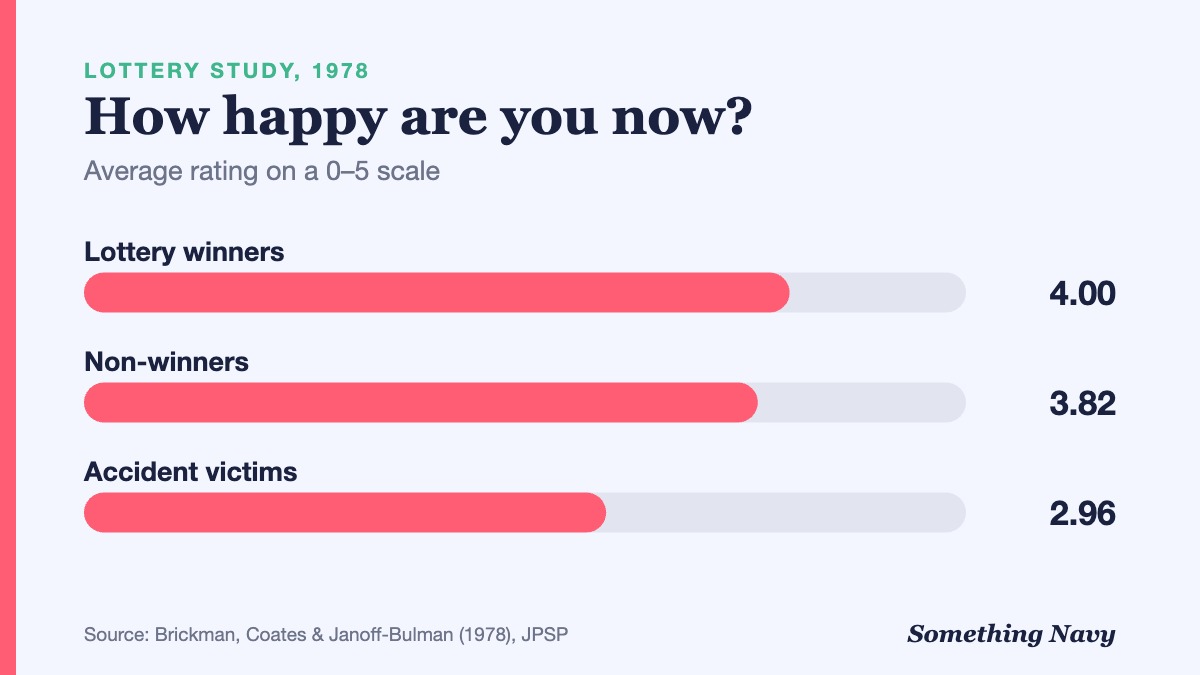
Everyone rated how happy they were at this stage of life on a scale from 0 to 5. The results, published in 1978, have been quoted at dinner parties ever since. The winners scored 4.00. The people who had not won scored 3.82, a gap too small to count statistically.
The accident victims scored 2.96. That is clearly lower, but it is still above the midpoint of the scale, which surprised readers who expected despair.
The finding that tends to get lost is the more interesting one. The researchers asked everyone how much they enjoyed seven ordinary things: talking with a friend, watching television, eating breakfast, hearing a funny joke, getting a compliment, reading a magazine and buying clothes. The winners rated these everyday pleasures lower than the non-winners did, 3.33 against 3.82.
Brickman and his colleagues suggested two forces at work. A huge high resets the yardstick, so ordinary pleasures feel smaller next to it. And over time, the high itself becomes normal.
A big win does not only fade. It can make the small stuff taste blander on the way down.
Hold on, can a study of 22 people carry all that weight?
It cannot, and it was never meant to. The sample was tiny, close to half the winners approached declined to take part, and the study took a single snapshot rather than following people over years. The winners had known about their prize for anything from under a month to 18 months, so nobody tracked what happened afterwards.
It was a clever, provocative paper that opened a question. The popular version, “winning the lottery makes no difference”, is a cartoon of it. Later research has found that money and circumstances can matter more than this one snapshot implied, which is a story we cover in our piece on whether money really buys happiness.
What survived, and has been confirmed many times since, is the core observation: people get used to good things much faster than they expect to.
Does everyone have a happiness “set point” they always drift back to?
For decades the dominant answer was yes. The idea was that each of us has a baseline, largely inherited, and that life events push us up or down only briefly before we float back to it, like a cork in water.
Richard Lucas, a psychologist at Michigan State University, tested that idea with something the lottery researchers never had: years of data on the same people before and after big life events. Working with large national panel surveys from Germany and Britain, which asked the same people about their life satisfaction year after year, he and his colleagues could see what people were like before a wedding, a job loss or a disability, not just afterwards.
In a 2007 review of that work, Lucas reported a more mixed picture. Marriage brought a lift around the wedding, but on average people were back at their earlier level within about two years. People who lost a spouse took longer, roughly seven years on average, to adapt.
Other events left a mark that did not fade. On average, people who went through divorce or unemployment did not return to their earlier level of life satisfaction, and serious illness or disability was linked to significant, lasting drops.
His summary was blunt: “Happiness levels do change, adaptation is not inevitable, and life events do matter.”
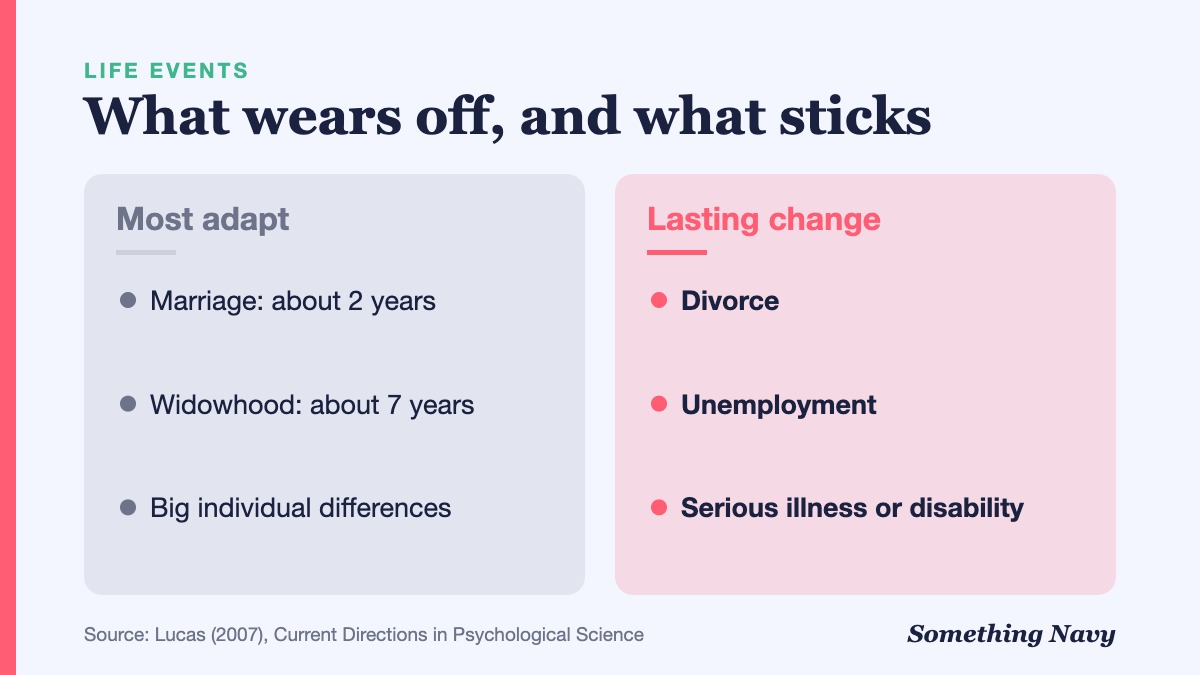
He also found large differences between individuals. The averages hide people who adapt quickly and people who barely adapt at all.

So if bad things can stick, why don’t good things?
Partly because of what each one does to your days. A disability or a lost job changes what you can do, every day, in ways you keep bumping into. A new car changes your commute for a week and then becomes the way you commute.
Kennon Sheldon at the University of Missouri and Sonja Lyubomirsky at the University of California, Riverside, describe the fade as two leaks working together. In a 2012 study, they surveyed 481 university students three times, roughly six weeks apart. At each point students named the best positive change in their lives over the previous weeks, such as a new relationship, a new job or a new vehicle, and rated how much it was still giving them.
First leak: the good thing produces fewer and fewer happy moments, because you stop noticing it. Second leak: your expectations quietly rise to meet it. The pay rise becomes your salary. The house becomes your house. As the authors put it, “The happiness that comes from a particular success or change in fortune abates with time.”
The pay rise didn’t stop being money. It stopped being news.
Is that why my pay rise felt amazing for about a fortnight?
Very likely. Money is almost perfectly designed to be adapted to. It arrives in the same account, in the same format, on the same day each month. There is nothing new to notice after the first time.
Worse, a raise tends to fund small upgrades to things you already do, a nicer coffee, a better brand of olive oil, which then become the new normal too. In Sheldon and Lyubomirsky’s terms, the aspirations leak wins.
That does not mean the extra money is useless. It means the feeling of being richer is a short-lived signal, while the practical benefits, a bit less worry or a bit more choice, carry on working quietly in the background. You stop feeling the raise; you don’t stop having it.
Should I buy experiences instead of things, then?
This is the most famous practical advice in the field, and it comes from a 2003 paper by the psychologists Leaf Van Boven and Thomas Gilovich (Gilovich is based at Cornell University).
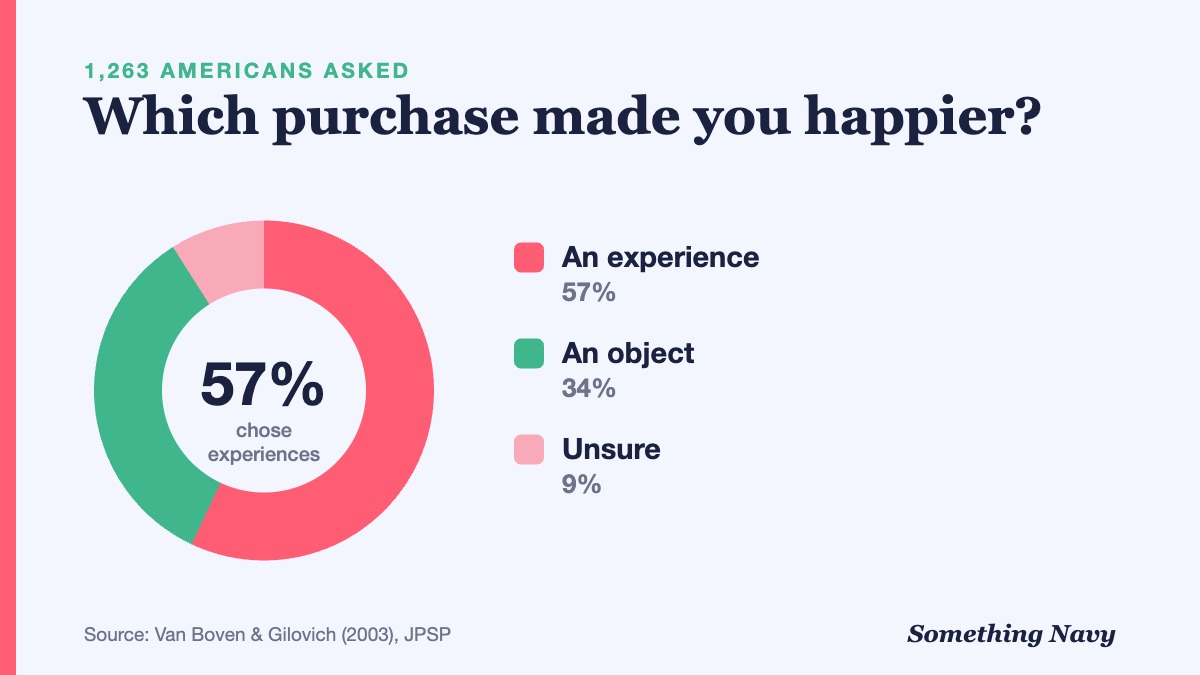
In one of their studies, a national telephone survey reached 1,263 Americans aged 21 to 69. Each was asked to think of a material purchase and an experiential purchase made to increase their happiness, and to say which had done more. 57% picked the experience, such as a trip or a concert. 34% picked the object. The remaining 9% or so were unsure.
One explanation is about adaptation. A sofa is there every day, so you get used to it every day. A holiday ends, and then lives on in memory, where it is often edited into something better than it was. We go into how memory tidies up experiences in our piece on the peak-end rule.
Is there a catch?
Two, and they matter.
First, the advantage was not universal in that survey. It was stronger among people with more income and education, and in the lowest-income group the split was roughly even. If you are worried about the bills, a reliable washing machine may genuinely do more for you than a weekend away.
Second, the memory effect cuts both ways. In a 2009 set of experiments, Leonardo Nicolao, Julie Irwin and Joseph Goodman tracked several hundred students’ happiness with small purchases over periods of up to two weeks. Experiences that went well did make people happier than objects did. Experiences that went badly made them unhappier, and for longer. Lead author Nicolao summed it up: “people adapt more slowly to experiences than to objects.”
So a disastrous holiday can sting long after a disappointing toaster has been forgotten. Slow adaptation is a gift only when the experience is good.
What if I just take a break from the thing I love?
This is the least intuitive finding in the whole field, and possibly the most useful.
Leif Nelson, then at the University of California, San Diego, and Tom Meyvis at New York University’s Stern School of Business ran six studies in 2008 in which people did something mildly pleasant and rather repetitive, such as sitting in a massage chair or listening to music. Some had their experience interrupted by a short break; others had it straight through.
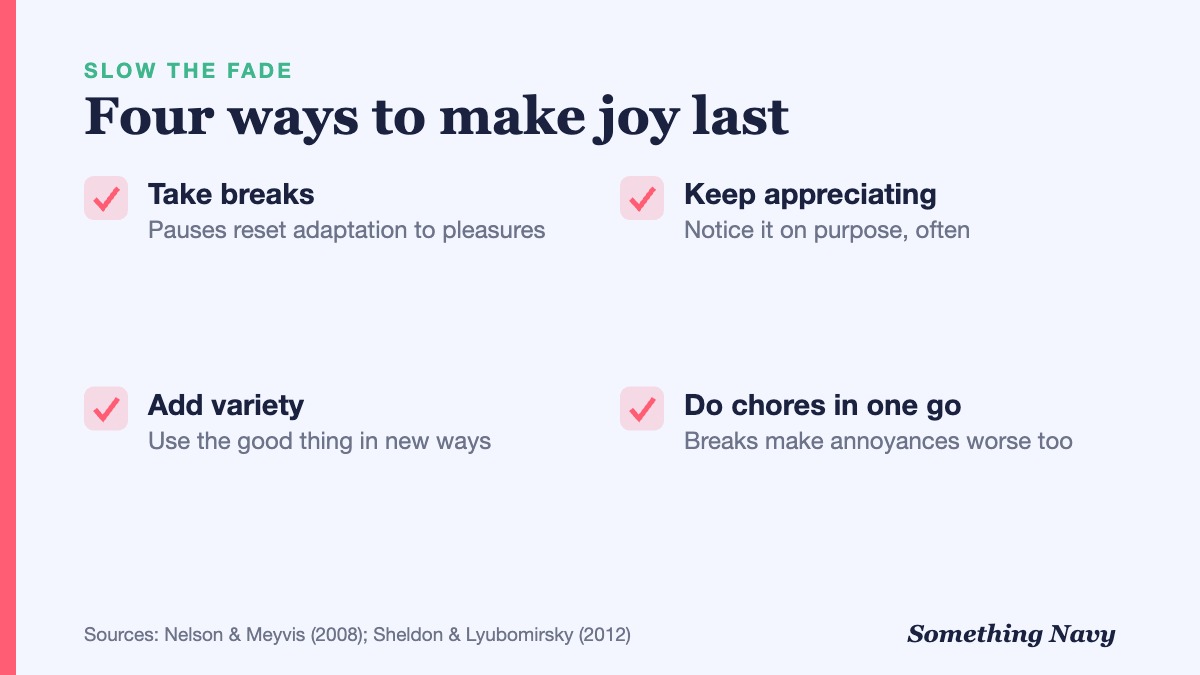
Breaks made the pleasant experiences more enjoyable. The pause seemed to reset adaptation, so the pleasure came back fresher. Yet when people were offered the choice, they tended to avoid the breaks, because they assumed interruptions would spoil things.
The same logic runs in reverse. Interruptions made an irritating noise more irritating, because adaptation to the bad thing was reset too. That suggests doing chores in one unbroken stretch, and spreading treats out.
Nelson, Meyvis and Jeff Galak then pushed this somewhere almost comic. In a 2009 follow-up, students who watched a sitcom with its original advert breaks enjoyed it more than those who watched it ad-free, even though people predicted the opposite. The effect was not universal (in one study it held for younger viewers but not older ones), but the pattern kept turning up.
The pause is part of the pleasure.
How do I keep enjoying the house, the car, the relationship?
Sheldon and Lyubomirsky’s students point the way. Among the 481, the people who held on to their boost were not simply those with the biggest changes. They were the ones who kept getting variety out of the change, and who kept appreciating it rather than taking it for granted. Variety and appreciation both slowed the creep of rising expectations.
It is worth being honest about the limits: this was one group of US students reporting on themselves over a few months, and the study shows associations rather than proving cause. But it fits neatly with the interruption experiments and with decades of work on attention.
A new car you only drive to work becomes furniture. The same car taken somewhere new on a Sunday keeps giving you something to notice.
Try this today
- Ration the good stuff. Leave a gap between episodes of your favourite show, or between the squares of good chocolate. A short break can make the next bit taste better.
- Do the boring jobs in one go. Breaks reset annoyance too, so a single 40-minute tidy beats four 10-minute ones.
- Use the thing differently. Cook a new dish in the kitchen you renovated. Take the bike on a route you have never ridden.
- Picture it gone. Spend 30 seconds imagining your home, partner or job had never come along. Contrast brings the colour back.
- Spend on something that will become a story, if your basics are covered, and accept that a bad trip can sting for longer than a bad gadget.
Is it a bit sad that we’re built to get bored of good things?
It can feel that way. But adaptation is the same system that rescues us. It is why widowed people, on average, slowly rebuild their lives; why the dread of a new job turns into routine; why the accident victims in 1978, on average, still put themselves above the midpoint of the scale.
Lucas made this point too. Adaptation helps people move on from long periods of distress and let go of goals that are no longer realistic. A mind that never adjusted would be stuck forever, in the best moments and in the worst.
The trick is to know which way the current runs. It will carry you back up after many knocks, and it will quietly carry you back down after a win. Deliberate gratitude is one way of rowing against it: it is appreciation on purpose, the very ingredient that slowed the fade in Sheldon and Lyubomirsky’s students.
So should I stop buying nice things?
No. Buy the nice thing. Just stop expecting it to do the job forever on its own.
The research does not say joy is pointless because it fades. It says joy is a renewable resource that needs a little management: some variety, some gaps, some attention. The people who stay delighted with their lives are rarely the ones who own the most. They are the ones who keep noticing.
Tonight, pick up the phone you stopped seeing. Look at what that camera can do, the way you did on the first evening.
It is still the same phone. You just get to meet it again.
Sources
- Brickman, P., Coates, D., & Janoff-Bulman, R. (1978). Lottery winners and accident victims: Is happiness relative? Journal of Personality and Social Psychology, 36(8), 917–927. DOI
- Lucas, R. E. (2007). Adaptation and the set-point model of subjective well-being: Does happiness change after major life events? Current Directions in Psychological Science, 16(2), 75–79. DOI
- Sheldon, K. M., & Lyubomirsky, S. (2012). The challenge of staying happier: Testing the hedonic adaptation prevention model. Personality and Social Psychology Bulletin, 38(5), 670–680. DOI
- Van Boven, L., & Gilovich, T. (2003). To do or to have? That is the question. Journal of Personality and Social Psychology, 85(6), 1193–1202. DOI
- Nicolao, L., Irwin, J. R., & Goodman, J. K. (2009). Happiness for sale: Do experiential purchases make consumers happier than material purchases? Journal of Consumer Research, 36(2), 188–198. DOI
- Nelson, L. D., & Meyvis, T. (2008). Interrupted consumption: Disrupting adaptation to hedonic experiences. Journal of Marketing Research, 45(6), 654–664. DOI
- Nelson, L. D., Meyvis, T., & Galak, J. (2009). Enhancing the television-viewing experience through commercial interruptions. Journal of Consumer Research, 36(2), 160–172. DOI
Cover photo: Sam Grozyan on Unsplash. Charts and graphics: Something Navy.
How we reported this. We went back to the original research for this story, 7 sources in all, listed above, and checked every figure against them. If you think we have got something wrong, tell us and we will look at it. Read more about how we work.