
The party was not going well. According to Leslie Jamison’s 2023 account in The New Yorker, two young psychologists at Oberlin College in Ohio, Pauline Clance and Suzanne Imes, found themselves at a disappointing student gathering in the early 1970s and decided to rescue it by turning it into a discussion circle.
What came out of that circle was not small talk. Students who by any outside measure were thriving began confessing that they felt like frauds, that they had slipped through somehow, and that one day someone would notice.
Clance and Imes recognised the feeling. They had already been comparing notes about their own sense of fraudulence. Within a few years they would give it a name that now turns up in job interviews, graduation speeches and celebrity profiles. Just not quite the name they chose.
More than 150 women who thought they had fooled everyone
Both women later moved to Atlanta, Clance to teach at Georgia State University and Imes to complete her PhD there. Over five years they talked with more than 150 “successful” women, many of them in therapy, and noticed the same pattern again and again.
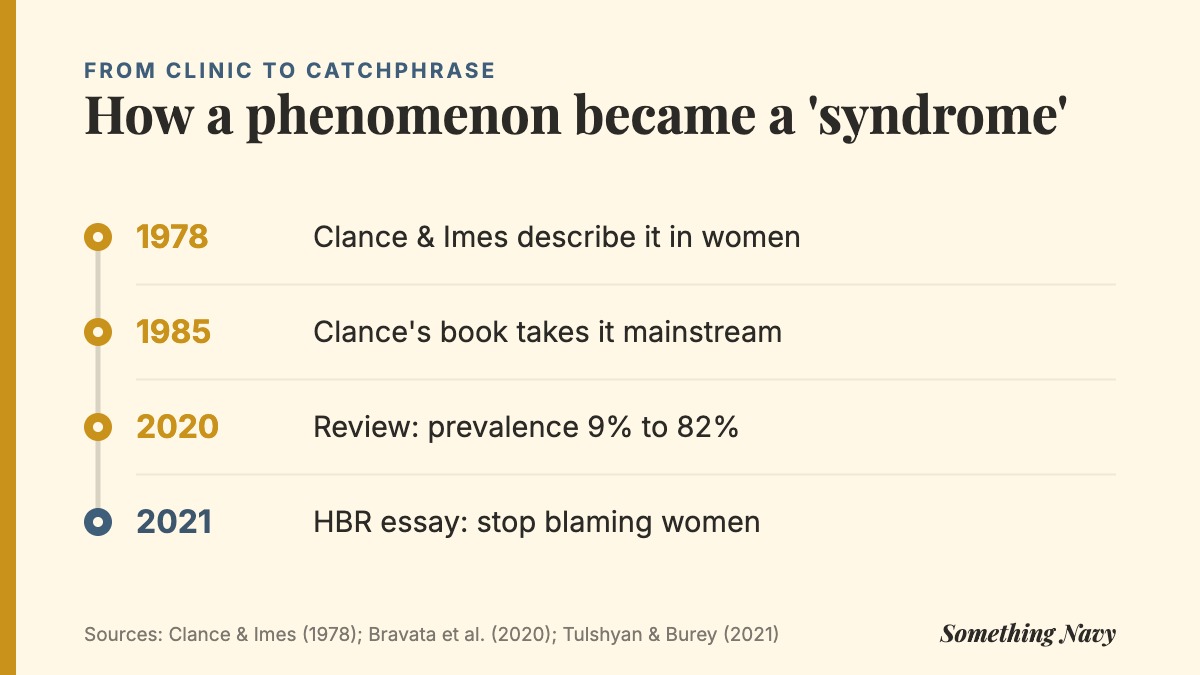
In 1978 they published what they had seen in the journal Psychotherapy: Theory, Research and Practice, under the title “The impostor phenomenon in high achieving women: Dynamics and therapeutic intervention”. They described it as “an internal experience of intellectual phoniness”: a conviction, held despite degrees, promotions and praise, that you are not really as able as other people think.
It is worth being clear about what kind of paper this was. It was not a survey or an experiment. There was no control group and no questionnaire with a cut-off score. It was a clinical description, drawn from the authors’ therapy rooms and conversations, of how a particular group of high-achieving women talked about themselves.
The paper traced the feeling partly to family dynamics and to the messages girls received about intelligence and success. It also offered practical ideas from group therapy. Clients were encouraged to list the people they believed they had fooled, and to note the positive feedback they received alongside their reasons for dismissing it. Simply hearing that others in the room felt the same way, the authors suggested, did a great deal of the work.
Based on their clinical experience, Clance and Imes thought the experience was less common in men. That impression would not survive later research, as we will see.
Why they chose the word phenomenon
The word in the title matters. Clance and Imes did not call it a syndrome, a disorder or a complex. They called it a phenomenon, and they meant it.
In psychiatry, a syndrome is a cluster of symptoms that tends to signal an underlying condition. Clance has described what she and Imes observed as an experience, not a pathology. Their aim, as Jamison reports, was to normalise the feeling, not to turn it into something people could be diagnosed with.
It has never become a formal diagnosis. You will not find impostor syndrome in the diagnostic manuals clinicians use, and there is no agreed threshold at which an ordinary wobble of self-doubt becomes a clinical problem.
Yet popular culture rebranded it anyway. By the time the idea truly took off, it was “impostor syndrome” almost everywhere, a shift both women have found frustrating, according to Jamison.
The spelling has drifted too. The original paper used “impostor”, which is still the form most researchers prefer. “Imposter” is now just as common in everyday writing, and both are correct.
How a careful label became a catchphrase
In 1985 Clance published a book on the subject, which helped carry the idea beyond therapy rooms and journals. In it she described what she called the impostor cycle, a loop we will come back to, and the concept began to be measured with questionnaires rather than simply observed.
From there it spread in two directions at once. Researchers built scales and ran studies, often on students. Meanwhile the phrase entered management books, careers advice and confessional interviews, usually with “syndrome” attached and usually aimed at women.
That second strand gave the idea enormous reach. It also loosened it. A term coined to describe a specific, stubborn pattern in high achievers began to be applied to almost any moment of nerves at work, including the perfectly sensible nerves of doing something difficult for the first time.
Counting impostors: the 9 to 82% problem
So how common is it? The most thorough attempt to answer that came from a team led by Bravata, who published a systematic review in the Journal of General Internal Medicine (online in December 2019, in print in 2020).
The researchers searched the literature for studies that measured impostor feelings with a validated questionnaire. They found 62 that qualified, covering 14,161 participants, 60% of them women. Half of the studies were of students, and the weighted average age of participants, where reported, was just 20.
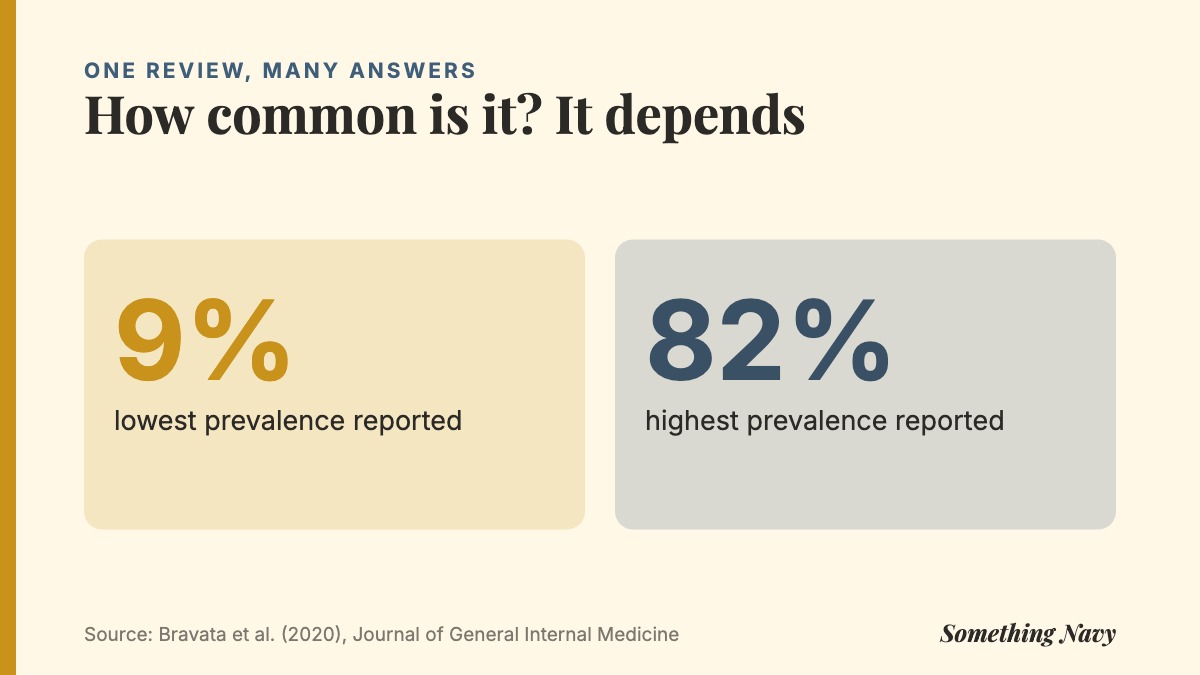
The headline result is not a single number. Reported prevalence ranged from 9% to 82%, depending largely on which screening tool was used and where the cut-off was set.
That spread is the finding. If one study draws the line at a modest score and another at a high one, they will produce wildly different answers about how many people “have” impostor feelings, even in similar groups. When you see a confident claim that 70% of people experience it, the honest response is to ask: measured how, and in whom?
The review found other things worth knowing. Impostor feelings often occurred alongside depression and anxiety, and were associated with worse job performance, lower job satisfaction and burnout. The abstract also reports that rates were particularly high among ethnic minority groups, although the individual studies behind that summary were not uniform.
All of these are associations. A study that finds impostor feelings and burnout together cannot tell you which came first, or whether something else, such as an unsupportive workplace, drives both.
Most striking of all: the authors found no published studies that had tested a treatment. After four decades of books, workshops and coaching programmes, nobody had yet run a trial showing that any of it worked.


Men feel it too, and may handle it worse
The 1978 paper focused on women, and the popular version of the idea has stayed stubbornly female. The data tell a different story. Bravata’s review concluded that impostor feelings were common among both men and women, and across ages from adolescents to late-career professionals.
Clance herself revised her view. As The Psychologist reported in 2010, she had initially believed the experience mainly affected women, but men, including male academics, later reported it too. Some studies find women scoring higher; many find no meaningful difference.
There may, though, be a difference in how the feeling plays out. In 2018 a team led by management researcher Rebecca Badawy reported two experiments with undergraduates in the journal Personality and Individual Differences. Students answered questions from the GRE, a graduate admissions test. In one study, half were falsely told they had got every answer in the first set wrong. In the other, half were told a professor would see their results.
Women in the sample reported higher impostor feelings overall. But under pressure, men with strong impostor feelings became more anxious, put in less effort and tended to perform worse. Women with strong impostor feelings, given harsh feedback, actually tried harder and did better.
The authors suggested the men might be self-handicapping, easing off so they had a ready excuse for failure, perhaps because traditional norms expect men to be competent. They were candid that the findings were exploratory, based on students in a lab, and might not generalise. It is one intriguing study, not a settled fact. But it is a useful corrective to the idea that this is a women’s problem.
The loop that keeps success from sticking
The most useful part of Clance’s work may be her description of how impostor feelings sustain themselves. As summarised by psychologists Jaruwan Sakulku and James Alexander in a 2011 review, the impostor cycle runs like this.
It starts with a new task that matters: an exam, a pitch, a promotion. Anxiety rises. The person then does one of two things. Either they over-prepare, working far beyond what the task requires, or they procrastinate and then prepare in a frantic rush.
The task goes well. There is a brief flicker of relief. Then the explanation arrives. The over-preparer decides they only succeeded because they worked so hard. The procrastinator decides they got lucky. Either way, ability does not get the credit, and positive feedback is quietly discounted.
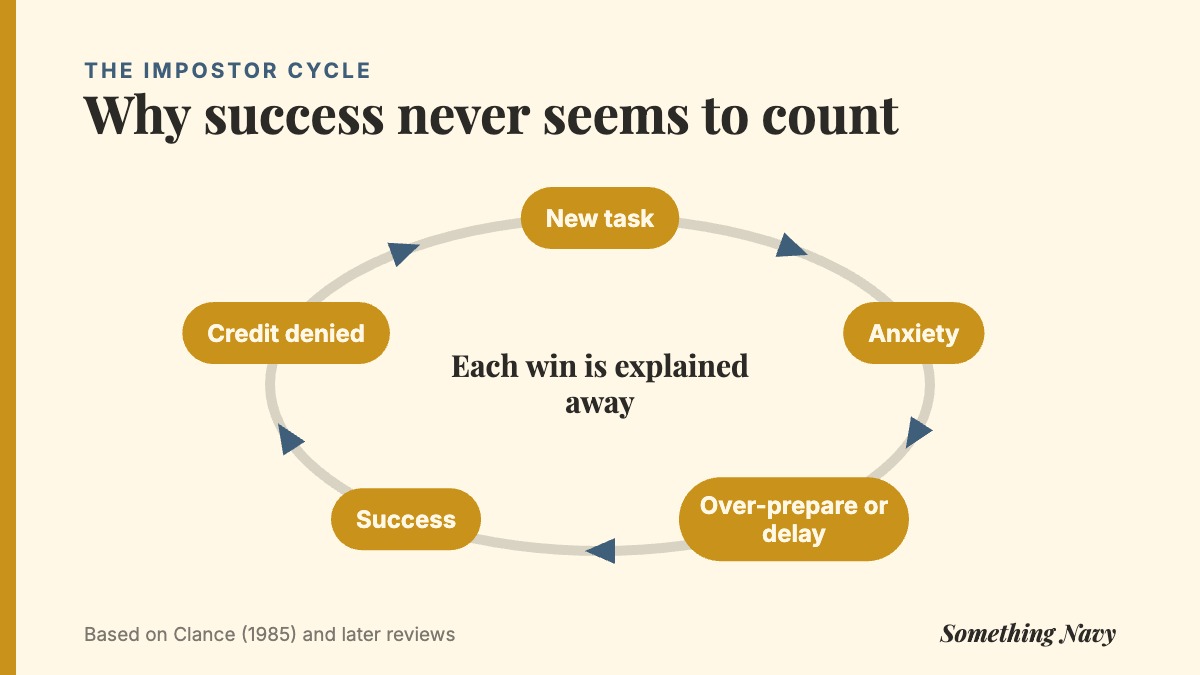
This is why success alone does not cure impostor feelings, and can even feed them. Every win is filed under effort or luck, which means the next task must be met with the same anxiety and the same punishing preparation. A promotion simply raises the stakes for the next round.
It is also why the feeling can look, from the outside, like conscientiousness. The over-preparer is often the person colleagues admire most, which makes the cycle easy to miss and hard to question.
The critics who want the label retired
Not everyone thinks the concept, at least in its popular form, has done more good than harm. In 2021 Ruchika Tulshyan and Jodi-Ann Burey published an essay in Harvard Business Review with a blunt title: “Stop telling women they have imposter syndrome”.
Their argument was that the label takes an ordinary feeling of discomfort and second-guessing at work and turns it into a personal flaw, especially for women. The concept, they noted, was developed in the 1970s without accounting for systemic racism, classism and other biases. If you are regularly overlooked, interrupted or doubted, feeling like an outsider may be an accurate reading of your situation, not a distortion.
Imposter syndrome directs our view toward fixing women at work instead of fixing the places where women work.
Ruchika Tulshyan and Jodi-Ann Burey, Harvard Business Review (2021)
Others interviewed by Jamison made a similar point: people from groups that were missing from the original sample often struggle to recognise themselves in it, and what gets labelled impostor syndrome can sometimes be the strain of working inside a system that was not built with them in mind.
Clance and Imes have acknowledged that their original sample was limited. Their model focused on family and gender socialisation, not on discrimination. That is not a scandal; it is what a small clinical paper from 1978 looks like. The problem is treating it as a universal explanation five decades later.
Myths it is worth dropping
- “It’s a mental health condition.” It is not a recognised diagnosis. Its originators called it a phenomenon and described it as an experience, not a pathology.
- “It mostly affects women.” The 1978 paper studied women, but later research finds it common in men too, at every age.
- “Seven in ten people have it.” Prevalence estimates range from 9% to 82%, depending on the questionnaire and the cut-off.
- “Proven techniques can cure it.” As of the 2020 review, no published study had tested a treatment.
- “If you feel like an outsider, the problem is you.” Sometimes the doubt is distorted. Sometimes the environment really is treating you as if you do not belong.
What the evidence can and cannot tell you
Put together, the research supports a few modest conclusions. Feeling like a fraud despite clear evidence of competence is common, in men and women, students and senior professionals. It tends to keep company with anxiety, low mood and burnout. And it appears to sustain itself through a recognisable loop of anxiety, overwork or delay, success and dismissal.
It supports far less than the popular version claims. There is no reliable single prevalence figure. There is no tested cure. And the original concept was built on a narrow group of women in therapy, without the tools to separate private self-doubt from the very public signals some people receive that they do not belong.
There is also a quieter risk in the label’s popularity. Jamison notes how often impostor syndrome is now confessed, almost as a badge of humility. If everyone has it, the term starts to blur a useful distinction between the nervousness of doing something hard and a persistent, corrosive belief that your achievements are fake.
Something related happens with the spotlight effect, the tendency to overestimate how much other people notice our slips. Impostor feelings often rest on a similar assumption: that colleagues are scrutinising us for signs of fraud far more closely than they are.
Holding the feeling more lightly
If the feeling is familiar, the most useful first step may be the one Clance and Imes started with at that flat Oberlin party: saying it out loud. Hearing that respected colleagues feel the same way does not prove you are competent, but it does weaken the belief that you alone are faking.
Their homework suggestions still make sense as exercises, even without trial evidence behind them. Write down the praise you receive, and next to it the reason you gave yourself for dismissing it. Seen in black and white, “they were just being nice” and “I got lucky” start to look less like insight and more like a habit.
It can also help to interrupt the cycle at the preparation stage. If you know you will over-prepare, set a limit in advance using if-then planning: if I have rehearsed the talk three times, then I stop. That leaves room for a more accurate explanation when it goes well.
And it is worth asking the question the critics raise. Is this doubt coming from inside, or am I responding to something real in the room? Sometimes the answer is both. Clance and Imes never set out to diagnose anyone. They set out to describe an experience so that people would feel less alone in it, which may still be the best thing the idea can do.
Sources
- Clance, P. R., & Imes, S. A. (1978). The impostor phenomenon in high achieving women: Dynamics and therapeutic intervention. Psychotherapy: Theory, Research & Practice, 15(3), 241–247. DOI
- Bravata, D. M., Watts, S. A., Keefer, A. L., Madhusudhan, D. K., Taylor, K. T., Clark, D. M., Nelson, R. S., Cokley, K. O., & Hagg, H. K. (2020). Prevalence, predictors, and treatment of impostor syndrome: A systematic review. Journal of General Internal Medicine, 35(4), 1252–1275. DOI
- Badawy, R. L., Gazdag, B. A., Bentley, J. R., & Brouer, R. L. (2018). Are all impostors created equal? Exploring gender differences in the impostor phenomenon-performance link. Personality and Individual Differences, 131, 156–163. DOI
- Sakulku, J., & Alexander, J. (2011). The impostor phenomenon. International Journal of Behavioral Science, 6(1), 73–92. DOI
- Tulshyan, R., & Burey, J.-A. (2021, February 11). Stop telling women they have imposter syndrome. Harvard Business Review. Link
- Jamison, L. (2023). Why everyone feels like they’re faking it. The New Yorker. Link
- Jarrett, C. (2010). Feeling like a fraud. The Psychologist. British Psychological Society. Link
How we reported this. We went back to the original research for this story, 7 sources in all, listed above, and checked every figure against them. If you think we have got something wrong, tell us and we will look at it. Read more about how we work.
Cover photo: Vitaly Gariev on Unsplash. Charts and graphics: Something Navy.