
How many close friends do you have? Not acquaintances, not colleagues you like, not people you follow online, but friends you could call at two in the morning. For many adults, the honest answer is smaller than they would like, and smaller than it might have been a generation ago.
Surveys in the United States and Britain have been tracking friendship for decades, and together they tell a story of fewer close friends, less time together and a quiet rise in loneliness. They also show that the picture is more varied, and more hopeful, than the gloomiest headlines suggest. Here is what the numbers actually say, and what they mean for the rest of us.
The headline figure: America, 1990 and 2021
The most widely quoted numbers come from a survey of 2,019 American adults carried out in May 2021 by the Survey Center on American Life. It asked people how many close friends they had, not counting relatives, and compared the answers with a Gallup poll from 1990.
| Number of close friends | 1990 | 2021 |
|---|---|---|
| None | 3% | 12% |
| Three or fewer | 27% | 49% |
| Ten or more | 33% | 13% |
The shift is striking. The share of Americans with no close friends at all quadrupled, from 3% to 12%. Almost half of adults now said they had three or fewer close friends, compared with just over a quarter in 1990. At the other end, the share with a wide circle of ten or more close friends fell from a third to around one in eight.
Some writers have called this a “friendship recession”. It is a vivid phrase, but the numbers need some context. The 2021 survey took place during the pandemic, when social life was unusually disrupted, and different surveys ask the question in slightly different ways. Earlier Gallup data, from 2003, found Americans had a median of five close friends, and only 2% said they had none.
A second opinion from Pew
Two years later, the Pew Research Center asked more than 5,000 American adults a similar question, and found a less dramatic picture.
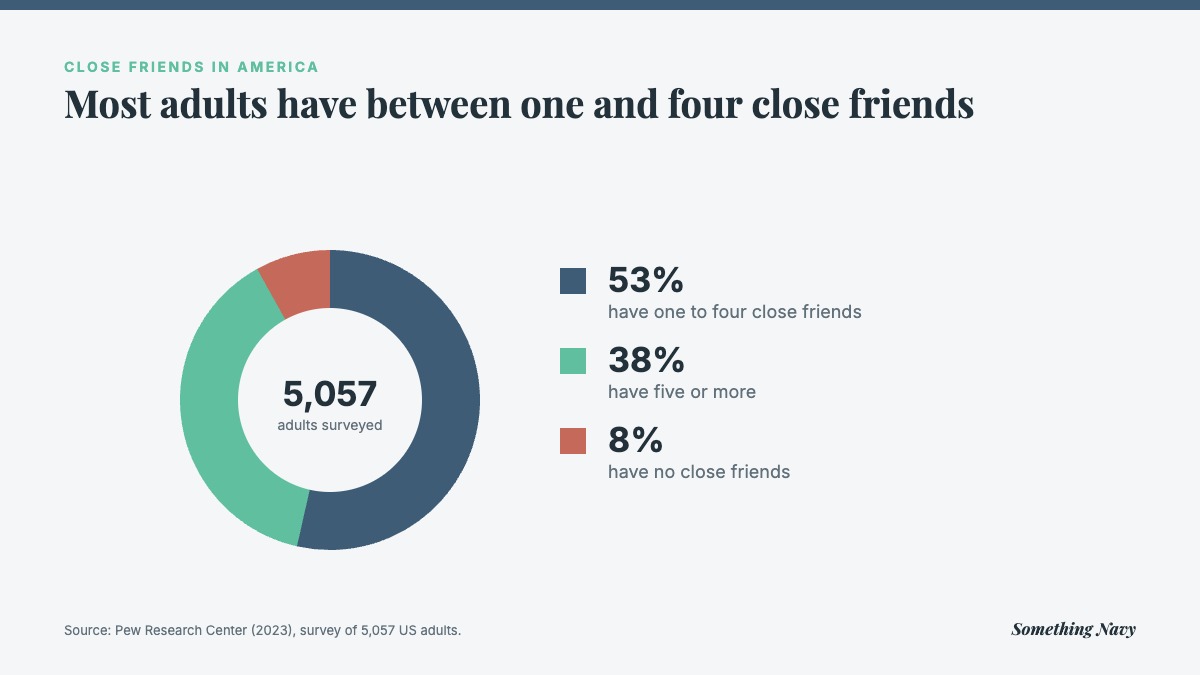
Just 8% said they had no close friends. More than half, 53%, said they had between one and four, and 38% had five or more. Pew’s figures suggest that most people do have a small, close circle, even if it is narrower than they might wish.
Pew also found clear differences by age, and they ran in an unexpected direction. Nearly half of adults aged 65 and over, 49%, said they had five or more close friends. Among those under 30, the figure was 32%. Older people, it seems, have often had decades to build and keep friendships, while younger adults are still in the period of life when people move, change jobs and start families, all of which can scatter friendship groups.
Less time together
Even people with friends are spending less time with them. In his 2023 advisory on loneliness, the US Surgeon General reported that Americans’ time spent in person with friends fell from about 60 minutes a day in 2003 to about 20 minutes a day in 2020. Over a month, that is a drop from roughly 30 hours to 10. The decline was steepest among people aged 15 to 24, the age at which many lasting friendships are formed. Over a similar period, the time Americans spent alone went up.
Some of that change reflects the pandemic. Much of it, however, began well before 2020 and appears to be tied to longer-term shifts in how people work, commute, move house and spend their leisure time, including a growing share of it on screens.
Why is this happening?
No single cause explains the decline, and researchers are careful about claiming one. But several long-running changes in how people live point in the same direction.
People move more than they used to, often for university or work, and every move can leave a friendship group behind. Many adults now marry and have children later, which can mean a long stretch of life in which friends drift as they settle in different places on different timelines. Working hours and commutes eat into evenings. And as more leisure time moves on to screens, the casual, unplanned encounters that once filled pubs, clubs, churches and community halls have become less common.
None of these changes is inherently bad. Moving for a good job, starting a family or enjoying a quiet night in are all reasonable choices. The difficulty is that friendship tends to thrive on exactly the things these changes reduce: proximity, routine and unstructured time together.
Does social media fill the gap?
It is tempting to assume that online contact has replaced face-to-face friendship, and in some ways it has helped. Messaging makes it easier to stay in touch with friends who live far away, and online groups can connect people with shared interests who would never otherwise meet.
But the surveys are asking about close friends, the people we confide in and rely on, and those relationships appear to depend heavily on time spent together in person. Scrolling through someone’s updates can create a sense of keeping up with their life without the shared experiences that actually deepen a friendship. At best, online contact seems to support friendships that already exist. It is less clear that it can build new ones on its own.
The pandemic question
The 2021 figures were collected while many countries were still living with restrictions on social contact, so it is reasonable to ask whether they captured a temporary dip. Some of the change probably was temporary. But the Surgeon General’s data on time spent with friends shows a decline that began long before 2020, and the 2023 Pew survey, carried out after restrictions had ended, still found a meaningful minority of adults with no close friends at all. The pandemic seems to have accelerated an existing trend rather than created a new one.
What about Britain?
In the UK, the Office for National Statistics tracks loneliness rather than friendship counts. In its survey covering December 2023 to January 2024, about a quarter of adults, 27%, said they felt lonely always, often or some of the time, and 7% said they felt lonely always or often. Those figures have been relatively stable since early 2020.
Loneliness and having few friends are not the same thing. Some people with large networks feel lonely, and some people with one or two close friends feel deeply connected. But the two are closely related, and both trends point in the same direction.
Men, women and the kind of friendship
The Survey Center data also highlighted a difference in what friendship looks like for men and women. In the week before the survey, 41% of women said they had received emotional support from a friend, compared with 21% of men. Nearly half of women, 48%, had shared private feelings with a friend, compared with 30% of men.
That does not mean men have fewer friends. In Pew’s survey, men were slightly more likely than women to report five or more close friends, 40% compared with 36%. The difference seems to lie in what happens within those friendships, with many men reporting fewer of the conversations that leave people feeling supported.


How many friends can we actually have?
There may be natural limits to how many close relationships any of us can maintain. The anthropologist Robin Dunbar of the University of Oxford has spent decades studying the structure of social networks. In a 2018 review in Trends in Cognitive Sciences, he opens with a bold claim: “Friendship is the single most important factor influencing our health, well-being, and happiness.”
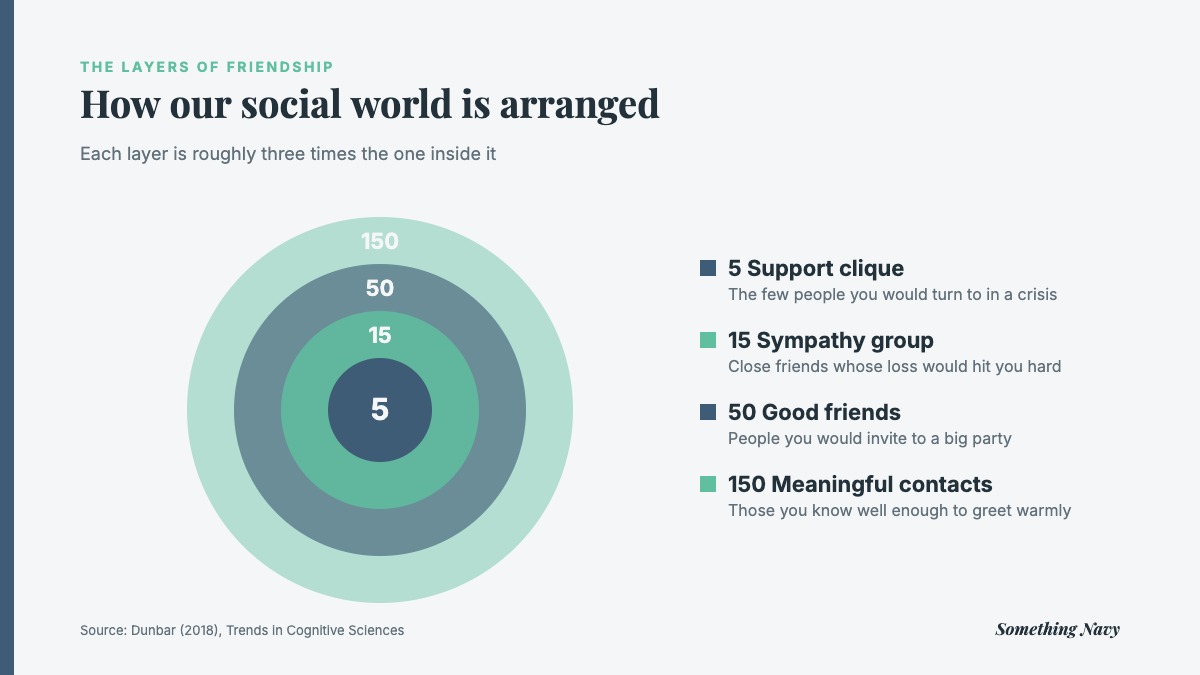
Dunbar’s work, and later research building on it published in PNAS, suggests that our relationships are arranged in layers of increasing size and decreasing emotional closeness. A commonly cited version describes an inner circle of around five intimate friends, then about 15 good friends, around 50 friends, and roughly 150 meaningful contacts. Each layer is about three times the size of the one inside it.
If that is right, having four or five truly close friends is not a sign of social failure. It may be close to what human beings are built for. The worry is not that most people have only a handful of close friends, but that a growing minority have none at all.
Friendship is the single most important factor influencing our health, well-being, and happiness.
Robin Dunbar, Trends in Cognitive Sciences, 2018
Why it matters for health
Friendship is not just pleasant. It appears to be good for us in a measurable way. In a landmark 2010 meta-analysis in PLoS Medicine, Julianne Holt-Lunstad, Timothy Smith and Bradley Layton combined 148 studies involving more than 308,000 people. They found that people with stronger social relationships had a 50% greater likelihood of survival over the study periods than those with weaker ones. The effect was comparable to well-known risk factors such as smoking.
Quality, not just quantity
It is easy to read these figures as a scoreboard, with more friends always better. But the research on health and happiness tends to emphasise the quality of relationships as much as their number. One friend who listens, shows up and knows you well may matter more than a dozen people you see occasionally.
That is part of why the gender findings are so interesting. A man with several friends he plays football with but never confides in may have a respectable number on paper and still lack the kind of support that helps in a crisis. Equally, someone with a single close friend and a warm network of acquaintances may be far better connected than the surveys suggest.
So a useful question is not only “how many close friends do I have?” but “who would I call if something went wrong, and when did I last really talk to them?” If the answer to the second part is “a while ago”, that is often the easiest place to start.
How friendships are made
The good news is that friendship responds to effort, and the research is surprisingly practical about what that effort involves. A classic study of student housing at the Massachusetts Institute of Technology in the late 1940s, by Leon Festinger, Stanley Schachter and Kurt Back, found that residents were most likely to become friends with the people who lived closest to them. Proximity, and the casual encounters it creates, is one of the most reliable ingredients of friendship.
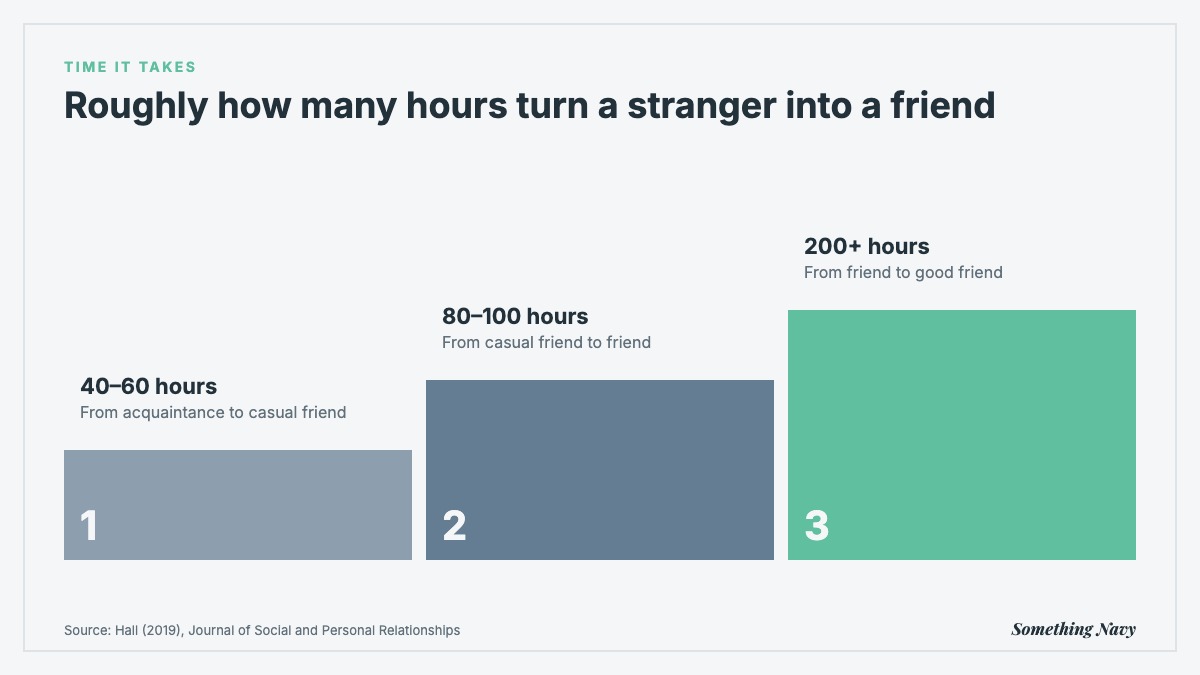
The other ingredient is time. In a 2019 study in the Journal of Social and Personal Relationships, Jeffrey Hall of the University of Kansas surveyed adults who had recently moved and new university students. He estimated that it takes roughly 40 to 60 hours together to form a casual friendship, 80 to 100 hours to become friends, and more than 200 hours to become good friends. We looked at his findings in more detail in our piece on how many hours it takes to make a friend.
Put those two ideas together and the decline in time spent with friends starts to look like the heart of the problem. Friendship is built in hours, and many of us are simply spending fewer of them together.
Rebuilding a circle
- Put yourself near people regularly. Classes, clubs, volunteering and regular routines create the repeated, low-pressure contact that friendships grow from.
- Turn acquaintances into friends deliberately. Suggest a coffee, a walk or a second meeting. Someone has to go first, and it is usually appreciated.
- Go a little deeper. Personal conversation builds closeness faster than small talk, as research on talking to strangers shows.
- Make it routine. A standing weekly call or monthly dinner removes the effort of arranging every meeting from scratch.
- Keep old friends warm. A short message to someone you have lost touch with is often welcomed more than you expect.
Sources
- Cox, D. A. (2021). The state of American friendship: Change, challenges, and loss. Survey Center on American Life. Report
- Pew Research Center (2023). What does friendship look like in America? Pew
- Gallup (2004). Americans satisfied with number of friends, closeness of friendships. Gallup
- Office of the US Surgeon General (2023). Our epidemic of loneliness and isolation. Advisory (PDF)
- Office for National Statistics (2024). Public opinions and social trends, Great Britain: 13 December 2023 to 1 January 2024. ONS
- Dunbar, R. I. M. (2018). The anatomy of friendship. Trends in Cognitive Sciences, 22(1), 32–51. DOI
- Tamarit, I., Cuesta, J. A., Dunbar, R. I. M., & Sánchez, A. (2018). Cognitive resource allocation determines the organization of personal networks. PNAS, 115(33), 8316–8321. DOI
- Holt-Lunstad, J., Smith, T. B., & Layton, J. B. (2010). Social relationships and mortality risk: A meta-analytic review. PLoS Medicine. DOI
- Festinger, L., Schachter, S., & Back, K. (1950). Social pressures in informal groups: A study of human factors in housing. Harper.
- Hall, J. A. (2019). How many hours does it take to make a friend? Journal of Social and Personal Relationships, 36(4), 1278–1296. DOI
How we reported this. We went back to the original research for this story, 10 sources in all, listed above, and checked every figure against them. If you think we have got something wrong, tell us and we will look at it. Read more about how we work.
Cover photo: Helena Lopes on Unsplash. Charts and graphics: Something Navy.