
In brief
- We tend to judge past experiences by their most intense moment and by how they ended, a pattern known as the peak-end rule.
- How long an experience lasted barely affects how we remember it. Psychologists call this duration neglect.
- The effect is strongest for short experiences dominated by one feeling, such as pain, and weaker for long, varied ones like holidays.
Ask someone about a holiday and they will rarely give you an hour-by-hour average. They will tell you about the night the storm knocked out the power, the restaurant at the end of the harbour, and the miserable queue at the airport on the way home. Everything in between is a blur. Memory, it turns out, is not a recording. It is an edit, and the editor has some very particular habits.
The most famous of those habits is the peak-end rule. Here is what it is, where it came from, how far the evidence stretches, and what it might mean for the way you plan everything from a dentist appointment to a dinner party.
What exactly is the peak-end rule?
The peak-end rule describes the way we evaluate experiences after they are over. Rather than adding up every moment, our memory gives special weight to two points: the most intense moment, which can be the best or the worst, and the way the experience finished. Our overall judgment tends to sit close to an average of those two.
The flip side is what researchers call duration neglect. Whether something lasted ten minutes or thirty, a week or a fortnight, makes surprisingly little difference to how good or bad we later say it was, provided the peak and the end are similar.
Where did the idea come from?
The rule grew out of work by the psychologist Daniel Kahneman and his colleagues in the early 1990s. One of the earliest studies, published in 1993 in the Journal of Personality and Social Psychology by Barbara Fredrickson and Kahneman, asked 128 students to watch short film clips, some pleasant and some unpleasant, each in a short and a long version. After each clip, participants gave an overall rating of how they felt about it, and their moment-by-moment feelings were recorded throughout.
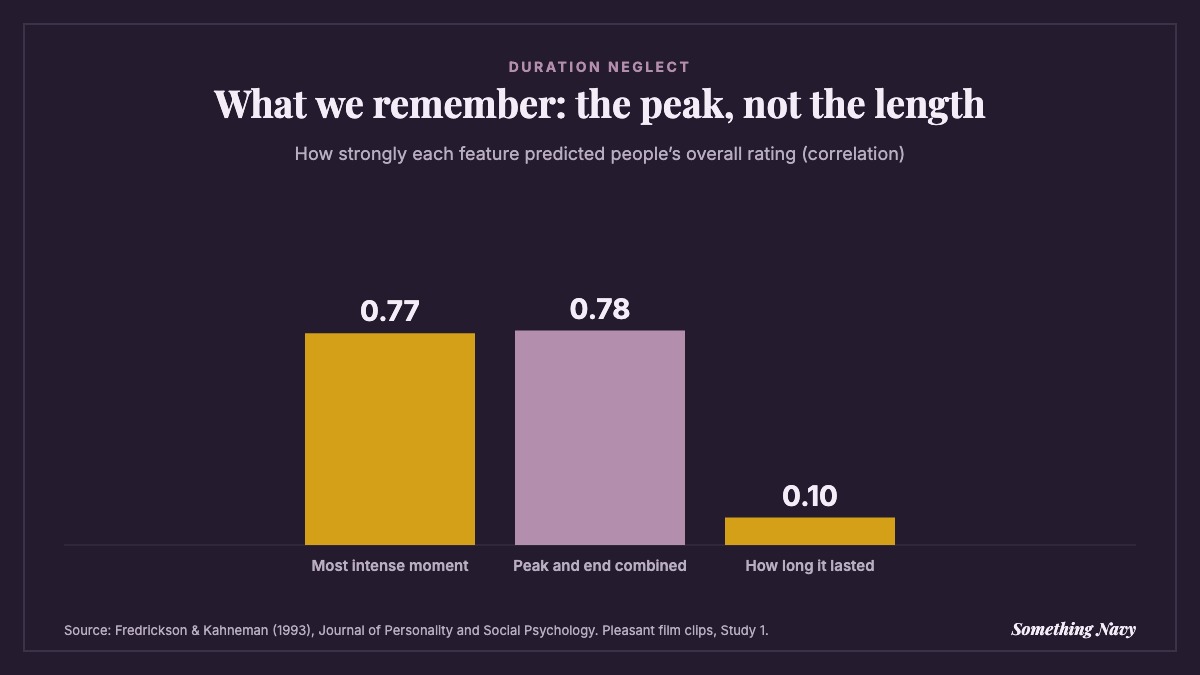
The results were stark. For the pleasant clips in the first study, the most intense moment correlated with people’s overall rating at 0.77, and the combination of peak and end at 0.78. The length of the clip correlated at just 0.10. Once the peak and end were taken into account, duration contributed almost nothing.

Does it apply to pain?
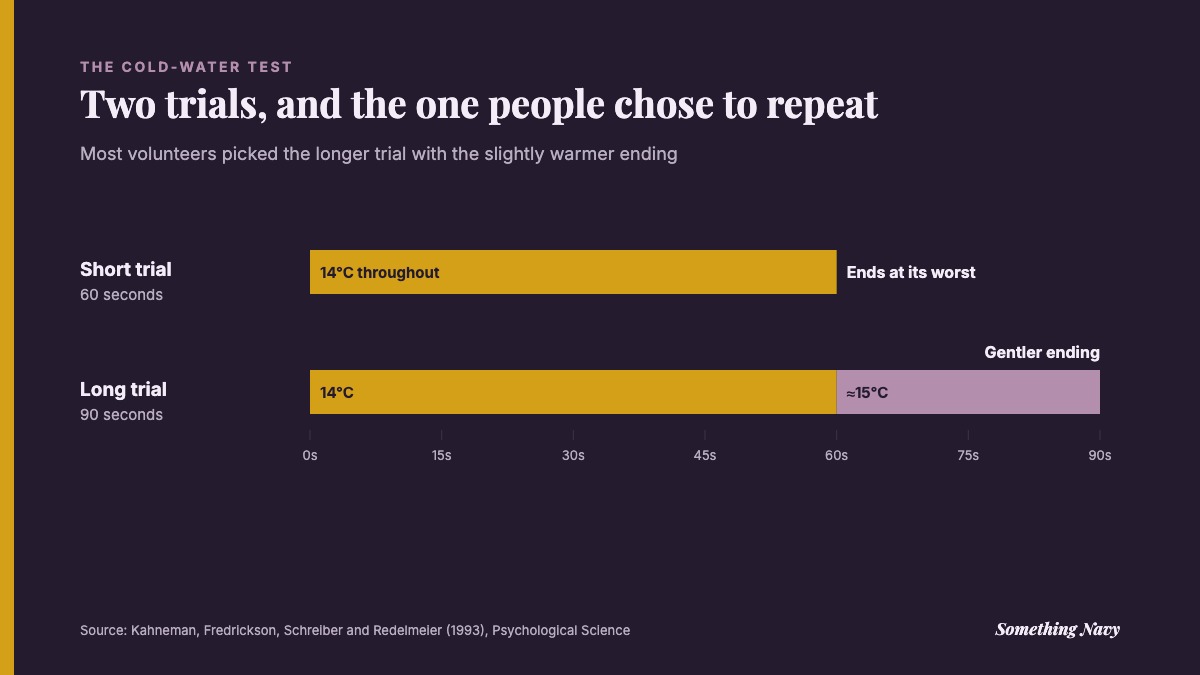
Yes, and this is where the research became genuinely surprising. In a study published the same year in Psychological Science, Kahneman and colleagues asked volunteers to hold a hand in cold water on two occasions. One trial lasted 60 seconds at 14°C. The other included the same 60 seconds, followed by a further 30 seconds in which the water was warmed very slightly, to about 15°C. Logically, the longer trial was worse: it contained all the pain of the short one, plus more. Yet when asked which trial they would rather repeat, most participants chose the longer one, because it ended more gently.
The finding was soon tested in hospitals. In 1996, Donald Redelmeier and Kahneman published a study in the journal Pain in which 154 people having a colonoscopy and 133 people having lithotripsy, a treatment for kidney stones, rated their pain as the procedure went on. Afterwards, patients’ judgments of their total pain were strongly linked to the peak intensity of pain and to how much it hurt in the last three minutes. Longer procedures were not remembered as worse.
Can you change a memory by changing the ending?
That was the question behind a bigger trial. Redelmeier, Joel Katz and Kahneman randomly assigned 682 colonoscopy patients to two groups, publishing the results in 2003 in Pain. In one group, the procedure ended normally. In the other, the scope was left in place for a short extra period at the end without being moved, which was mildly uncomfortable but much less painful than what had come before.
The patients with the gentler ending rated their final moments as less painful, 1.7 compared with 2.5, and the procedure overall as less unpleasant, 4.4 compared with 4.9. More importantly, over a median follow-up of 5.3 years, they were more likely to return for a repeat colonoscopy. A slightly longer, slightly gentler procedure had changed both memory and behaviour.
Why would memory work like this?
Nobody knows for certain, but the most common explanation is that memory works by storing a small number of representative moments rather than a continuous record. Holding on to every second of every experience would be impossibly costly. Keeping a few key snapshots is far more efficient.
If you are going to keep only a few snapshots, the peak and the end are sensible choices. The most intense moment tends to be the most emotionally charged, and strong emotion is one of the things that makes memories stick. The end is the most recent part of the experience, which gives it an advantage, and it also tells us how the story resolved. A tense negotiation that ends in agreement feels like a success. The same negotiation ending in a walkout feels like a failure, even if most of it went exactly the same way.
Seen this way, duration neglect is less a flaw than a side effect. If memory summarises experiences with a couple of snapshots, the length of the experience simply is not part of the summary. That works well enough most of the time. It goes wrong in unusual situations, like the cold-water study, where a longer experience with a gentler ending is objectively worse but feels better in hindsight.
Is the effect reliable?
Broadly, yes. A meta-analysis published in 2022 in Organizational Behavior and Human Decision Processes, led by researchers at George Mason University, pooled 174 effect sizes from studies of the peak-end rule. The combined peak-end effect was large, with a correlation of about 0.58 between the peak-end average and people’s overall evaluations. Duration, once again, had essentially no effect.
The rule also seems to apply to pleasant things. A 2008 study in Psychonomic Bulletin & Review by Amy Do, Alexander Rupert and George Wolford at Dartmouth College reported “strong evidence that the peak-end rule applies to both material goods and pain”.
So where does it fall short?
The clearest limits appear when experiences are long and complicated. In a 2008 study in Memory & Cognition, Simon Kemp and colleagues asked people to rate holidays day by day and then overall. The peak-end rule was, in their words, “not an outstandingly good predictor” of how people remembered the whole trip. Average enjoyment did about as well.
That makes intuitive sense. A two-week holiday contains dozens of distinct episodes, each with its own high and low points, and we may remember it as a collection of stories rather than a single feeling. The peak-end rule works best for short experiences with one dominant emotion: a medical procedure, a film, a difficult phone call.
What does this say about the two selves?
Kahneman later framed these findings as a tension between two selves. In his 2010 TED talk, “The riddle of experience vs. memory”, he described an “experiencing self” that lives through each moment and a “remembering self” that keeps score afterwards. The trouble is that it is the remembering self that makes our decisions. We choose our next holiday, our next dentist and whether to go back to a restaurant based on memories that have been edited around peaks and endings.
That can lead to choices that look odd from the outside, such as preferring the longer of two painful experiences. But it also gives us a lever. If memory weighs endings heavily, endings are worth designing with care.
Where do you see it in everyday life?
Once you know about the peak-end rule, it is hard to stop noticing it. Think of a meal at a restaurant where the food was excellent but the bill took forty minutes to arrive. Many people walk out remembering the wait more than the food. Or a long-haul flight that was cramped and dull but ended with a smooth landing and a quick passport queue, which can leave a surprisingly warm impression.
The same pattern shows up in relationships and work. A friendship that has lasted for years can feel tainted by one bitter final argument. A job that was mostly rewarding can be remembered through the lens of an awkward exit. A long, difficult project that finishes with a successful launch can feel, in hindsight, like it was worth every late night.
None of this means those memories are wrong. The peak and the end often do carry important information. But it is worth knowing that your memory is applying a particular kind of filter, especially when you use those memories to make decisions about what to do next.
Does the order of good things matter too?
If endings carry extra weight, then the order in which good experiences arrive should matter as well. That is broadly what researchers have found. The Dartmouth team behind the 2008 study looked at pleasant experiences, including receiving gifts, and found that the way an experience finished shaped how people judged it overall. Saving the best for last tends to leave a better impression than front-loading it.
This has practical implications for anyone planning an event, a lesson or a presentation. A common instinct is to lead with the strongest material and let things wind down. The peak-end rule suggests a different shape: make sure there is a clear high point somewhere in the middle, and do not let the final stretch fizzle. A conference that ends with its best speaker, a dinner that ends with a memorable dessert, a holiday that ends with a favourite place rather than a rushed transfer, all play to the way memory works.
A word for the experiencing self
There is one more lesson in Kahneman’s framing, and it is easy to miss. If the remembering self is the one that makes decisions, the experiencing self can end up neglected. We might endure a long stretch of unhappiness at work, for instance, because the memory of a few high points and a promised good ending makes the whole thing feel worthwhile.
Paying attention to how experiences feel while they are happening, not only to how we expect to remember them, can be a useful corrective. A week of mostly miserable days is still a week of mostly miserable days, however neatly it is wrapped up at the end. The peak-end rule describes how memory works. It does not have to dictate what we value.
How can you use it?
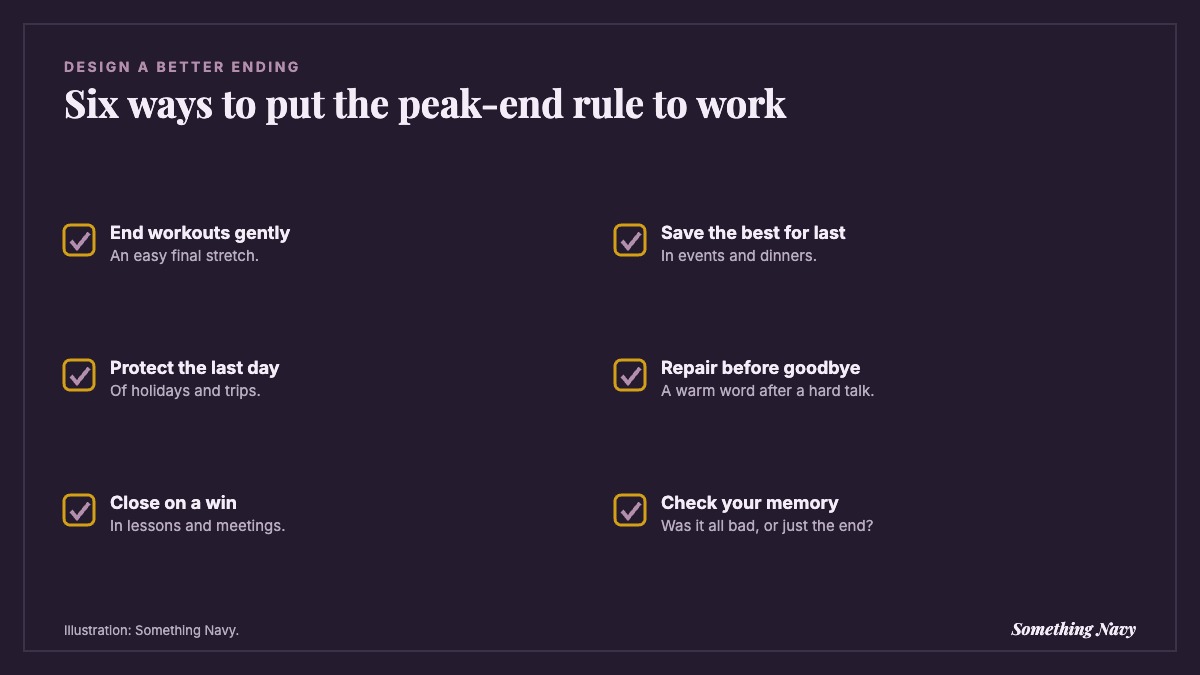
- End on a high, or at least a gentle note. Close a workout with an easy stretch, a hard conversation with a moment of warmth, a meeting with a clear next step.
- Protect the last day of a trip. A relaxed final morning may do more for the memory of a holiday than one more attraction squeezed into the middle.
- Finish difficult tasks with an easy win. Teachers and coaches often end a session with something students can do well.
- Be wary of judging by the ending alone. A relationship or job that finished badly may have contained years of good experiences that your memory is underweighting.
It is worth remembering that memory has other quirks too. Our piece on the doorway effect explains why walking into a new room can wipe a thought from your mind, and our article on the Zeigarnik effect looks at why unfinished tasks stay with us.
Sources
- Fredrickson, B. L., & Kahneman, D. (1993). Duration neglect in retrospective evaluations of affective episodes. Journal of Personality and Social Psychology, 65(1), 45–55.
- Kahneman, D., Fredrickson, B. L., Schreiber, C. A., & Redelmeier, D. A. (1993). When more pain is preferred to less: Adding a better end. Psychological Science, 4(6), 401–405. DOI
- Redelmeier, D. A., & Kahneman, D. (1996). Patients’ memories of painful medical treatments: Real-time and retrospective evaluations of two minimally invasive procedures. Pain, 66(1), 3–8. DOI
- Redelmeier, D. A., Katz, J., & Kahneman, D. (2003). Memories of colonoscopy: A randomized trial. Pain, 104(1–2), 187–194. DOI
- Alaybek, B., Dalal, R. S., et al. (2022). All’s well that ends (and peaks) well? A meta-analysis of the peak-end rule and duration neglect. Organizational Behavior and Human Decision Processes, 170, 104149. DOI
- Do, A. M., Rupert, A. V., & Wolford, G. (2008). Evaluations of pleasurable experiences: The peak-end rule. Psychonomic Bulletin & Review, 15(1), 96–98. DOI
- Kemp, S., Burt, C. D. B., & Furneaux, L. (2008). A test of the peak-end rule with extended autobiographical events. Memory & Cognition, 36(1), 132–138. DOI
- Kahneman, D. (2010). The riddle of experience vs. memory. TED. TED
How we reported this. We went back to the original research for this story, 8 sources in all, listed above, and checked every figure against them. If you think we have got something wrong, tell us and we will look at it. Read more about how we work.
Cover photo: David Straight on Unsplash. Charts and graphics: Something Navy.