Think about your closest friends and how you got close. Most likely it was not one great conversation. It was a shared dorm corridor, a team, a commute, a run of late nights on the same project. Friendship, it turns out, runs on a resource that is surprisingly easy to measure: time.
That matters more than it might seem. Friendships are not just pleasant; they are one of the strongest predictors of long-term health and wellbeing that researchers have found. Yet many adults say making new friends is harder than it used to be. Research on how friendships form helps explain why, and what to do about it.
The study that counted the hours
Jeffrey Hall, a communication researcher at the University of Kansas, set out to put a number on it. In a study in the Journal of Social and Personal Relationships, he surveyed 355 adults who had recently moved and were looking to make new friends. He then followed 112 first-year students through their first weeks at university, tracking how much time they spent with new people and how close they felt.
His findings, as summarized by the university: it took roughly 40 to 60 hours together to move from acquaintance to casual friend, around 80 to 100 hours to become a friend, and more than 200 hours to become a close friend.
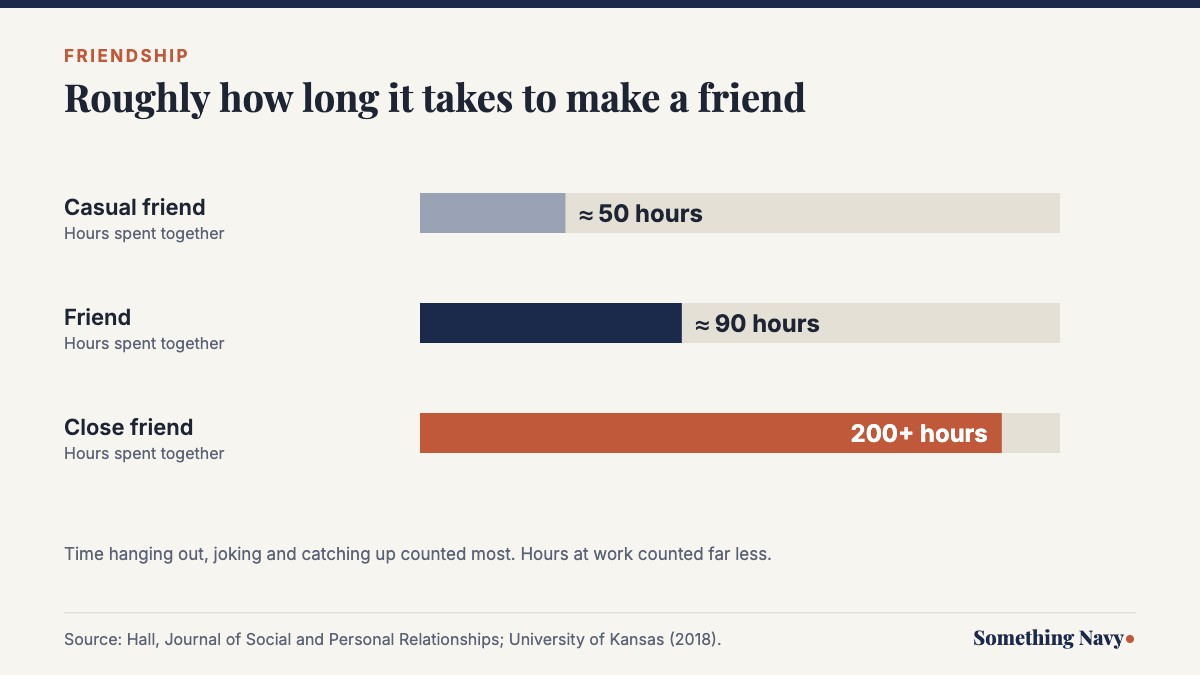
Two hundred hours is a lot. Spread across evenings and weekends, it can take many months. That goes some way to explaining why adult friendships often feel slow to form, and why the people we met at school or university so often remain the ones we are closest to. At those stages of life, the hours pile up almost without trying.


Not every hour counts the same
What you do with the time matters. Hall found that hanging out, joking around, catching up and playing games together moved relationships forward. Hours spent side by side at work did much less, unless colleagues also spent time together away from their working roles.
Proximity, in other words, is not enough on its own. Friendships grow when people choose to spend time together and when that time feels personal rather than transactional. “You can’t snap your fingers and make a friend,” Hall said when the research was released. “Maintaining close relationships is the most important work we do in our lives.”
Why so many adult friendships stall at “friendly”
Hall’s numbers help explain a familiar frustration: you meet someone you really like, you get on well, and somehow it never deepens. Often the relationship simply never gets enough hours. Long commutes, demanding jobs and family responsibilities eat into exactly the kind of loose, unstructured time that friendships feed on.
His student data also showed that the friendships that took off tended to get an early burst of attention. Students who became close to someone sharply increased the time they spent together within a few weeks of meeting.
People like you more than you think
There is another quiet obstacle: we tend to underestimate how much new people like us. In a set of studies published in 2018 in Psychological Science, Erica Boothby, Gus Cooney, Gillian Sandstrom and Margaret Clark had strangers chat and then asked each person how much they liked their partner, and how much they thought their partner liked them. People consistently guessed they were liked less than they really were. The researchers called it the liking gap.
It was not just a first-meeting effect. In one study that followed 102 first-year students who shared dorm rooms, the gap was still there months into the academic year. That matters, because if you assume someone was only being polite, you are less likely to suggest meeting again, and the friendship never gets its hours.
Why it is worth the effort
Close relationships are not a luxury. A landmark 2010 meta-analysis by Julianne Holt-Lunstad, Timothy Smith and Bradley Layton combined 148 studies covering more than 300,000 people followed for an average of seven and a half years. People with stronger social relationships had about a 50 percent greater likelihood of survival over the study periods than those with weaker ones, an effect comparable to well-known health risks such as smoking.
In 2023, the US Surgeon General issued an advisory on loneliness and isolation, noting that about half of US adults report experiencing loneliness and that a lack of social connection carries health risks comparable to smoking up to 15 cigarettes a day.
Finding the hours
Regular, built-in contact is the easiest way to accumulate time without having to arrange every meeting from scratch. A weekly walk, a class, a five-a-side game or a standing Sunday coffee adds up far faster than an occasional catch-up dinner. Shared activities also give you something to do together, which takes the pressure off conversation in the early stages.
If a colleague seems like a potential friend, the shift usually comes when you spend time together that is not about work: lunch away from the office, a drink after a conference, a walk where the project never comes up. And when you click with someone new, follow up quickly, and assume they enjoyed it more than you think. A few meetings in close succession seem to do more than the same number spread over a year.
The friendships you already have need upkeep too. A message, a call or a visit keeps the hours you have invested from quietly draining away. For more on keeping close relationships healthy, see our piece on the communication habits that predict a breakup.
Frequently asked questions
Research by Jeffrey Hall at the University of Kansas estimated about 40 to 60 hours to become casual friends, 80 to 100 hours to become friends, and more than 200 hours to become close friends.
Adults usually have less unstructured free time and fewer settings, like school, where they see the same people repeatedly. Friendships may simply not get enough hours together.
Less than you might expect. Hall found that time spent working together did little to build friendship unless colleagues also spent personal time together.
It is the tendency to underestimate how much a new acquaintance likes you after a conversation. Research suggests it can persist for months.
More in Relationships.
Sources
- Hall, J. A. How many hours does it take to make a friend? Journal of Social and Personal Relationships (published online 2018). doi.org/10.1177/0265407518761225
- University of Kansas (2018, March 6). How to make friends? Study reveals how many hours it takes. news.ku.edu
- Boothby, E. J., Cooney, G., Sandstrom, G. M., & Clark, M. S. (2018). The liking gap in conversations: Do people like us more than we think? Psychological Science, 29(11), 1742–1756. PDF
- Holt-Lunstad, J., Smith, T. B., & Layton, J. B. (2010). Social relationships and mortality risk: A meta-analytic review. PLOS Medicine, 7(7), e1000316. PLOS Medicine
- Office of the U.S. Surgeon General (2023). Our Epidemic of Loneliness and Isolation. hhs.gov
How we reported this. We went back to the original research for this story, five sources in all, listed above, and checked every figure against them. If you think we have got something wrong, tell us and we will look at it. Read more about how we work.
Cover photo: Priscilla Du Preez on Unsplash. Charts and graphics: Something Navy.