You reach the end of the street and the sea opens up in front of you. Your shoulders drop before you have even decided to relax.
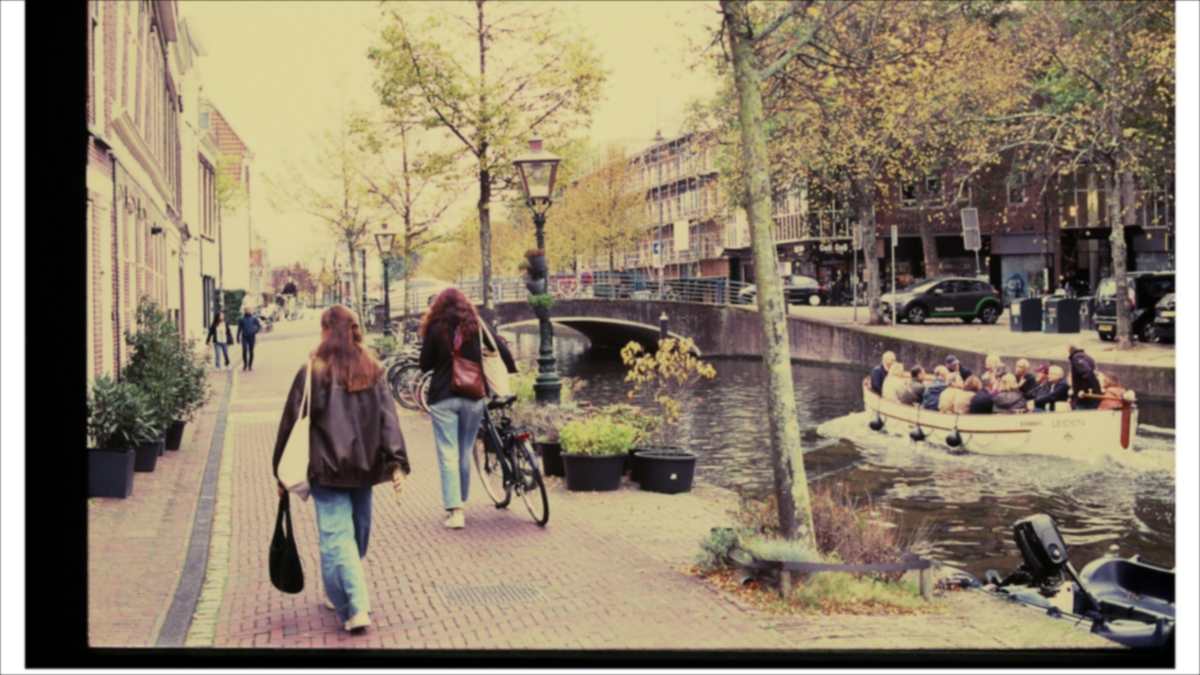
Maybe it is not the sea. Maybe it is a canal towpath on a grey Tuesday, the slap of water against a narrowboat, a heron standing very still on the far bank. Or the fountain in a shopping centre square that you somehow always end up sitting beside.
For a long time that was just a feeling, the stuff of holiday brochures and Victorian doctors prescribing sea air.
Since around 2010, a group of researchers based largely at the University of Exeter has tried to pin it down with data. Their findings are surprisingly consistent. In one study, the poorest city dwellers living within a kilometre of the sea had about 40% lower odds of showing signs of a common mental health problem than similar people living far inland.
That is a big number. It also comes with big caveats, so let us walk the shoreline, follow the water inland, and see what holds up.
Start at the shoreline: 48 million people and a coastline
The field has a name: blue space, meaning any outdoor water you can see, hear or reach, from beaches to canals to the fountain in your park.
The first clue came from the census. In 2012, Ben Wheeler, Mathew White and colleagues at Exeter’s European Centre for Environment and Human Health analysed small-area data from the 2001 census for England: responses from over 48 million people, including a simple question about whether their health was good.
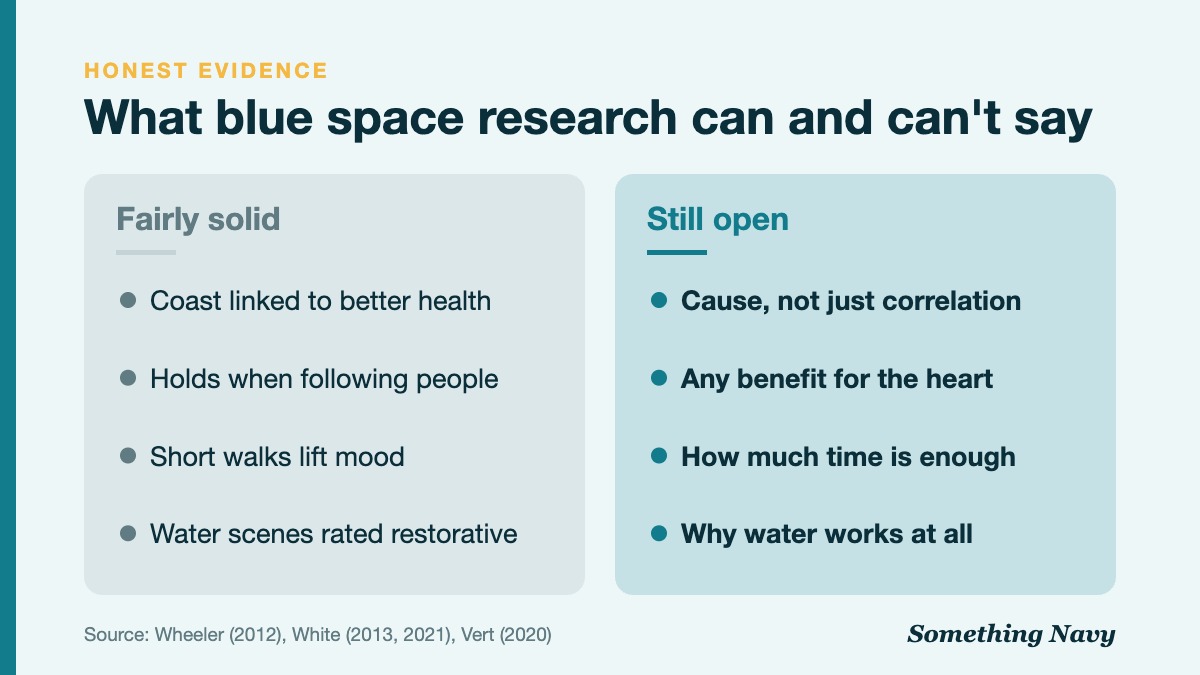
The pattern, published in Health & Place, was clear: the closer to the coast, the more people reported good health, after accounting for age, sex and socio-economic factors. The link was strongest in the most deprived areas.
Wheeler was careful about what this meant. In the centre’s press release he said that “this type of study cannot prove cause and effect.”
He was right to be. Retirees who can afford it move to the seaside, and healthier people may find it easier to choose where they live. A snapshot cannot tell those stories apart.
The same people, followed as they moved
So the team tried a stronger design. In 2013, White and colleagues used English panel data that tracked the same individuals over time. That let them compare each person with themselves, cancelling out stable traits such as personality.
The result held. People reported significantly better general health and mental health in the years when they lived nearer the coast, after accounting for things like employment and how much green space was nearby.
Two details matter. There was no coastal effect on life satisfaction. And the authors called the individual effects small, while arguing they could add up across a community.
Small for you. Potentially meaningful for a town of 50,000 people.
Where the sea seemed to matter most
In 2019, Jo Garrett and colleagues at Exeter, working within the EU-funded BlueHealth project, pooled data from the Health Survey for England between 2008 and 2012. They focused on 25,963 adults living in towns and cities.
Each had completed a standard 12-item questionnaire that screens for symptoms of common mental disorders such as anxiety and depression. The team grouped people by distance from the coast and by household income.
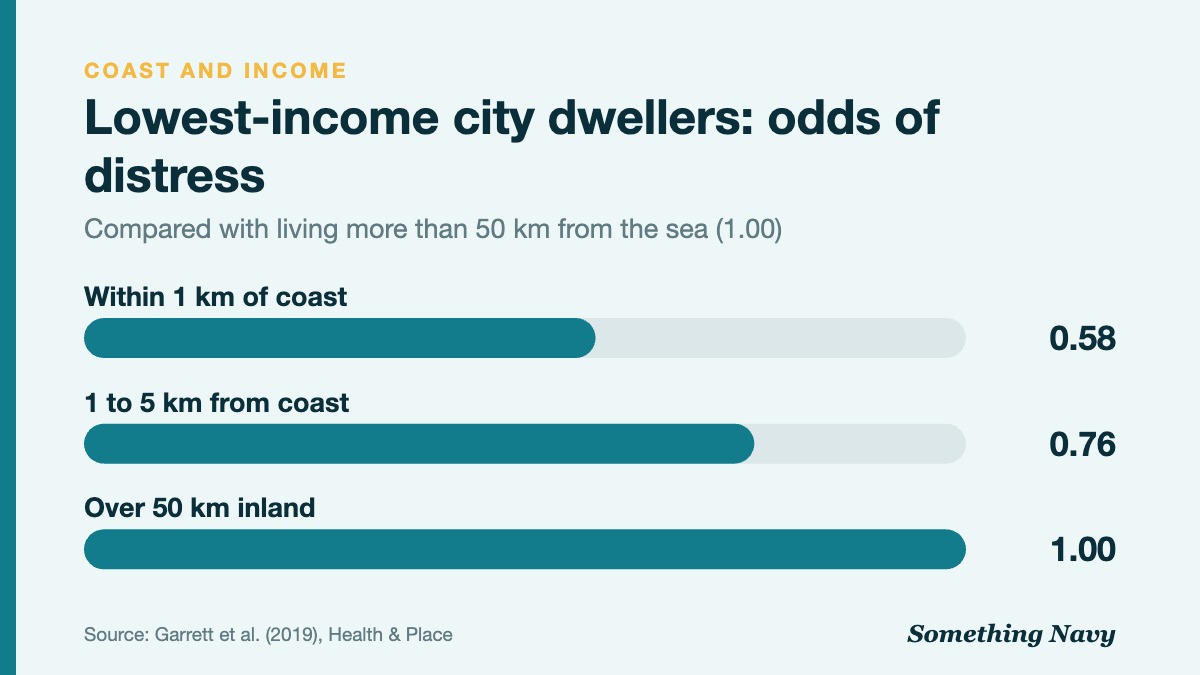
Across everyone, living within 1 km of the sea was linked with slightly lower odds of mental distress. But when the team looked by income, the association showed up only in the lowest-earning fifth of households. There, people living within 1 km of the coast had about 40% lower odds of high scores than similar people living more than 50 km away, and the link stretched out to 5 km. (In statistical terms, odds ratios of 0.58 within 1 km and 0.76 at 1 to 5 km.)
In the paper, the authors suggested coastal access could help narrow mental health inequalities; Garrett described a possible “‘protective’ zone”.
Why the poorest? Wealthier people may have other ways to recover from stress: holidays, gardens, quieter homes. Without those, a free beach a few streets away may do more of the heavy lifting.
The same caveats apply: a one-off survey, self-reported symptoms, and authors who said plainly the results should be interpreted cautiously.
By the numbers
- 48 million+ census responses in the 2001 England data behind the first coastal health study
- 25,963 urban adults in the 2019 study of coast, income and mental health
- About 40% lower odds of mental distress for the lowest-income households within 1 km of the sea
- 16,307 people across 18 countries and regions in the BlueHealth survey analysis
- 20 minutes: the length of the beach walks that lifted mood in a Barcelona experiment


Eighteen countries, and a twist about your postcode
England is one small, damp, sea-ringed country. Does the pattern travel? In 2021 White, now working with an international team, analysed the BlueHealth International Survey in Scientific Reports. It covered 16,307 people in 18 countries and regions: 14 in Europe, plus California, Canada, Hong Kong and Queensland. People reported where they lived, how often they had visited green spaces, inland water and the coast in the past four weeks, and their wellbeing and medication use.
Here is the twist. People in greener or coastal neighbourhoods did report higher wellbeing. But that link largely disappeared once the researchers took account of how often people actually visited those places.
In other words, the address mattered less than the habit.
Visits to green spaces, inland water and the coast were all linked with better wellbeing and less distress. Good news for those of us who will never own a sea view.
There was one awkward result. People who visited rivers and lakes more often were slightly more likely to be using anxiety medication. The authors suggested the reverse of cause: anxious people may seek out water to manage how they feel. In survey data, the arrow can point either way. The effects were also small, and the sample came from online panels in wealthy places only.
Follow the river inland: what different water seems to do
Put the studies side by side and a rough map emerges. It is not a ranking of “best” water; each type has been studied in different ways.
| Type of blue space | What studies found | How strong is the evidence? |
|---|---|---|
| Living near the coast | Better self-rated health, strongest in deprived areas; holds when following the same people (Wheeler 2012; White 2013) | Large, observational |
| Coast, for low-income city dwellers | About 40% lower odds of distress within 1 km of the sea (Garrett 2019) | Large, cross-sectional |
| Visits to rivers, lakes and coast | Higher wellbeing, less distress; postcode alone mattered little (White 2021) | Large, cross-sectional, small effects |
| A beach walk in a city | Better mood after 20-minute walks; no heart benefit (Vert 2020) | Randomised, 59 people |
| Water in a view | Water scenes, even built ones, rated more restorative (White 2010) | Photo ratings |
| Fountain and birdsong sounds | Faster stress recovery than loud traffic on one measure (Alvarsson 2010) | Lab study, 40 students |
On the promenade: a 20-minute experiment
To test cause and effect, you need to send people to the water and compare.
Cristina Vert and colleagues at ISGlobal in Barcelona did exactly that in a randomised crossover study published in Environmental Research in 2020. They recruited 59 healthy adult office workers. Over several weeks, each took repeated 20-minute walks along a city beach, the same walks through city streets, and equivalent time resting indoors, in random order.
Straight after the beach walks, people reported better wellbeing and mood than after the street walks or the rest. Mark Nieuwenhuijsen, who coordinated the study, described a significant improvement in wellbeing and mood “immediately after” the blue walks.
The heart did not play along: blood pressure and heart rate showed no extra benefit. The authors speculated longer exposure might be needed.
A short walk by the water can lift your mood today. It is not a heart treatment.
It also fits what we know about what walking does for your thinking: movement itself helps, and the setting seems to add something on top.
Why the eye loves water
So what is it about water? There are a few overlapping explanations.
The first is visual. In 2010, White and colleagues showed people 120 photographs of natural and built scenes, half of them containing water, with the amounts of water, greenery and buildings carefully balanced. Their results, in the Journal of Environmental Psychology, were striking. Scenes with water were rated as more attractive, produced more positive feelings and were seen as more restorative. The effects were large.
Built scenes with water, think a harbour or a city river, were rated about as positively as green countryside without it. A canal can do some of the work of a field.
Psychologists often point to attention restoration theory. Moving water and changing light hold your attention gently, giving your mind a break from the effortful focus that screens and traffic demand. Wind on a lake is interesting, but it does not need a reply.
Water also comes with space. A river cuts a corridor of open sky through a city; a beach gives you a horizon.
Stop by the fountain: what the ear hears
The second explanation is sound. Waves, rain and fountains make a steady hush that can mask harsher noise.
In a small study from Sweden, Jesper Alvarsson, Stefan Wiens and Mats Nilsson put 40 university students through a stressful round of speeded mental arithmetic, then let them recover while listening to different sounds. One was a fountain mixed with birdsong. Others were road traffic at loud and quieter volumes, and a quiet backyard with a ventilation hum.
The researchers tracked skin conductance, a measure of the body’s stress arousal. Recovery was quicker during the fountain and birdsong, with an estimated half-life of 101 seconds, against 111 for quieter traffic, 121 for the backyard and 160 for loud traffic. But only that comparison with loud traffic was statistically reliable, and a second measure, heart rate variability, showed no effect at all.
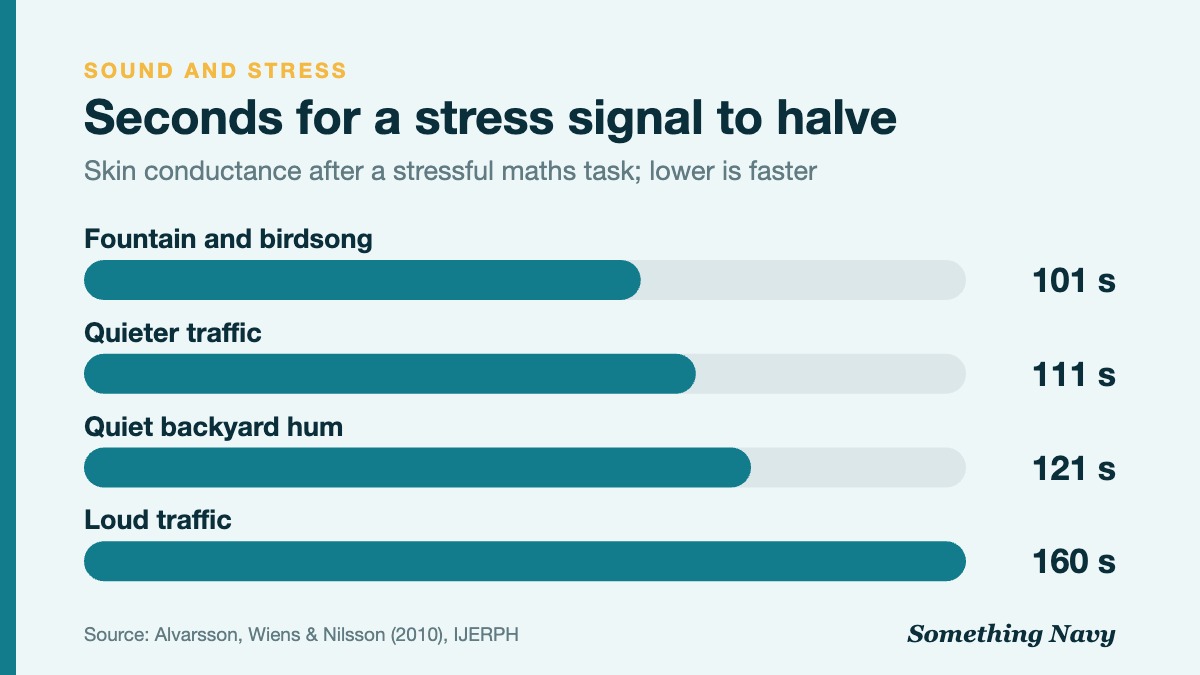
Honest summary: running water and birdsong look easier on a stressed body than traffic, but that rests on one short lab study.
What “Blue Mind” gets right, and where to be careful
If you have read one popular book on this, it is probably Blue Mind by the marine biologist Wallace J. Nichols, published by Little, Brown in 2014. Its argument is that being near, in, on or under water puts people into a calmer, more meditative state.
The book popularised the idea, and its spirit matches the research above. But it is a persuasive book, not a systematic review. Its subtitle promises water can make you “happier, healthier, more connected, and better at what you do”, which is a much wider claim than the studies here can support.
The research supports something more modest and more useful. Time near water is consistently linked with feeling better, short visits seem to lift mood, and the benefit may be largest for people with the fewest other resources.
Water will not fix a life. But it might make an ordinary Wednesday feel more bearable.
Back in the city: finding blue space on a weekday
Hold on to the 18-country finding: visits mattered more than postcodes. Blue space is something you can do, not just something you can buy.
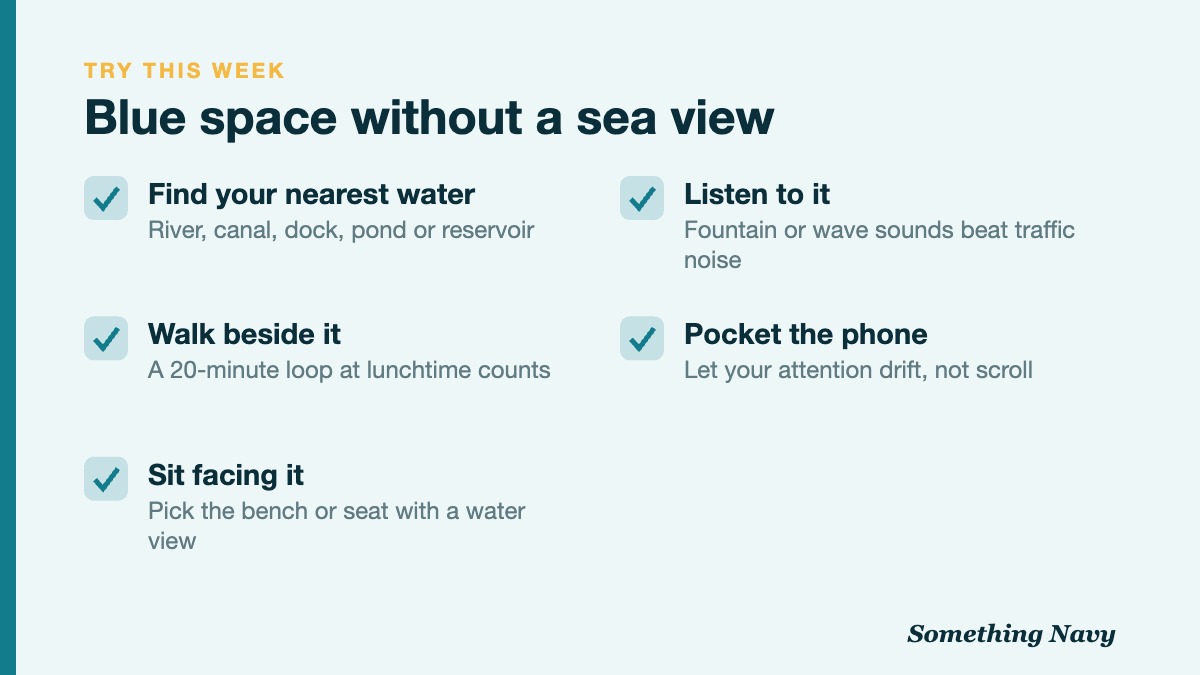
- Find your nearest water on a map. A river, canal, reservoir, dock or pond is often closer than you think. Towpaths are flat, free and quieter than the streets beside them.
- Walk beside it, briefly. The Barcelona walks were 20 minutes. A lunchtime loop along a river counts.
- Sit where you can see it. Choose the café seat facing the harbour or the bench by the boating lake.
- Listen to it. A tabletop fountain or a recording of waves will not replace the outdoors, but it beats traffic noise.
- Bring a little indoors. A photograph or painting of water where your eye lands, alongside a few houseplants, is a cheap way to give tired eyes somewhere soft to rest.
- Leave the phone in your pocket. The point is undemanding attention, and even a phone in view can tug at your focus.
Two cautions. Cold and fast-flowing water carry real risks, so walk beside it rather than taking an unplanned dip. And if you are struggling, water is a companion to support, not a substitute for it.
The tide goes out
The researchers who first linked the coast to health spent years testing it: following people over time, adding controls, running the numbers across 18 countries. The pattern bent and shrank a little. It did not disappear.
What is left is modest, and quietly hopeful. You do not need a sea view. You need a reason to go and stand beside some water, often.
Next time your shoulders drop at the sight of a river, let them. It is not just in your head. Or rather, it is in your head, and that is exactly the point.
Frequently asked questions
Any outdoor water you can see, hear or reach, natural or built: coasts, lakes, rivers, canals, ponds, harbours and even fountains.
Probably not. In the 18-country BlueHealth survey, how often people visited nature mattered more than where they lived.
There is no agreed dose. In a Barcelona experiment, 20-minute beach walks improved mood straight away, so short, regular visits are a sensible starting point.
They may help a little, especially compared with traffic noise, but the evidence comes from one small lab study.
Sources
- Alvarsson, J. J., Wiens, S., & Nilsson, M. E. (2010). Stress recovery during exposure to nature sound and environmental noise. International Journal of Environmental Research and Public Health, 7(3), 1036–1046. DOI
- Garrett, J. K., Clitherow, T. J., White, M. P., Wheeler, B. W., & Fleming, L. E. (2019). Coastal proximity and mental health among urban adults in England: The moderating effect of household income. Health & Place, 102200. DOI
- Vert, C., Gascon, M., Ranzani, O., Márquez, S., Triguero-Mas, M., Carrasco-Turigas, G., Arjona, L., Koch, S., Llopis, M., Donaire-Gonzalez, D., Elliott, L. R., & Nieuwenhuijsen, M. (2020). Physical and mental health effects of repeated short walks in a blue space environment: A randomised crossover study. Environmental Research, 188, 109812. DOI
- Wheeler, B. W., White, M., Stahl-Timmins, W., & Depledge, M. H. (2012). Does living by the coast improve health and wellbeing? Health & Place, 18(5), 1198–1201. DOI
- White, M. P., Alcock, I., Wheeler, B. W., & Depledge, M. H. (2013). Coastal proximity, health and well-being: Results from a longitudinal panel survey. Health & Place, 23, 97–103. DOI
- White, M. P., Elliott, L. R., Grellier, J., Economou, T., Bell, S., et al. (2021). Associations between green/blue spaces and mental health across 18 countries. Scientific Reports, 11, 8903. DOI
- White, M., Smith, A., Humphryes, K., Pahl, S., Snelling, D., & Depledge, M. (2010). Blue space: The importance of water for preference, affect, and restorativeness ratings of natural and built scenes. Journal of Environmental Psychology, 30(4), 482–493. DOI
Cover photo: Lawrence Chismorie on Unsplash. Charts and graphics: Something Navy.
How we reported this. We went back to the original research for this story, 7 sources in all, listed above, and checked every figure against them. If you think we have got something wrong, tell us and we will look at it. Read more about how we work.