It is just past midnight and you are walking home from the party, keys in your fist, the cold finally clearing your head. And there it is: the conversation by the kitchen counter, playing again from the top.
The joke that landed a beat too late. The story about your flatmate that went on far too long.
By the time you reach your door you have reached a verdict. They were being polite. They were looking for an exit. They will not remember your name, and if they do, it will not be fondly.
Here is the thing the research keeps finding. You are very probably wrong.
Psychologists have a name for the distance between how much someone likes you after a chat and how much you think they do. They call it the liking gap, and in study after study it points the same way: other people like us more than we realise.
Five minutes, two strangers and a questionnaire
The term comes from a 2018 paper in Psychological Science by Erica Boothby, then at Cornell University, with Gus Cooney (then at Harvard), Gillian Sandstrom (then at the University of Essex) and Margaret Clark of Yale. Across five studies, they set out to test something most of us have felt but never measured.
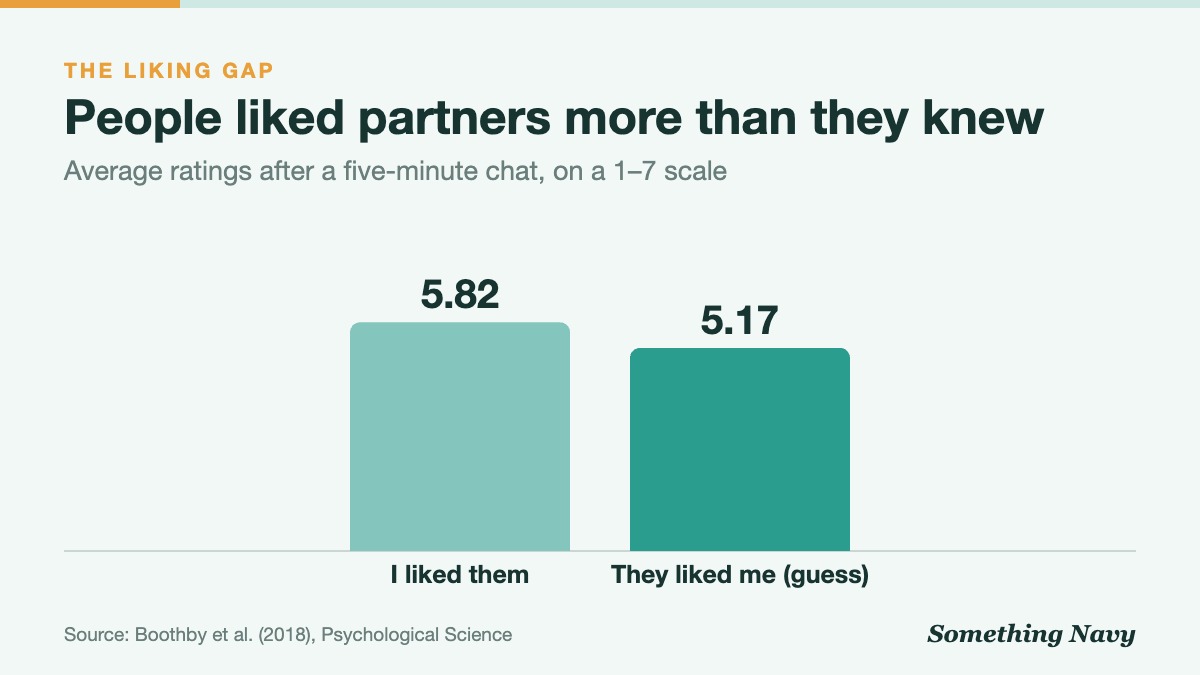
In the first, pairs of people who had never met sat down for a conversation of about five minutes, armed with standard icebreaker questions: where are you from, what do you do for fun. Afterwards, each person rated privately how much they liked their partner, and how much they thought their partner liked them.
On a seven-point scale, people gave their partners an average of 5.82. They guessed that their partners had given them 5.17.
Both people in each pair were doing this at once. Each walked away thinking, in effect, “I liked them more than they liked me.” Both cannot be true. And as the ratings showed, neither of them was.
That first study was small, just 36 people. In a second study with 84 Yale students and recent graduates, conversations were unstructured and the gap appeared again. In a third, 102 strangers recruited through Harvard’s Decision Science Laboratory talked for as long as they liked, from two minutes up to 45, with an average of about 23. The gap did not shrink in the longer conversations.
It survived the real world, too
Lab studies have a way of producing effects that vanish outside the lab. So the researchers took the question to personal development workshops in the UK, where 100 members of the public were paired off to introduce themselves before spending the rest of the session together.
Asked how interesting their partner had found them, on a five-point scale, people guessed 3.61. Their partners had actually rated them 4.30.
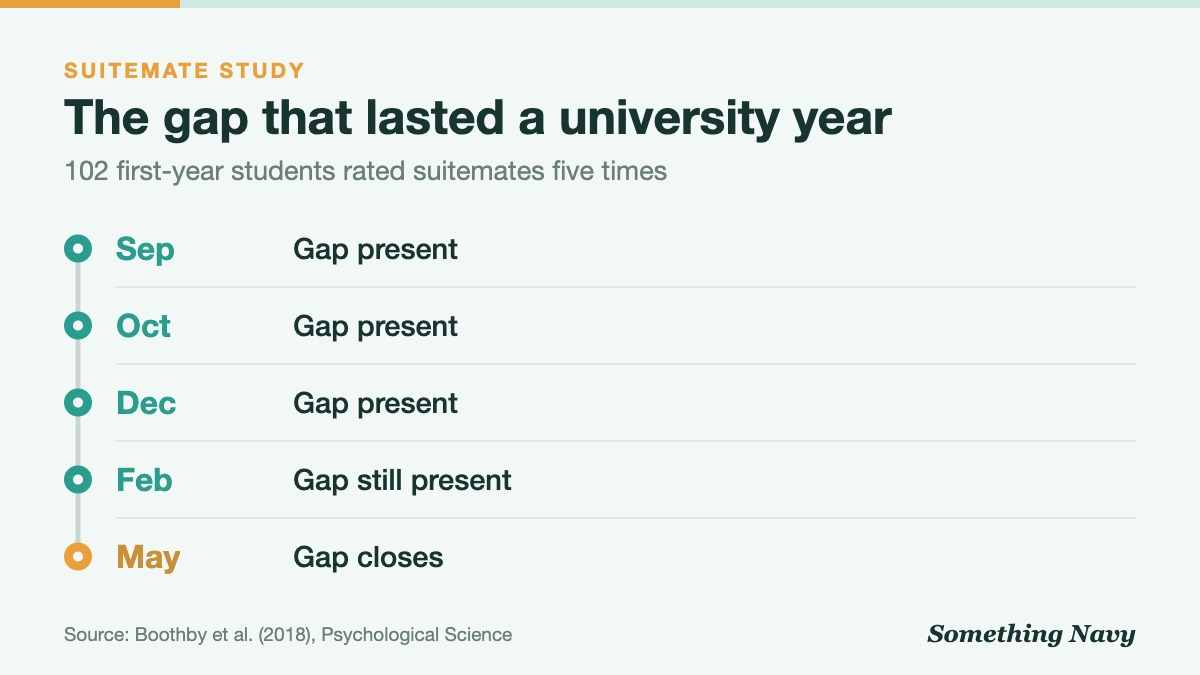
The most striking study followed 102 first-year university students living in shared suites. They rated their suitemates, and guessed how their suitemates rated them, five times between September and May.
The gap was there in September. It was still there in October, December and February. Only at the final check-in in May did it finally close, and the authors suggest one plausible reason: by then, students were deciding whom to live with the following year, and those conversations may have forced the truth into the open.
If you had a good time talking to someone, they probably had a good time too.
Erica Boothby, speaking to CNBC
The evidence was on their faces all along
If people liked their partners more than their partners knew, you would expect that liking to leak out somehow. It did.
The researchers asked two trained research assistants, who did not know what the study was testing, to watch video recordings of the first study’s conversations and judge how much each person seemed to like the other. Their outside judgements predicted how much people really did like their partners.
But they did not predict how much people thought they were liked. The signals were there: the smiles, the leaning in, the follow-up questions. The people in the conversation simply were not reading them.
A neutral stranger watching a video had a clearer view of your partner’s feelings than you did, sitting a metre away.


What you are doing instead of listening
So where was everyone’s attention? Clark, speaking to Yale News, put it simply: people “seem to be too wrapped up in their own worries about what they should say or did say.”
The second study captured this directly. After chatting, participants listed the three moments they felt had most shaped their impression of their partner, and the three moments they believed had most shaped their partner’s impression of them. Then they rated how positive each moment was.
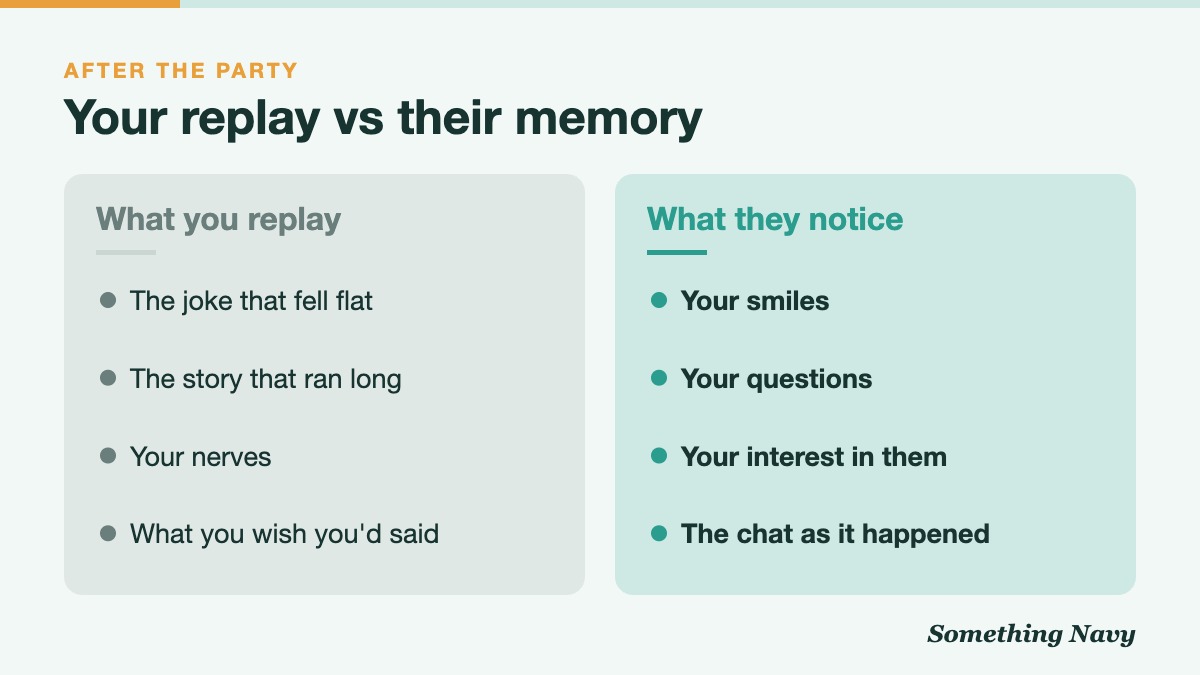
The moments people chose about themselves were consistently more negative. When we judge the other person, we remember the good bits: the funny story, the shared interest. When we imagine being judged, we reach straight for the stumble.
And the mood of those self-focused thoughts helped explain the size of the gap.
A harsher judge for one person only
There is a quieter reason, too. In their discussion, the authors point out that we hold ourselves to higher standards than we hold anyone else.
You know what you meant to say. You know the smoother version of the story, the sharper punchline, the question you wish you had asked. Your partner has no access to that ideal version. They only hear the conversation that actually happened, and measured against nothing, it was pleasant.
We also assume our nerves are more visible than they are, which is a close cousin of the spotlight effect, our habit of overestimating how much others notice about us. You felt the flush in your cheeks. They saw someone who was easy to talk to.
Clark has described one more ingredient: a kind of self-protective pessimism. Assuming the worst feels safer than assuming you were liked and being wrong.
Who feels it most
You might expect anxious or shy people to suffer most, and there is a hint of that. In the first study, the shyest third of participants showed the biggest gap, while the least shy third showed a small one that was not statistically reliable.
That comparison rests on just ten people per group, so it should be read as a clue rather than a conclusion. The broader point is that the gap was not confined to the anxious. It showed up for men and women alike, and Yale’s summary of the research noted that both partners in a pair tended to fall for it at the same time.
Nor is it something we pick up in adulthood. In 2021, Wouter Wolf, Amanda Nafe and Michael Tomasello at Duke University tested children aged four to 11 who spent five minutes building a tower with an unfamiliar child, then rated each other using a scale of emoticon faces.
The liking gap appeared at around age five, the age at which children start to care about how others see them, and it grew wider as they got older.
We seem to learn to doubt ourselves at roughly the same time we learn that other people are judging us.
At work, the gap has a price
In a 2021 follow-up in Organizational Behavior and Human Decision Processes, Adam Mastroianni, Cooney, Boothby and Andrew Reece looked at groups rather than pairs. They studied small group conversations, engineering students working on a team project, and a survey of working adults.
The gap appeared in all three. It was largest between peers, rather than between managers and the people who report to them, and it was partly driven by people dwelling on the negative aspects of the impression they were making.
In the workplace survey, people who believed their colleagues liked them less were less likely to ask for help, less willing to speak openly and felt less included. They also reported lower team effectiveness and job satisfaction.
Those links come from a survey, so they show association, not proof that the gap causes the problems. It is easy to see how it could, though. If you think a colleague finds you tiresome, you will think twice before knocking on their door.
Why the 2am replay is so convincing
None of this makes the walk home feel any less real. The replay is vivid because it is built from the most emotionally charged moments, and those are exactly the moments the research says we overweight.
You have a perfect record of your own inner commentary and almost no record of theirs. So the mind fills the gap with your own criticism, then attributes it to them.
Boothby made a similar point in her interview with CNBC: we “sub in those thoughts for what the other person must be thinking about us.” Meanwhile, as she added, the other person has their own concerns. Quite possibly they are on their own walk home, wincing at their own stories.
The person you are worrying about is probably worrying about you.
What to do with this tonight
Knowing about a bias does not switch it off. In the suitemate study, offering students a $100 bonus for guessing accurately made no difference to the gap.
What you can change is what you do next: where you point your attention, and whether you act on the verdict your inner critic hands down.
Try this: the after-party reset
- Swap the evidence. For every cringe moment you replay, name one thing the other person did: a laugh, a question, a story they chose to share. These were the signals the outside observers spotted.
- Reverse the roles. Ask yourself how you would rate them for that same stumble. If you would barely notice it in someone else, they probably barely noticed it in you.
- Apply the discount. Whatever you think they made of you, nudge it upwards. The research suggests your first estimate is too low.
- Send the message. If you enjoyed the chat, follow up within a day or two. A quick “really good to meet you” costs little and closes the gap from their side too.
- Next time, look outward. During a conversation, give your full attention to the other person’s face and words. Curiosity leaves less room for self-monitoring.
That last step matters more than it sounds. A lot of social anxiety is attention pointed inward, and the most reliable way to turn it outward is to become genuinely interested in what the other person is saying. Our piece on why talking to strangers feels better than we expect explores a related blind spot about how much we will enjoy the exchange.
And if the first meeting went better than you thought, it is worth showing up again. Friendship takes time and repetition, as the research on how many hours it takes to make a friend shows, and the liking gap is one of the things that quietly stops us from putting in those hours.
A gap worth closing
It is worth being honest about what the research does not say. The liking gap describes an average. Some conversations genuinely do go badly, and nothing here means everyone adores you. Most of the participants were young, many were students, and most studies took place in the US and UK.
But the direction of the error has been consistent across strangers, workshops, suitemates, teams and children. When we guess wrong about how a conversation went, we tend to guess too low.
The researchers’ concern is the real reason to take it seriously. If both people leave a pleasant chat thinking they were the one who liked the other more, both may wait for the other to make the next move. Neither does. A friendship that could have started simply does not.
So the next time you are walking home and the replay starts, let it play once. Then remember the face across the kitchen counter, the laugh you got, the question they asked you back.
That is what they will remember. And it is probably what they are replaying right now.
Frequently asked questions
No. The liking gap appears in people across the range of shyness, although the first study hinted it may be larger in shyer people. Social anxiety is a broader, more persistent fear of being judged that can benefit from professional support.
It narrows with familiarity. In the suitemate study it lasted from September to February and only closed in May, when students were choosing who to live with the next year.
The main studies used face-to-face conversations, so the research does not yet tell us much about messaging. It is reasonable to suspect the same self-critical review happens, but that has not been tested in these papers.
Look at what they did rather than what you felt: did they ask questions, laugh, share something personal or keep the conversation going? Those are the cues neutral observers used to judge liking accurately.
Sources
- Boothby, E. J., Cooney, G., Sandstrom, G. M., & Clark, M. S. (2018). The liking gap in conversations: Do people like us more than we think? Psychological Science, 29(11), 1742–1756. DOI
- Mastroianni, A. M., Cooney, G., Boothby, E. J., & Reece, A. G. (2021). The liking gap in groups and teams. Organizational Behavior and Human Decision Processes, 162, 109–122. DOI
- Wolf, W., Nafe, A., & Tomasello, M. (2021). The development of the liking gap: Children older than 5 years think that partners evaluate them less positively than they evaluate their partners. Psychological Science, 32(5), 789–798. DOI
- Yale News. (2018, September 4). At first meeting, people like you more than you think. Link
- Association for Psychological Science. (2018). You probably made a better first impression than you think. Link
- Piñon, N. (2022, December 21). Harvard, Penn research says people like you more than you think: How to use that to your advantage. CNBC, via NBC Chicago. Link
Cover photo: Helena Lopes on Unsplash. Charts and graphics: Something Navy.
How we reported this. We went back to the original research for this story, 6 sources in all, listed above, and checked every figure against them. If you think we have got something wrong, tell us and we will look at it. Read more about how we work.