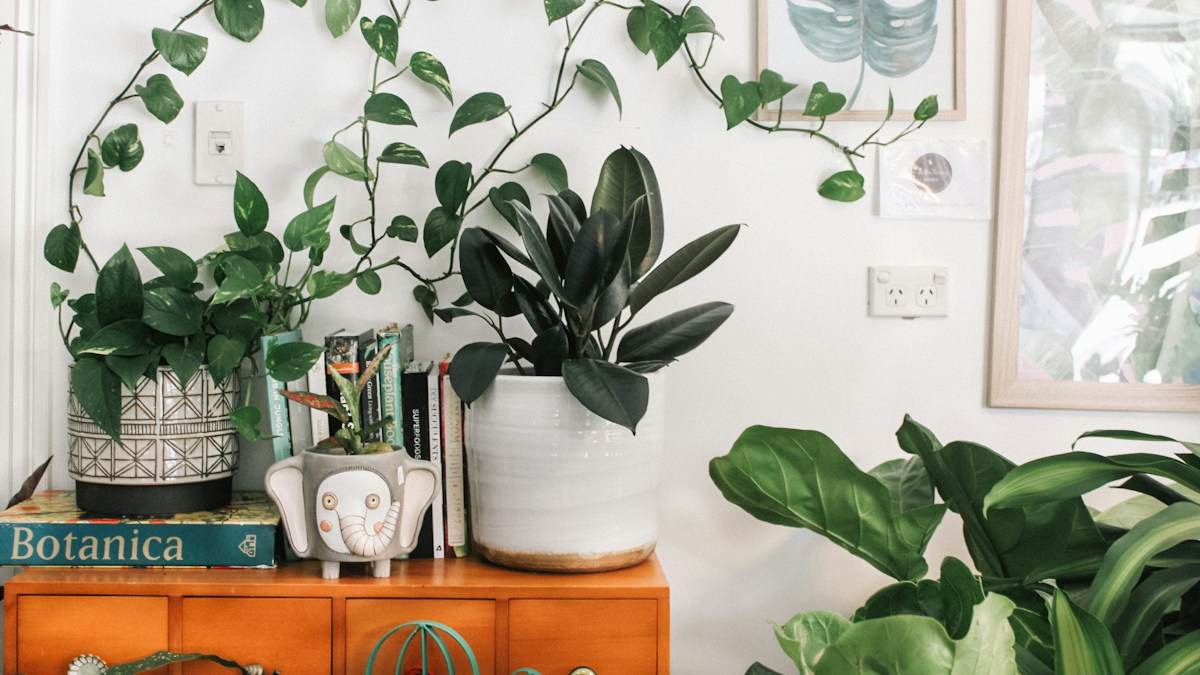
The snake plant at the garden centre comes with a little plastic label. Next to the watering advice there is often a leaf symbol and two words: “air purifying”. Sometimes the label goes further and mentions NASA.
It is a lovely idea. You buy a pot of green, put it on the bookcase, and it quietly scrubs the chemicals out of your living room while you watch television. Millions of people have bought plants partly on that promise, and lists of the “best air-cleaning houseplants” are among the most shared gardening content online.
The promise is, for practical purposes, false. But the story does not end there, because when researchers stopped asking what plants do to the air and started asking what they do to people, they found something more interesting.
A space agency, a sealed box and a peace lily
The legend begins with a report dated 15 September 1989. B.C. Wolverton, Anne Johnson and Keith Bounds, working at NASA’s John C. Stennis Space Center in Mississippi, published Interior Landscape Plants for Indoor Air Pollution Abatement. The work was funded jointly by NASA and the Associated Landscape Contractors of America, a trade body whose members had an obvious interest in the answer.
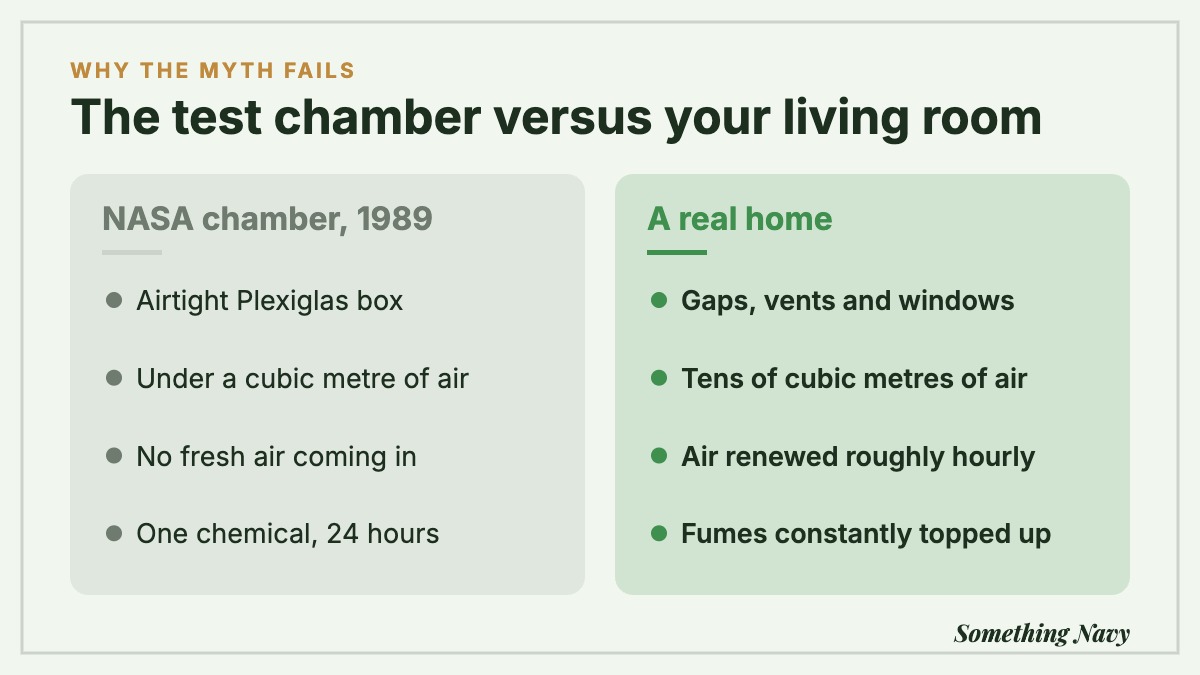
The method was simple. The team placed common houseplants, including peace lily, mother-in-law’s tongue, English ivy, bamboo palm and several dracaenas, inside Plexiglas chambers. The lids were fastened with bolts and wing-nuts so the boxes were airtight. The smaller chambers measured 76cm on each side; the larger ones were twice as tall and held well under a cubic metre of air.
They then injected one of three chemicals: benzene, trichloroethylene or formaldehyde. Air samples were taken at the start, after six hours and after 24 hours. In many trials the concentrations fell substantially, and the report became the founding document of a very long-running houseplant myth.
What the experiments actually showed
Read closely, the report itself contains a clue that the leaves were not doing all the work. The authors noted that when dense foliage covered the soil, benzene removal dropped, and they recommended “maximizing air exposure to the plant root-soil area” when placing plants in buildings. In other words, much of the action seemed to be happening in the pot, where roots and soil microbes meet the air.
None of that makes the chamber results wrong. A plant in a small sealed box, with nothing coming in and nothing going out, really can pull down the level of a chemical over a day. The problem is the leap from that box to your flat.
A home is not sealed. It is far bigger than a Plexiglas cube, and its air is constantly being swapped with outdoor air through gaps, vents, extractor fans and open windows. Meanwhile, sources inside the home, from cooking to cleaning sprays to new furniture, keep topping the pollutants up.
Thirty years later, two engineers did the maths
In November 2019, Bryan Cummings and Michael Waring, environmental engineers at Drexel University in Philadelphia, published a review in the Journal of Exposure Science & Environmental Epidemiology with a title that left little room for doubt: “Potted plants do not improve indoor air quality”.
They gathered 12 published chamber studies spanning about 30 years of research. In most of them, according to Drexel’s summary, a plant sat in a sealed chamber “often with a volume of a cubic meter or smaller”. Rather than arguing with any individual result, Cummings and Waring translated 196 experimental results into a single common measure used for air purifiers: the clean air delivery rate, or CADR.
CADR answers a practical question. How many cubic metres of perfectly clean air would you need to pump into a room each hour to get the same effect as this device? It lets you compare a potted fern directly with an open window or a ventilation system.
The answer for plants was tiny. The median single-plant CADR across the studies was 0.023 cubic metres per hour, with individual results spread across orders of magnitude.
Between 10 and 1,000 plants per square metre
Here is the figure that should be printed on the garden-centre labels instead. To match the pollutant removal that ordinary air exchange already provides in a typical building (roughly one complete change of indoor air every hour), Cummings and Waring calculated you would need between 10 and 1,000 plants per square metre of floor space.
Not per room. Per square metre.
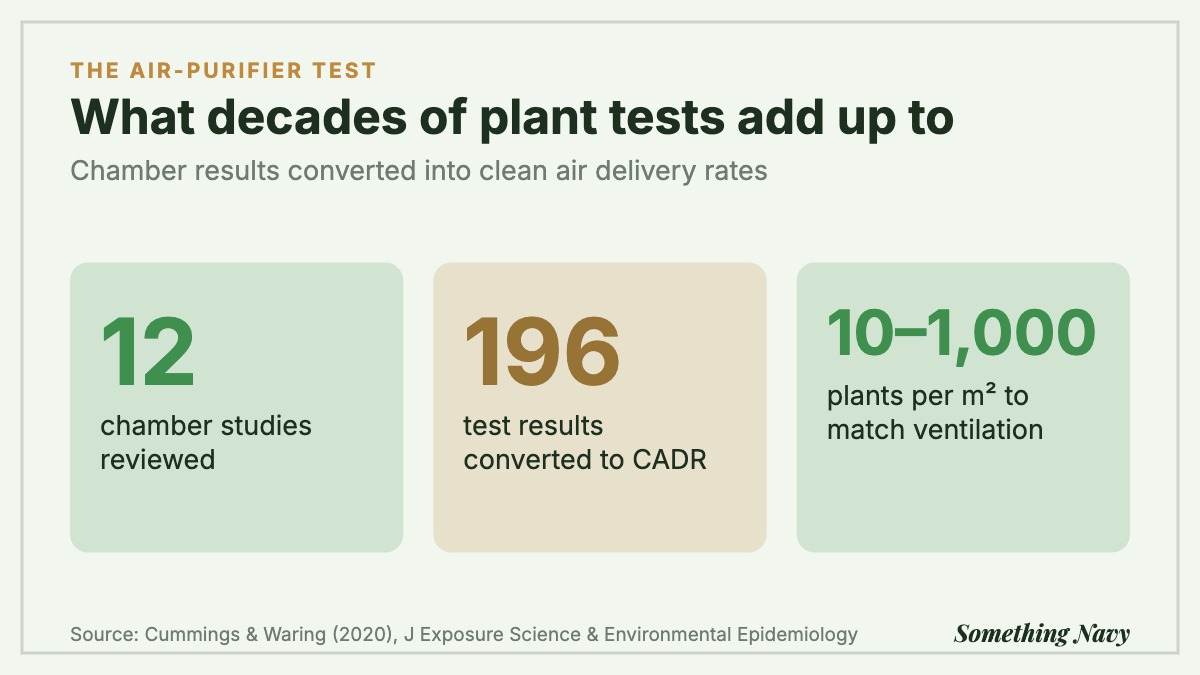
To make that concrete, take a modest 20 square metre living room with a 2.4 metre ceiling. That is 48 cubic metres of air. A single air change an hour means about 48 cubic metres of fresh air arriving every hour. Dividing that by the median plant’s 0.023 cubic metres gives roughly 2,000 plants. This is our own back-of-the-envelope sum using their median, not a figure from the paper, but it sits comfortably inside their range of 200 to 20,000 plants for a room that size.
At that point you are not decorating a living room. You are living in a greenhouse.
Waring put it plainly in the university’s press release: “Plants are great, but they don’t actually clean indoor air quickly enough” to make a difference in a home or office.


Why your windows beat your monstera
The deeper lesson is about scale. Chamber studies measured how fast a plant reduced a chemical inside a box with no ventilation, so even a slow process looked impressive. In a real building, ventilation is already diluting pollutants far faster than any pot could, so the plant’s contribution disappears into the noise.
It also explains why the myth survived so long. Nobody was lying about the chamber results. The numbers were real; they were simply answering a different question from the one shoppers thought they were answering. Cummings and Waring suggested future research would be better spent on how plants take up chemicals, on engineered biofiltration systems, and on the effects plants have on well-being.
If indoor air genuinely worries you, the useful tools are unglamorous: opening windows, using the extractor fan when you cook, and cutting down on sources of fumes in the first place. A peace lily will not hurt, but it is not a substitute.
So far, so deflating. Now for the turn in the story.
The question nobody was asking
That last suggestion from the Drexel engineers, to study well-being, points to a body of research that was running in parallel all along. Psychologists had been asking whether simply having plants around changes how people feel, think and work.
This is a harder thing to measure than benzene in a box. Moods shift for a hundred reasons, people know when a plant has appeared on their desk, and it is almost impossible to run a blind trial of greenery. So the evidence is messier. But some of it is striking, and one of the most cited studies came from real offices rather than a laboratory.
The call centre, the consultancy and the 15% claim
In 2014, Marlon Nieuwenhuis of Cardiff University’s School of Psychology, with Craig Knight of the University of Exeter, Tom Postmes of the University of Groningen and Alex Haslam of the University of Queensland, published three field experiments in the Journal of Experimental Psychology: Applied. They wanted to test a fashionable management idea, the “lean” office of clear desks and bare surfaces, against a “green” one with plants.
In the first study, at a London consultancy, plants were added to part of an open-plan floor. Of the staff who answered surveys both before and three weeks after, 67 people provided usable data. Those in the green area reported better concentration and, tellingly, better air quality than colleagues in the lean area.
Yes, better perceived air quality. People felt the air had improved, even though, as the engineers would later show, the plants could barely have changed it.
The second study moved to a health insurer’s call centre in Zwolle in the Netherlands, comparing two near-identical floors. Among the 81 employees who completed all three survey waves, satisfaction rose on the green floor and was still higher three and a half months later. But the company’s own productivity measure, the average time taken to handle a call, showed no difference between floors.
The third study, again in London, randomly assigned 33 employees to lean or green workstations and timed them on two tasks. On a vigilance task, crossing out every lowercase “b” on a page, the green group finished faster: 5.39 minutes against 6.67 on average, a statistically significant gap. On a longer information-processing task, the green group took 17.39 minutes against 20.39, but that difference was not statistically significant. Error rates did not differ.
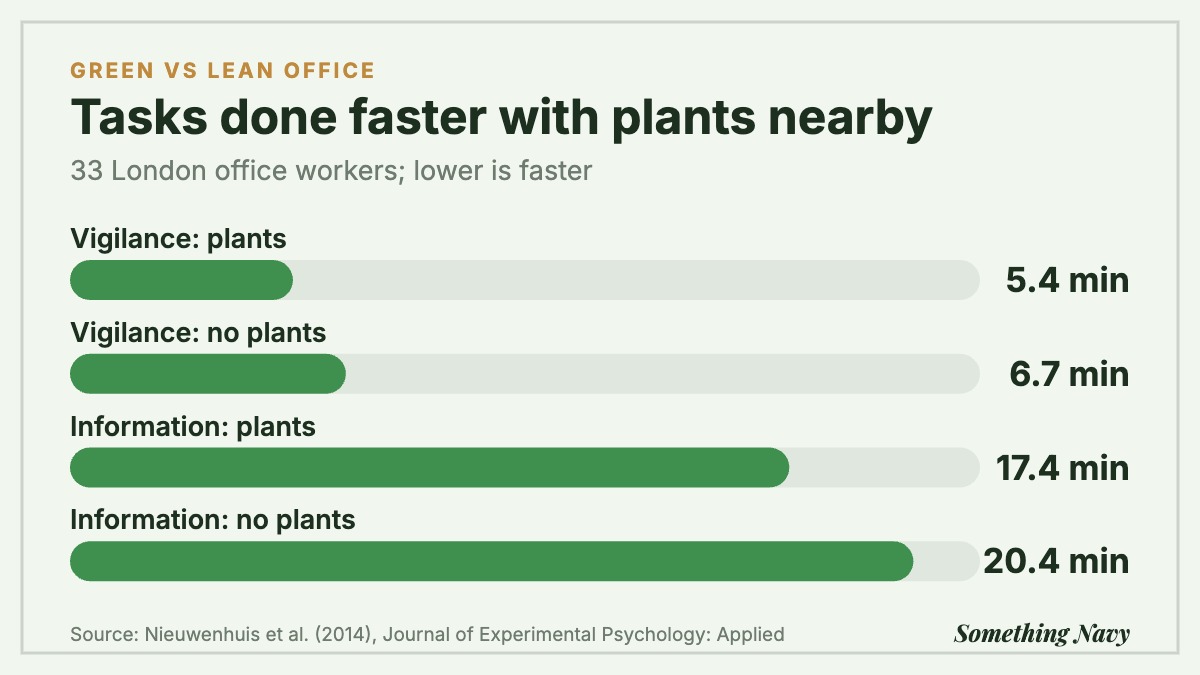
This is where the famous headline comes from. The paper’s discussion says greening the office raised productivity by 15%, and a Cardiff press release repeated the figure. The paper does not set out exactly how that number was calculated, though it lines up with the information-task times, roughly 15% faster, which was the result that did not reach significance. It is a reasonable reading of the data, not a precise law of office design.
Still, the direction of the findings across three settings was consistent, and Haslam summed up the challenge to minimalist offices in five words.
Sometimes less is just less.
Alex Haslam, University of Queensland
If you have read about whether a messy desk helps creativity, the theme will feel familiar. Spaces that look efficient to a facilities manager are not always the ones people actually work well in.
Six plants at the back of a classroom
Schools offer a different test. Ke-Tsung Han ran a semester-long study in a junior high school in Taiwan, published in Environment and Behavior in 2009. Two eighth-grade classes, 76 students in total, were compared. Six plants were placed at the back of one classroom, where pupils facing the front could not easily see them. The other class carried on as normal.
Students filled in questionnaires every other week. Those in the plant classroom rated their room higher for preference, comfort and friendliness. The school records were more surprising: the plant class had significantly fewer hours of sick leave and fewer punishment records for misbehaviour. Academic achievement, however, showed no significant difference.
With only two classes, there is plenty that could explain the gap besides the plants, from a different teacher’s mood to a cold sweeping through one room. Han himself acknowledged that other factors may have been involved. It is an intriguing result, not a proof.
Fifteen minutes with a trowel
Some of the most suggestive work looks not at having plants but at handling them. In a 2015 study in the Journal of Physiological Anthropology, Lee and colleagues asked 24 young men, average age about 25, to do two things on separate days in random order: spend 15 minutes repotting a small Peperomia, or spend 15 minutes typing on a computer.
After repotting, the men rated themselves as more comfortable, soothed and natural. After the computer task they described feeling uncomfortable, awakened and artificial. Their diastolic blood pressure was lower after the plant task, around 65 mmHg against about 72 after typing, and a heart-rate measure linked to the body’s stress response was lower in the final three minutes of repotting, though not across the whole session.
The sample was small, all male and young, and the sessions were short. But it hints that the act of tending, getting soil on your fingers and attending to something slow, may matter as much as the greenery itself. That chimes with research on how clutter affects stress at home: the objects around us, and what we do with them, shape how a room feels.
Mixed results, honestly reported
It would be easy to swap one myth for another, so it is worth stepping back. In 2009 Tina Bringslimark, Terry Hartig and Grete Patil published a critical review of the experimental literature in the Journal of Environmental Psychology. They examined studies of indoor plants and emotional states, pain perception, creativity, task performance and physiological arousal.
Their verdict was cautious. In general, they wrote, “the results appear to be quite mixed”. The one finding that recurred was better pain management when plants were present. They blamed the inconsistency on the sheer variety of the studies, with different manipulations, settings, samples, exposure times and measures, and called for much more careful design and reporting.
That caution still applies. Many plant studies are small, short and unblinded, and people who know they are in a “green” condition may answer questionnaires more warmly. A plant can also be a signal: an employer who adds greenery and asks staff what they think is also showing that someone cares, and that alone can lift satisfaction.
None of this means the effects are imaginary. It means they are probably modest, variable from person to person, and tangled up with attention, ownership and the meaning we attach to living things.
Choosing plants for how they make you feel
- Put it where you will see it. The office and classroom studies placed plants in people’s working space, not in a forgotten corner.
- Pick something you will enjoy caring for. In the repotting study, the hands-on task was what seemed to calm people. A plant you tend may give more than one you ignore.
- Make the space yours. In the call-centre study, the benefits seemed to work through staff feeling more engaged with their workplace. Choosing your own plant is part of that.
- Do not buy it for the air. For fumes and stuffiness, open a window or use the extractor fan. Treat any plant as a mood purchase, not a medical device.
- Start small. One healthy plant you like beats a crowded windowsill of struggling ones that feel like a chore.
What a plant is really for
Look again at that London consultancy. The workers with plants said the air felt cleaner. By any engineering measure, it almost certainly was not. Yet they also reported concentrating better, and on one task they really did work faster.
That gap between what plants do to a room and what they do to the people in it is the whole story. The NASA label sold the wrong benefit. A fern is a terrible air purifier and, on the evidence so far, a modestly decent companion: something alive to look at, to look after, and to notice growing while your phone sits demanding attention on the desk beside it.
So keep the snake plant. Just peel off the label.
Sources
- Bringslimark, T., Hartig, T., & Patil, G. G. (2009). The psychological benefits of indoor plants: A critical review of the experimental literature. Journal of Environmental Psychology, 29(4), 422–433. DOI
- Cummings, B. E., & Waring, M. S. (2020). Potted plants do not improve indoor air quality: A review and analysis of reported VOC removal efficiencies. Journal of Exposure Science & Environmental Epidemiology, 30(2), 253–261. DOI
- Han, K.-T. (2009). Influence of limitedly visible leafy indoor plants on the psychology, behavior, and health of students at a junior high school in Taiwan. Environment and Behavior, 41(5), 658–692. DOI
- Lee, M., Lee, J., Park, B.-J., & Miyazaki, Y. (2015). Interaction with indoor plants may reduce psychological and physiological stress by suppressing autonomic nervous system activity in young adults: A randomized crossover study. Journal of Physiological Anthropology, 34, 21. DOI
- Nieuwenhuis, M., Knight, C., Postmes, T., & Haslam, S. A. (2014). The relative benefits of green versus lean office space: Three field experiments. Journal of Experimental Psychology: Applied, 20(3), 199–214. DOI
- Wolverton, B. C., Johnson, A., & Bounds, K. (1989). Interior landscape plants for indoor air pollution abatement (Final report). NASA John C. Stennis Space Center. Link
Cover photo: Prudence Earl on Unsplash. Charts and graphics: Something Navy.
How we reported this. We went back to the original research for this story, 6 sources in all, listed above, and checked every figure against them. If you think we have got something wrong, tell us and we will look at it. Read more about how we work.