
It is the first week of January and someone in the family group chat has just posted a photo of new running shoes. “Half marathon in May. Holding myself to it.” Within minutes there are eleven thumbs-up, two flexed-bicep emojis and an aunt saying she is so proud.
It feels good. That is exactly the problem, according to one influential strand of psychology. Another strand, just as respectable, says that posting the shoes was the smartest thing the runner could have done.
So which is it? Should you keep your ambitions to yourself, or tell everyone and let the fear of looking foolish carry you to the finish line? The honest answer is that both camps have evidence, and the evidence is more interesting than either slogan.
The three-minute talk that told millions to keep quiet
Most people who believe goals should be kept secret picked the idea up from one place. In July 2010, at TEDGlobal, the musician and entrepreneur Derek Sivers gave a talk called “Keep your goals to yourself”. It runs about three minutes and has been played millions of times.
His argument was simple and sticky. Telling people your plan gives you a small social reward, and that reward can stand in for the real thing. You get some of the satisfaction of achievement without any of the work, so you do less of the work.
Sivers was a messenger, not a researcher, and he said so: he was summarising a body of psychology. The study at the centre of it had been published the year before, and it is worth looking at closely, because it says something narrower and stranger than “never tell anyone anything”.
For silence: when someone reads your intentions
In 2009 Peter Gollwitzer of New York University and the University of Konstanz, with Paschal Sheeran, then at the University of Sheffield, and Konstanz colleagues Verena Michalski and Andrea Seifert, published four small experiments in Psychological Science under the title “When intentions go public”.
All four involved students at a German university who wanted to become something: a psychologist, a clinical psychologist, a lawyer. These are what psychologists call identity goals. You do not finish them on a Tuesday; you spend years becoming the kind of person who has them.
The set-up was almost comically subtle. Students wrote down what they intended to do to reach their goal. In one condition the experimenter read what they had written. In the other, the page was discarded or handed in unread. Nobody gave a speech. Someone simply took notice.
In Study 1, 49 psychology students wrote down their two most important study intentions, such as studying more statistics. A week later, those whose intentions had been read reported acting on them on fewer days: an average of 1.92 days, against 2.70 for students whose plans stayed private.
In Study 2, 30 law students who had stated an intention to make the best possible use of their legal education were given 20 criminal law cases to work through, with up to 45 minutes and the freedom to stop early. Those whose intention had been noticed worked for about 41.5 minutes on average; those whose intention had been ignored worked for about 45.7.
Study 3 gave 57 psychology students who wanted to become clinical psychologists the chance to watch a 40-minute video of therapy sessions. Here the twist appeared. Among students strongly committed to the goal, those whose intentions had been read watched for about 28 minutes, compared with about 39 minutes for those whose intentions went unread. Among weakly committed students there was essentially no difference.
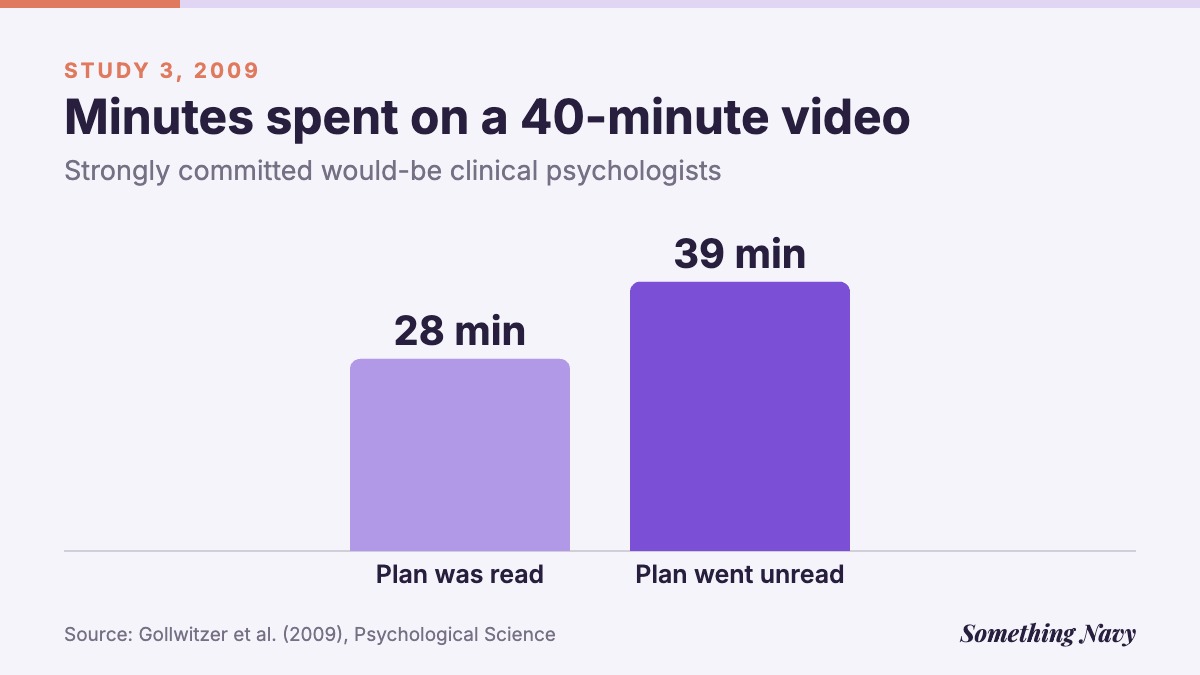
That detail matters. The effect did not hit the lukewarm. It hit the people who cared most, which is precisely who you would expect to be announcing their goals in the first place.
For telling: a meta-analysis of 19,951 people
Now the case for the defence. In 2016 Benjamin Harkin and colleagues at the universities of Sheffield and Leeds, with Paschal Sheeran (now at the University of North Carolina at Chapel Hill, and a co-author of the 2009 paper), published a meta-analysis in Psychological Bulletin. They pooled 138 randomised experiments involving 19,951 participants, mostly chasing health goals such as losing weight, quitting smoking or lowering blood pressure.
The question was whether prompting people to monitor their progress helps them reach their goals. It did. Interventions that increased monitoring improved goal attainment with an average effect size (d) of 0.40, a moderate effect by the usual conventions in psychology.
Then came the part that cuts against the secrecy argument. The benefit depended on what people did with the information. When progress was monitored in public, the effect was 0.55. When it was monitored privately but reported to at least one other person, it was 0.47. When it was monitored privately and kept private, the effect shrank to 0.19.
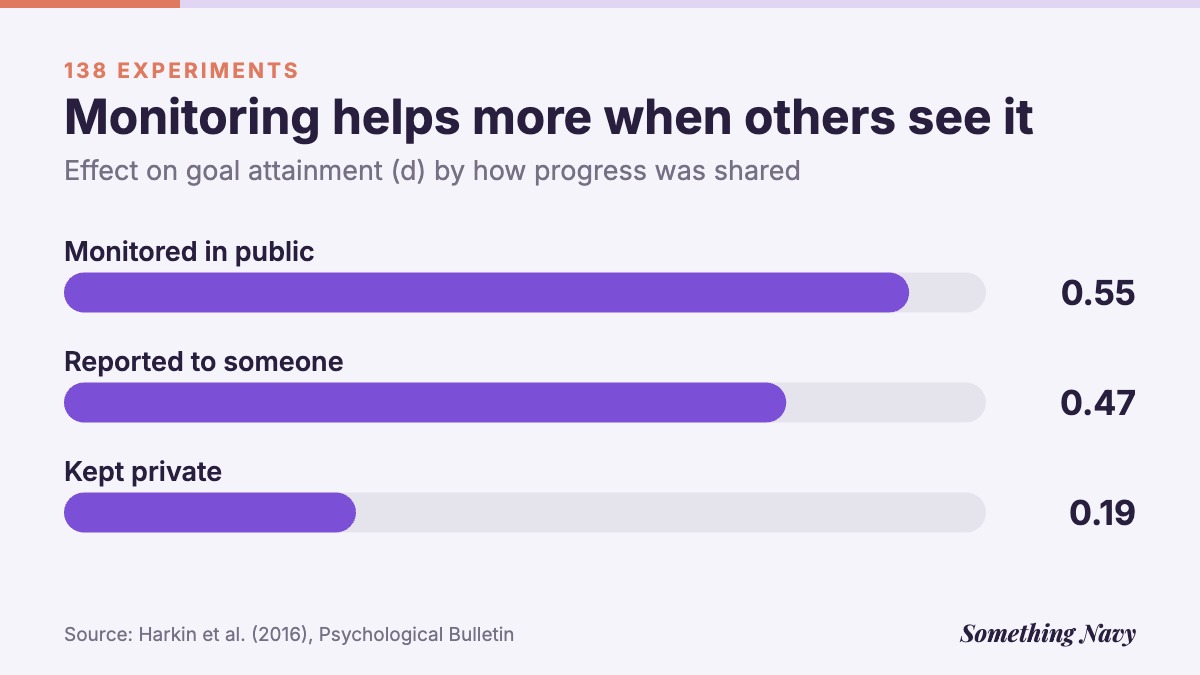
Writing it down helped too: monitoring that was physically recorded produced larger effects (0.43) than monitoring that was not (0.29). Harkin’s advice, in the American Psychological Association’s press release, was that people should be encouraged “to record, report or make public what they find out as they assess their progress.”
The classic example of “public” in these studies is the weight-loss group where everyone steps on the scales in front of everyone else. Not exactly a quiet, private approach.
For silence: saying it can feel like being it
Back to the 2009 experiments, and the puzzle at their heart. Why would being noticed make you try less? Gollwitzer’s explanation draws on self-completion theory, which he developed with Robert Wicklund in the early 1980s. The idea is that an identity like “doctor” or “writer” is built from symbols: qualifications, equipment, the right vocabulary, and also other people acknowledging that you are on your way.
Those symbols can substitute for one another. If someone recognises your intention, your sense of being the person you want to be gets a top-up, and the urge to earn it through effort eases off.
Study 4 tested this directly. Twenty-four law students either announced their intentions aloud to a small group or did an unrelated task. Afterwards, those who had gone public rated themselves as feeling more like a lawyer already. In the paper’s words, being noticed gave them “a premature sense of possessing the aspired-to identity.”
Anyone who has bought expensive gym kit and then felt oddly sporty while sitting on the sofa will recognise the sensation.
It is a genuinely useful insight. But look at what the studies measured: effort over a single week or a single lab session, in groups of 24 to 57 people. The difference in Study 2 was about four minutes, with most students near the time limit. Findings from samples this small deserve large, preregistered replications before they harden into rules for living.


For telling: it depends who is listening
The most direct challenge to the keep-it-secret advice came from Howard Klein, a management researcher at Ohio State University’s Fisher College of Business. With Robert Lount and Bryce Linford of Ohio State and Hee Man Park of Penn State, he published four studies in the Journal of Applied Psychology (online in 2019, in print in 2020).
In the central experiment, 171 undergraduates did a dull computer task, dragging a slider to the number 50 as many times as they could. Before a second round they set themselves a goal and wrote it down. A lab assistant then checked on it.
The trick was the assistant. For some students, he wore a suit and was introduced as a doctoral student and expert at the business school. For others, the same man wore casual clothes and was introduced as a part-time community college student working there. A control group shared their goal with nobody.
Students who shared their goal with the high-status version were more committed to it and performed better. Students who told the low-status version did no better than those who told no one. A semester-long follow-up with 292 students, who set grade targets and shared them, found the same pattern: telling a higher-status person went with greater commitment and a better chance of hitting the target grade.
The important thing is that you need to care about the opinion of who you are telling.
Howard Klein, Ohio State University
The mechanism, Klein’s team argued, is evaluation apprehension: a mild worry about how the listener will judge you. “Contrary to what you may have heard, in most cases you get more benefit from sharing your goal,” Klein said in the university’s press release, explicitly taking aim at the 2009 study and the TED talk.
The small print on both sides
It would be easy to declare a winner here, since Harkin’s analysis is enormous and Klein’s work is newer. That would be too quick.
Harkin’s comparison of public and private monitoring is a moderator analysis. It compares different studies with each other rather than randomly assigning people to tell or not tell, so other differences between those studies could be doing some of the work. And the goals were mostly concrete health targets, like a number on the scales, not identities like “becoming a psychologist”.
Klein’s experiment used American undergraduates and a slider task that nobody would choose to do on a free afternoon. Its status manipulation, a suit and a job title, is clever but artificial. The semester study comes closer to real life, yet it still involved students and grades.
And Gollwitzer’s studies, as noted, were small and short. None of these papers settles the question alone. Read together, though, they stop contradicting each other quite so much.
Where the two camps quietly agree
Look at what each side actually tested. Gollwitzer’s participants announced who they intended to become, and someone acknowledged it. There was no follow-up and no measure anyone would check. The recognition arrived before the effort and, for committed students, partly replaced it.
Harkin’s participants made their progress visible: what they ate, what they weighed, what they did. Klein’s participants stated a specific target to someone who would see whether they hit it. In both cases, telling created a future moment of judgement rather than a present moment of praise.
Tellingly, the 2009 paper anticipated this. In their discussion, Gollwitzer and colleagues suggested that stating specific, checkable standards, or considering the power of the audience, might create accountability that counters the effect. Klein’s status experiment reads almost like a test of that suggestion.
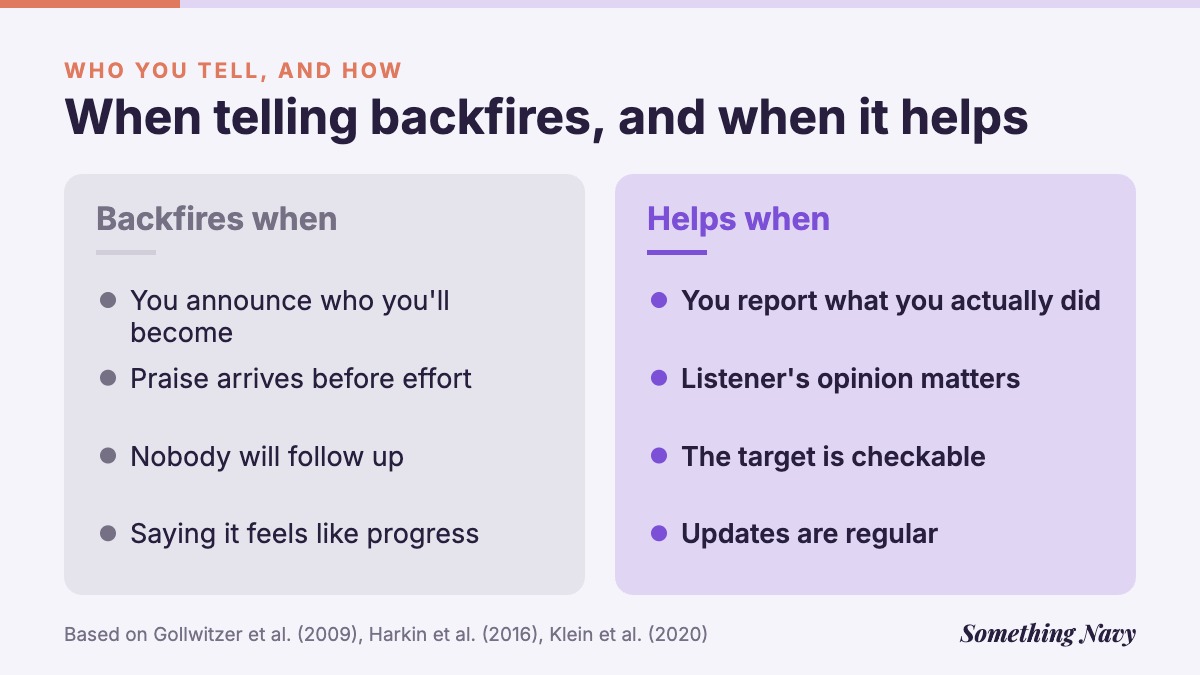
So the real variable is not whether you tell people. It is whether telling gives you a reward now or a reckoning later.
How to tell people well
If you want the accountability without the premature glow, the research points to a handful of habits. None of them requires secrecy.
Lead with behaviour, not identity. “I’m becoming a writer” invites a pat on the back. “I’m writing 500 words before work, five days a week” invites a question next Friday. The second is harder to feel finished about.
Report progress rather than plans. The strongest effects in Harkin’s data came from making results visible, not intentions. A weekly message saying what you did, including the weeks you did nothing, is closer to the evidence than a single grand announcement.
Choose a listener whose opinion you care about. In Klein’s experiments that meant someone of higher status, but the underlying ingredient was caring what they thought. A respected colleague, a demanding coach or a friend who will notice is worth more than a hundred likes.
Pair the announcement with a plan. Gollwitzer is best known for if-then plans, and his 2009 paper suggested they might protect against the public-intention effect, since the cue triggers the action whether or not anyone applauded. That idea was proposed rather than tested in the paper, but it costs nothing to try.
Tell them like this
- Name the action, not the identity. “I’m running three times a week” beats “I’m a runner now”.
- Pick one person whose judgement matters to you, rather than broadcasting to everyone.
- Give them a date and a number they can check, so telling creates a future check-in.
- Send progress, not promises. Short, regular updates match the strongest effects in the evidence.
- Notice the glow. If announcing a goal makes you feel as if you have already done it, treat that as a cue to start, not a reward.
It also helps to be wary of moments that make announcements feel like achievements. The new-year urge to declare everything at once, which psychologists link to the fresh start effect, is useful for getting going, but it is exactly when praise tends to arrive before any work has been done.
The announcement is not the achievement
Back to the runner in the family chat. The research does not say the post was a mistake. It says the eleven thumbs-up were the wrong kind of response: warm, instant and asking nothing in return.
A better reply might have come from the one cousin who actually runs, saying: “Brilliant. Send me your long run every Sunday.” That message offers no praise for the plan. It offers an audience for the effort, someone whose opinion matters and who will notice if the Sunday updates stop.
Habits take time to bed in, and often longer than people expect. Over those weeks, the person you tell matters less as a cheerleader and more as a witness. Tell people your goals, by all means. Just make sure that what you are giving them is something to check, not something to clap for.
Sources
- Gollwitzer, P. M., Sheeran, P., Michalski, V., & Seifert, A. E. (2009). When intentions go public: Does social reality widen the intention-behavior gap? Psychological Science, 20(5), 612–618. DOI
- Harkin, B., Webb, T. L., Chang, B. P. I., Prestwich, A., Conner, M., Kellar, I., Benn, Y., & Sheeran, P. (2016). Does monitoring goal progress promote goal attainment? A meta-analysis of the experimental evidence. Psychological Bulletin, 142(2), 198–229. DOI
- Klein, H. J., Lount, R. B., Park, H. M., & Linford, B. J. (2020). When goals are known: The effects of audience relative status on goal commitment and performance. Journal of Applied Psychology, 105(4), 372–389. DOI
- American Psychological Association. (2015, October 28). Frequently monitoring progress toward goals increases chance of success [Press release]. Link
- Grabmeier, J. (2019, September 3). Share your goals, but be careful whom you tell. Ohio State News. Link
- Sivers, D. (2010). Keep your goals to yourself [Video]. TEDGlobal 2010. Link
Cover photo: LinkedIn Sales Solutions on Unsplash. Charts and graphics: Something Navy.
How we reported this. We went back to the original research for this story, 6 sources in all, listed above, and checked every figure against them. If you think we have got something wrong, tell us and we will look at it. Read more about how we work.