There is probably someone you have been meaning to thank for years. A teacher who saw something in you before anyone else did. A manager who quietly put your name forward. A friend who drove across town at two in the morning and never mentioned it again.
You have drafted the message in your head more than once. Then you pictured them opening it, slightly baffled, wondering why you had got in touch after so long, and the draft went back in the drawer.
According to two behavioural scientists, that picture in your head is wrong, and wrong in a very consistent direction.
What the letter writers got wrong
In 2018 Amit Kumar of the University of Texas at Austin, who began the work as a postdoctoral researcher at the University of Chicago Booth School of Business, and Nicholas Epley of Chicago Booth published a set of experiments in Psychological Science. The design was simple. Participants wrote a letter of gratitude to someone who had affected their life in a meaningful way. Before it went out, they predicted how the recipient would feel: how surprised, how happy, how awkward.
Then the researchers contacted the recipients and asked them the same questions.
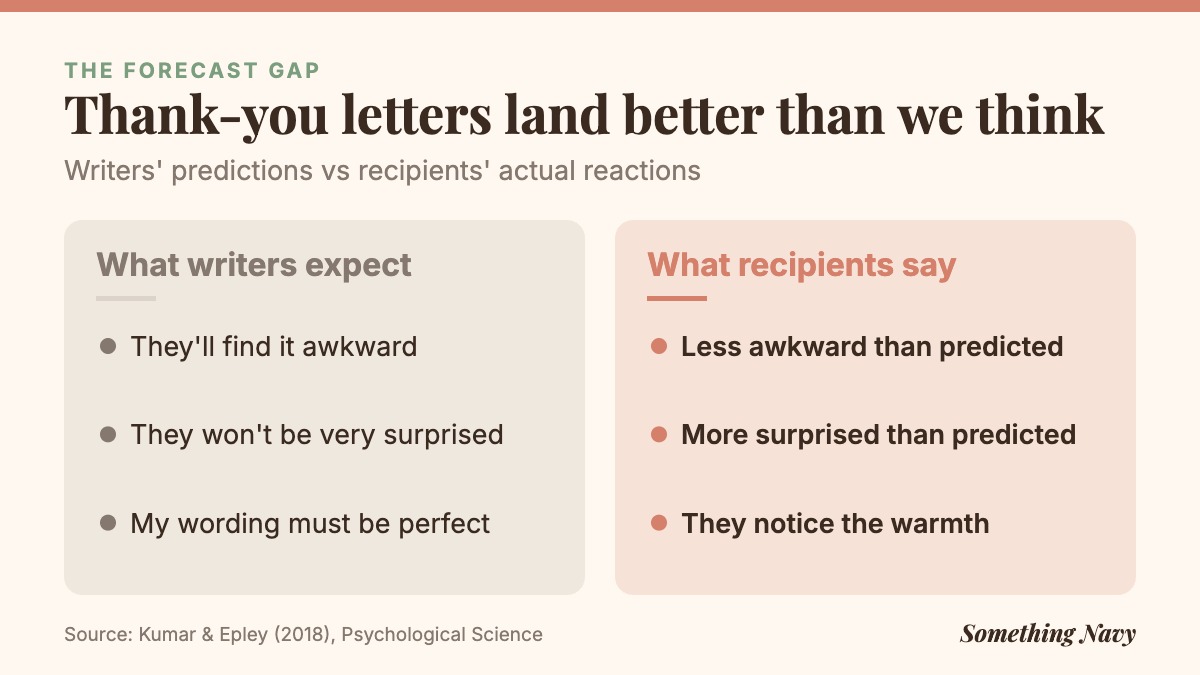
The writers underestimated how surprised the recipients would be by what they had written. They underestimated how good the letter would make them feel. And they overestimated how awkward the recipients would find it. In one experiment, business students wrote to classmates; in another, people could write to anyone they chose. The pattern held.
It is worth being clear about the size of the task. These were not elaborate tributes. Kumar told the University of Texas that it “only takes a couple minutes to compose letters like these”. The cost is a few minutes and a small risk of embarrassment. The payoff, it turns out, lands mostly on someone else, and it is bigger than the writer expects.
Why the letter stays in the drawer
Kumar and Epley wanted to know whether these mistaken forecasts actually stopped people from writing. So in later experiments they asked participants to think of several people they felt grateful towards, predict each person’s reaction, and say how likely they were to get in touch.
The answer was yes. People were more inclined to write to those they expected to respond warmly, and less inclined to write to those they thought would find it awkward. If your forecasts are too gloomy, you will send fewer letters than you should.
A final study found a second barrier. Writers fretted about how articulate they sounded, and they underestimated how competent and how warm the recipient would judge them to be. The gap was largest for competence. The writers were grading their own prose. The recipients were mostly registering the gesture.
If that sounds familiar, it is a close cousin of other social misjudgements Epley’s lab has documented, such as the way commuters expect conversations with strangers to be far less pleasant than they turn out to be. We are oddly pessimistic forecasters of other people’s kindness, including their kindness towards us.
What the letter study did
- Who: Amit Kumar (University of Texas at Austin) and Nicholas Epley (University of Chicago Booth School of Business).
- Method: People wrote gratitude letters, predicted the recipient’s reaction, then the researchers asked the recipients how they actually felt.
- Finding: Writers underestimated recipients’ surprise and pleasure and overestimated their awkwardness.
- Caveat: Not every recipient could be reached, though the authors report the errors were just as large where more recipients took part.
Where the gratitude boom began
The letter study sits on top of two decades of research into whether gratitude is good for the person feeling it. Most of that story starts with a 2003 paper by Robert Emmons of the University of California, Davis and Michael McCullough, then at the University of Miami, published in the Journal of Personality and Social Psychology under the memorable title “Counting blessings versus burdens”.
In the first of three studies, 201 undergraduates on a health psychology course were randomly split into three groups. Once a week for ten weeks, one group listed up to five things they were grateful for, another listed hassles, and a third simply noted events that had affected them. All of them kept records of their mood, health and habits.
By the end, the gratitude group rated their lives as a whole more favourably and felt more optimistic about the coming week. They reported fewer physical symptoms. They also said they had exercised about an hour and a half more per week than the hassles group: 4.35 hours against 3.01.
That last figure did a great deal of travelling in the years that followed. It is less often mentioned that these were self-reports from students who knew they were in a study, and that the groups did not differ significantly on day-to-day positive or negative mood.
Daily turned out to be no better than weekly
Emmons and McCullough’s second study tried a more intensive version. A new group of 166 students filled in daily reports for about two weeks, again listing blessings, hassles, or ways in which they were better off than others.
The daily gratitude group showed a lift in positive mood compared with the hassles group, and were more likely to say they had offered someone emotional support. But the differences in physical symptoms and exercise from the first study vanished. A third study, with 65 adults living with neuromuscular disease, found more positive mood, slightly longer sleep and higher life satisfaction as rated by their partners after 21 days of daily lists.
Doing it more often, in other words, did not simply produce more of the benefit. Sonja Lyubomirsky of the University of California, Riverside reported a sharper version of this in a 2005 review with Kennon Sheldon and David Schkade in the Review of General Psychology. Students were asked to count their blessings for six weeks, either once a week or three times a week. Only the once-a-week group showed gains in well-being compared with controls.
The authors’ suggestion was that counting several times a week made people bored with the practice. That is plausible, though it rests on unpublished data summarised in a review rather than a full peer-reviewed report, so it is best treated as a strong hint, not a rule.
Still, anyone who has tried to keep a daily gratitude list knows the feeling. By day nine you are writing “coffee” and “the weather” with all the conviction of someone filling in a timesheet.
The visit that topped the leaderboard, briefly
The most famous test of the thank-you letter itself came from Martin Seligman’s group at the University of Pennsylvania. In 2005 Seligman, Tracy Steen, Nansook Park and Christopher Peterson reported in American Psychologist on an online trial in which 577 adults recruited through a happiness website were randomly assigned to one of five exercises or a placebo task of writing about early memories. The 411 who completed every follow-up were analysed.
One exercise was the “gratitude visit”: over a week, write a letter to someone who had been especially kind but had never been properly thanked, then deliver it in person.
It produced the largest positive changes of anything in the study. Participants were happier and less depressed at the one-week and one-month check-ins. By three months, however, they were no happier than when they started.
The slower exercises did better over time. Writing down three good things each evening, and using a personal strength in a new way, showed benefits that persisted to six months, especially among people who kept going after the formal week ended. The visit was a firework. The habits were a pilot light.
The sample was self-selected (people who go looking for a happiness website are not a random slice of the public), but the shape of the result has stuck: a big, sociable burst of gratitude feels wonderful and fades, while small repeated practices are quieter and last longer.
When researchers added it all up
Single studies can mislead, so the question eventually passed to the meta-analysts. In 2016 Don Davis of Georgia State University and colleagues pooled 32 samples from 26 reports in the Journal of Counseling Psychology. Their title, “Thankful for the little things”, turned out to be apt in more ways than one.
What they found depended almost entirely on what gratitude was compared with. Against people who did nothing at all, gratitude exercises raised psychological well-being by an effect size of 0.31. Against a neutral task, such as listing the day’s events, the effect shrank to 0.17. Against other activities designed to make people feel good, it fell to 0.03, which is effectively zero.
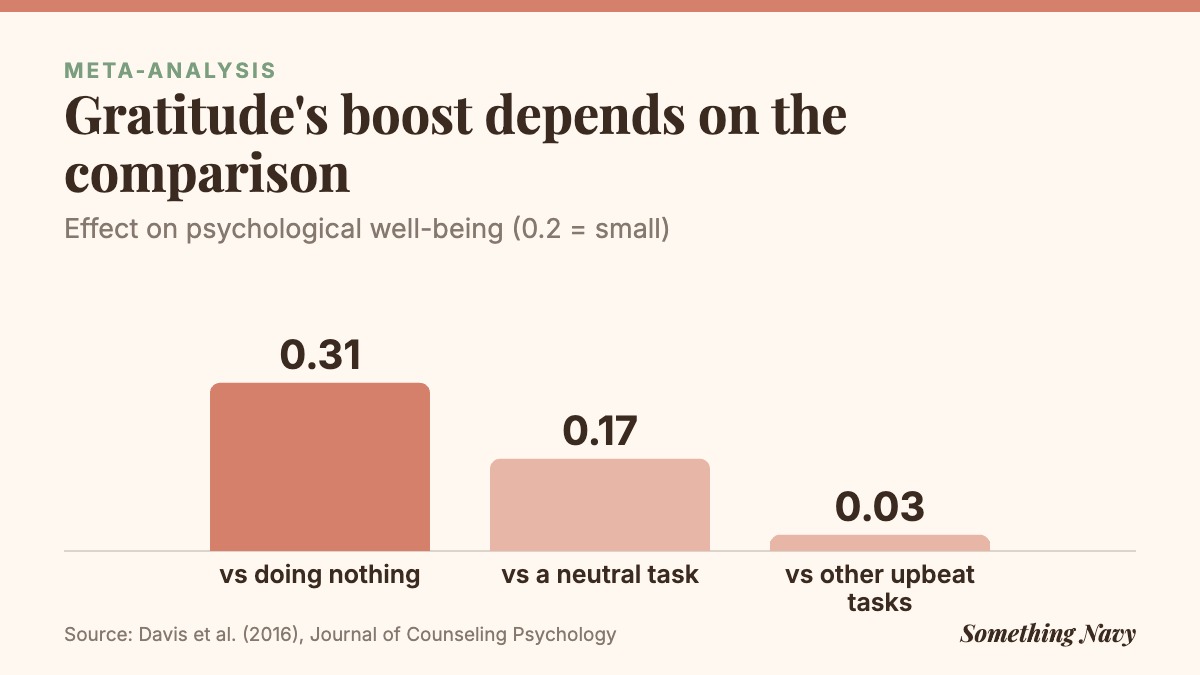
For a sense of scale, psychologists conventionally call an effect of 0.2 small and 0.5 medium. The gratitude exercise reliably beat doing nothing and beat busywork. It did not beat other kind, reflective things you might do with the same ten minutes.
A year later Lisa Dickens published a larger series of meta-analyses in Basic and Applied Social Psychology, drawing on 38 studies. Compared with neutral controls, gratitude interventions improved well-being by about 0.30, happiness by 0.25 and life satisfaction by 0.17, with a much smaller effect on depression of 0.13. Small, consistent, and positive.
Small, real, and not a treatment
The bluntest assessment came from David Cregg and Jennifer Cheavens at Ohio State University. Their meta-analysis, published in the Journal of Happiness Studies, asked a narrower question: do gratitude exercises reduce symptoms of depression and anxiety? They gathered 27 studies with 3,675 participants.
There was an effect, of about 0.29 straight after the intervention and 0.23 at follow-up. But it was larger when gratitude was compared with a waiting list than with an active control. “There was a difference, but it was a small difference,” Cheavens said in an Ohio State release. “It would not be something you would recommend as a treatment.”
Cregg was careful not to throw the practice out. Being more grateful, he said, has “intrinsic virtue”. The problem is when it is sold as a fix for clinical distress, which it does not appear to be. If you are struggling with low mood or anxiety, a gratitude list is not a substitute for proper help.
A placebo problem, and a British puzzle
The largest analysis so far appeared in 2025 in PNAS. Hyewon Choi, Shigehiro Oishi and colleagues, including Michael McCullough of the original 2003 study, pooled 145 papers covering 24,804 people in 28 countries.
Gratitude interventions produced a small overall increase in well-being, with an effect size of 0.19. Against other positive activities, they were no better. The authors concluded that gratitude may not be more effective than other positive interventions.
There was a further twist that should interest readers here. Effects varied significantly between countries, and in several, including the United Kingdom, France, Japan and the Netherlands, the researchers found no significant effect. That may partly reflect how few studies some countries contributed, and the cultural measures they tested did not explain the variation. But it is a reminder that an exercise designed mostly on American campuses does not automatically travel.
It comes at little cost, but the benefits are larger than people expect.
Amit Kumar, on gratitude letters
So why bother with the letter?
Put the evidence together and a consistent picture emerges. Privately listing blessings gives a modest nudge to mood, roughly comparable to other pleasant reflective habits, and doing it too often may dull it. Expressing gratitude to a specific person gives a bigger, briefer jolt, and Kumar and Epley’s work suggests most of us badly underrate how much it means at the other end.
That is why the letter, rather than the journal, is the more interesting experiment. Its benefits are not limited to your own happiness score. Someone else reads it.
It is also different from the kind of writing that helps people work through difficult experiences. Writing about trauma or stress is a separate research tradition, covered in our piece on whether journaling actually helps. A gratitude letter is shorter, outward-facing and, crucially, addressed to someone.
Your one-week experiment
You cannot run a randomised trial on yourself. But you can test the one claim in this story that is most personal: that your forecast of someone’s reaction is too pessimistic. Here is a week-long version, built from the methods in the studies above.
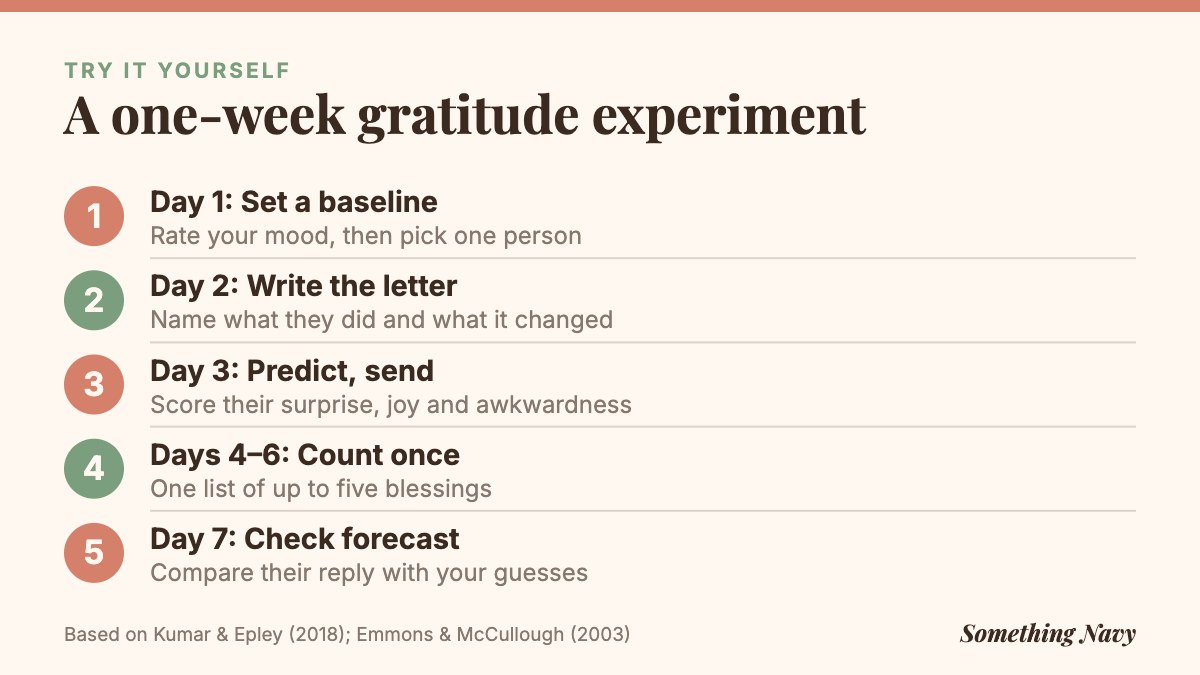
Day 1. Rate your general mood out of 10 and how connected you feel to other people. Then pick one person who helped you in a way you have never properly acknowledged. Not your partner or your mum, whom you thank routinely, but someone a little further out.
Day 2. Write the letter. Be specific: name what they did, when, and what changed for you because of it. Resist polishing. The recipients in Kumar and Epley’s studies cared about the warmth, not the wording.
Day 3. Before you send it, write down three predictions out of 10: how surprised they will be, how pleased, and how awkward they will feel. Then send it, or, if you can, deliver it in person as Seligman’s participants did.
Days 4 to 6. Once, not every night, write down up to five things you are grateful for, as Emmons and McCullough’s weekly group did. One honest list beats three dutiful ones.
Day 7. Compare any reply with your predictions. Re-rate your mood and connection. Note what surprised you.
A note on fairness: one week and one person cannot tell you whether gratitude “works” in general. What it can tell you is how good your social forecasting is. If the recipient replies more warmly than you guessed, you have reproduced the central finding of a study in Psychological Science at your kitchen table. If you want to keep going, the evidence favours a gentle rhythm, along the lines of how habits actually form, over a daily chore.
The drawer is still there
Not every letter lands. Some people will not reply, and a few may be puzzled. The studies measure averages, and averages contain exceptions.
But the person you thought of in the first paragraph of this article is still out there, possibly unaware that whatever they did mattered. The research says they will probably be more surprised and more pleased than you imagine, and that you will feel better for having written it.
The most robust thing about gratitude may be that it is not only about you.
Sources
- Kumar, A., & Epley, N. (2018). Undervaluing gratitude: Expressers misunderstand the consequences of showing appreciation. Psychological Science, 29(9), 1423–1435. DOI
- Emmons, R. A., & McCullough, M. E. (2003). Counting blessings versus burdens: An experimental investigation of gratitude and subjective well-being in daily life. Journal of Personality and Social Psychology, 84(2), 377–389. DOI
- Seligman, M. E. P., Steen, T. A., Park, N., & Peterson, C. (2005). Positive psychology progress: Empirical validation of interventions. American Psychologist, 60(5), 410–421. DOI
- Lyubomirsky, S., Sheldon, K. M., & Schkade, D. (2005). Pursuing happiness: The architecture of sustainable change. Review of General Psychology, 9(2), 111–131. DOI
- Davis, D. E., Choe, E., Meyers, J., Wade, N., Varjas, K., Gifford, A., Quinn, A., Hook, J. N., Van Tongeren, D. R., Griffin, B. J., & Worthington, E. L., Jr. (2016). Thankful for the little things: A meta-analysis of gratitude interventions. Journal of Counseling Psychology, 63(1), 20–31. DOI
- Cregg, D. R., & Cheavens, J. S. (2021). Gratitude interventions: Effective self-help? A meta-analysis of the impact on symptoms of depression and anxiety. Journal of Happiness Studies, 22(1), 413–445. DOI
- Choi, H., Cha, Y., McCullough, M. E., Coles, N. A., & Oishi, S. (2025). A meta-analysis of the effectiveness of gratitude interventions on well-being across cultures. Proceedings of the National Academy of Sciences. DOI
Cover photo: Towfiqu barbhuiya on Unsplash. Charts and graphics: Something Navy.
How we reported this. We went back to the original research for this story, 7 sources in all, listed above, and checked every figure against them. If you think we have got something wrong, tell us and we will look at it. Read more about how we work.